

Researchers from the University of Osaka and collaborating institutions developed an autonomous solid-state nanopore that combines sensing, memory, and signal generation in a single device. Unlike conventional nanopores, the sensor continually reshapes itself through chemical reactions, producing unique electrical signatures as molecules pass through, providing a basis for memory. The device successfully identified a variety of nucleotides and amino acids, providing a new platform for molecular sensing and future iontronic computing.
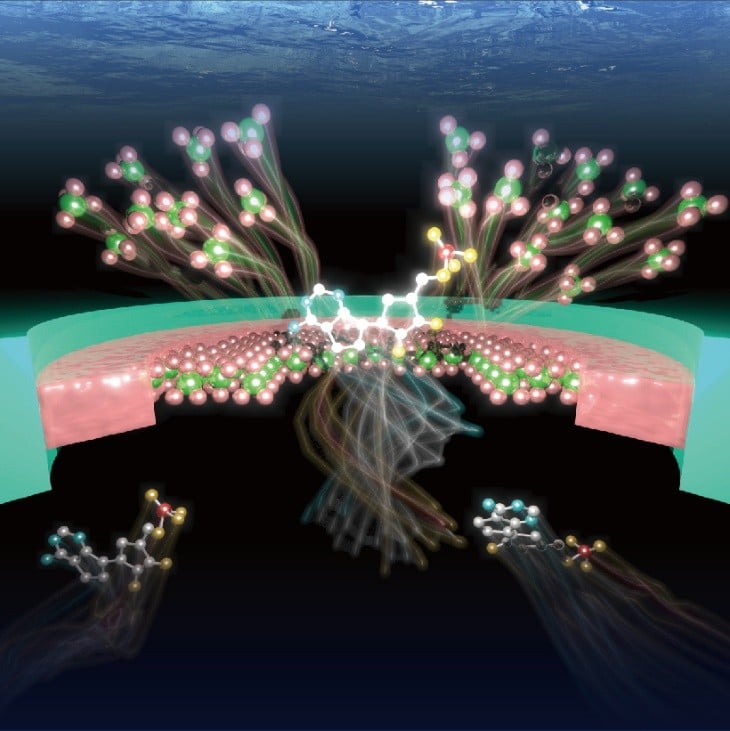
Fig. 1
Schematic illustration depicting single molecule sensing with an autonomous nanopore membrane.
Original content, Cannot be used without permission., Makusu Tsutsui
Researchers from the University of Osaka develop an autonomous nanopore combining sensing, memory, and signal generation in a single nanoscale device
Osaka, Japan – Most sensors are designed to do only one thing: detect what passes through them. But what if a sensor could do more? To create a new generation of technology, researchers have looked at living systems for inspiration. If a sensor could detect molecules, could it also remember previous interactions and selectively respond to them?
Researchers have now developed a device that does exactly that at a tiny scale, laying the groundwork for a new generation of smart molecular sensors.
In an article recently published in ACS Nano, researchers from SANKEN at the University of Osaka and collaborating institutions have created an autonomous solid-state nanopore that can sense molecules, generate electrical signals, and retain memories of recent events, without external control. Unlike conventional nanopores, which act as passive channels, the new device continuously changes its own structure through chemical reactions, creating a dynamic sensing environment that responds to molecules passing through it.
Nanopores are tiny holes only a few billionths of a meter wide, used to detect DNA, proteins, and other biological molecules. They achieve this by measuring changes in electrical current as the molecules pass through them. Most nanopores, however, simply act as fixed openings whose sensing behavior is determined by external electronics.
“Our nanopore works differently,” says lead author Makusu Tsutsui. “Under a constant voltage supply, chemical reactions inside the pore repeatedly build up and dissolve tiny mineral deposits. This continual cycle causes the nanopore to repeatedly open and close on its own, producing bursts of electrical signals without any external switching.”
These constantly changing openings also create a unique environment. As nucleotides and amino acids pass through the pores, they influence the ongoing chemical reactions and alter how the nanopore evolves over time.
“Different molecules change the size, duration, and timing of the electrical spikes in distinctive ways, effectively leaving behind unique electrical signatures," explains Tomoji Kawai, senior author. “As each signal also depends on the nanopore’s recent memory, the device behaves as a remembering, chemically active sensor.”
The team then used machine learning to analyze these state-dependent signatures, and successfully distinguished all four DNA nucleotides. They then accurately measured mixtures containing multiple nucleotides and extended the approach to identify seven different amino acids, all without actively controlling the nanopore during sensing.
“This represents a shift in how nanopores are designed,” remarks Tsutsui. “Instead of serving as passive channels that simply allow molecules to pass through, nanopores can actively respond to their chemical environment, giving them capabilities that go far beyond conventional sensing.”
Such multifunctional nanopores could improve molecular analysis for biomedical research and diagnostics or contribute to emerging iontronic technologies that process information using ions instead of electrons. By integrating sensing capabilities, memory, and signal generation into a single autonomous device, this work opens the door to a new generation of intelligent nanoscale systems.
###
The article, “Autonomous molecular sensing with a chemically stateful solid-state nanopore,” will be published in ACS Nano at DOI: https://doi.org/10.1021/acsnano.6c08258
The article is currently available via the ACS Publications website:https://pubs.acs.org/doi/10.1021/acsnano.6c08258
About The University of Osaka
The University of Osaka was founded in 1931 as one of the seven imperial universities of Japan and is now one of Japan's leading comprehensive universities with a broad disciplinary spectrum. This strength is coupled with a singular drive for innovation that extends throughout the scientific process, from fundamental research to the creation of applied technology with positive economic impacts. Its commitment to innovation has been recognized in Japan and around the world. Now, The University of Osaka is leveraging its role as a Designated National University Corporation selected by the Ministry of Education, Culture, Sports, Science and Technology to contribute to innovation for human welfare, sustainable development of society, and social transformation.
Website: https://resou.osaka-u.ac.jp/en
Advertisement