
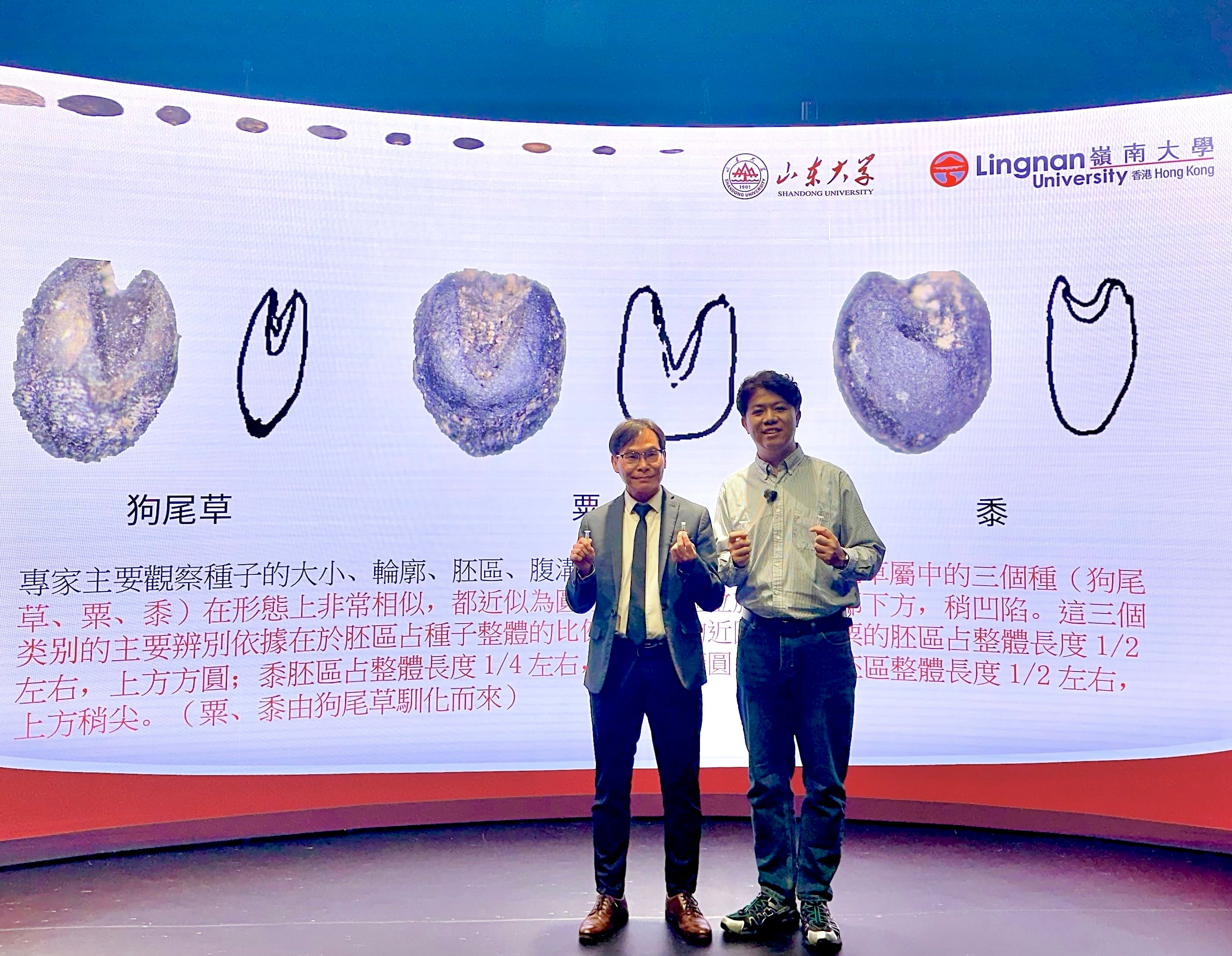
Lingnan University and Shandong University jointly develop the world’s first AI archaeological system dedicated to identifying ancient Chinese plant seeds.
From left: Prof Sam Kwong Tak-wu, Associate Vice-President (Strategic Research), J.K. Lee Chair Professor of Computational Intelligence and Dean of the School of Graduate Studies at Lingnan University; and Prof Cong Runmin, Professor of the School of Control Science and Engineering at Shandong University and Senior Visiting Scholar at Lingnan University.
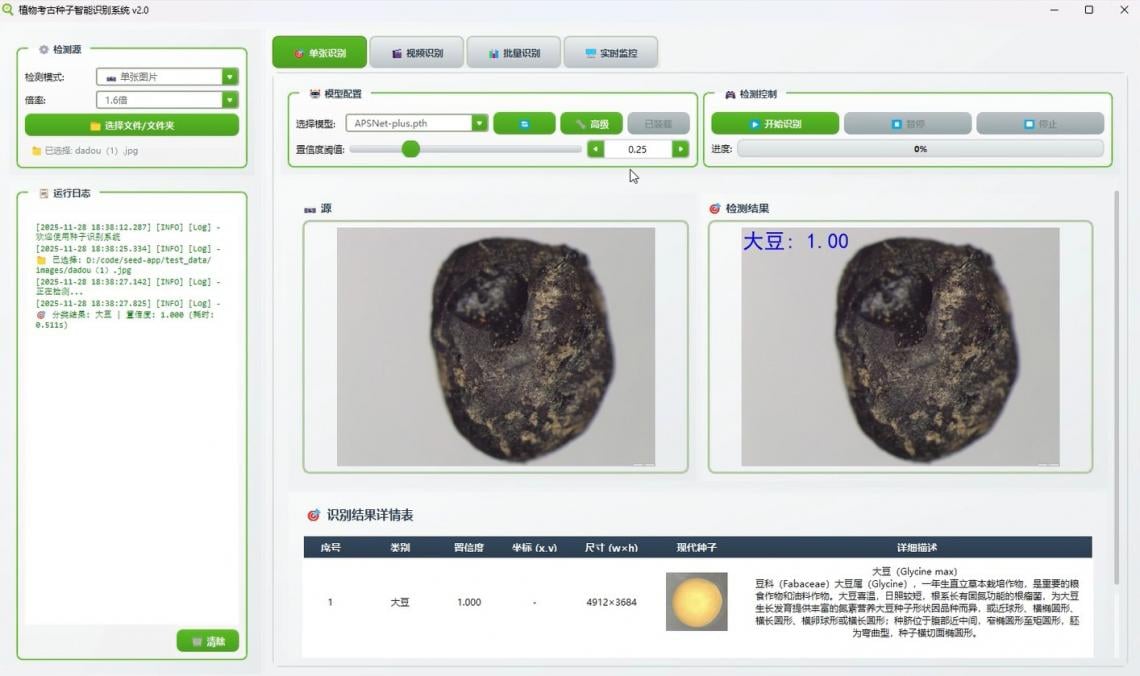
The AI archaeological system emulates the identification process of archaeobotanical experts and achieves a classification accuracy of over 90 per cent.
The research team collected images of 17 representative categories of ancient plant seeds from 18 archaeological sites across China, dating from about 5400 BCE to 220 CE, i.e. more than 5,000 years of history. These include common crops such as barley (Hordeum vulgare L.), wheat (Triticum aestivum L.), foxtail millet (Setaria italica (L.) P. Beauv.), and broomcorn millet (Panicum miliaceum L.), as well as fruit remains including peach stones (Prunus persica (L.) Batsch), and with 8,340 images they have established the Ancient Plant Seeds (APS) database.
Using the APS database as foundation, the research team designed and trained an AI model to develop APSNet, the world’s first AI archaeological system specifically designed to identify ancient plant seeds. The model incorporates the identification of archaeobotanists into its design by emulating the way experts first distinguish seeds according to their size and shape before analysing finer features such as embryo position and surface texture. This enables the system to automatically identify and classify plant species that appear to be very similar. Researchers simply upload seed images to the system or connect a digital microscope to obtain rapid identification results, and the records are automatically stored, creating an efficient and shareable workflow.
Testing results show that APSNet achieves a classification accuracy of 90.2 per cent. The research team also benchmarked it against 28 mainstream AI image classification models, and found that the new system delivers the best overall performance, outperforming the strongest existing model by 5.3 percentage points in classification accuracy.
Prof Sam Kwong Tak-wu, Associate Vice-President (Strategic Research), J.K. Lee Chair Professor of Computational Intelligence and Dean of the School of Graduate Studies at Lingnan University, said that it usually takes several years to train an archaeobotanical expert to identify ancient plant seeds independently, however specialists still need to spend considerable time examining and comparing seeds one by one under a microscope before reaching a conclusion, so that the process is highly labour-intensive. He noted that developing an automated identification system has long been an important research direction in archaeobotany, and the AI archaeological system developed by the research team integrates artificial intelligence, archaeology, and cultural heritage conservation, addressing a key challenge.
Prof Kwong observed “Research on applying AI to ancient plant seed identification remains very limited, and there are few publicly available and representative standard databases. The AI archaeological system developed in this study provides an important analytical foundation for future archaeobotanical research. It is designed as an assistive tool for researchers, enabling rapid preliminary classification while leaving the final identification to specialists. This helps reduce their workload and allows them to devote more time to in-depth archaeobotanical analysis, thereby improving research efficiency.”
Prof Cong Runmin, Professor of the School of Control Science and Engineering at Shandong University and Senior Visiting Scholar at Lingnan University, explained that ancient plant seeds are inherently difficult to identify because even seeds from the same species may vary considerably in size and appearance. He said “Plants grew in different historical periods and environments, and excavated seeds may also have undergone physical changes during long-term preservation. As a result, even seeds of the same species may differ substantially in size and appearance. Also, different plant species may share very similar shapes and surface textures, making accurate classification particularly challenging.”
He added that the preliminary classification and identification of ancient plant seeds still rely heavily on archaeobotanical experts, who examine the characteristics of individual seeds manually. The new system will be trialled at the Archaeobotany Laboratory of the Institute of Cultural Heritage of Shandong University, and support research into ancient crop cultivation, staple food sources, and ecological environments, providing new insights into ancient dietary culture and agricultural history.