
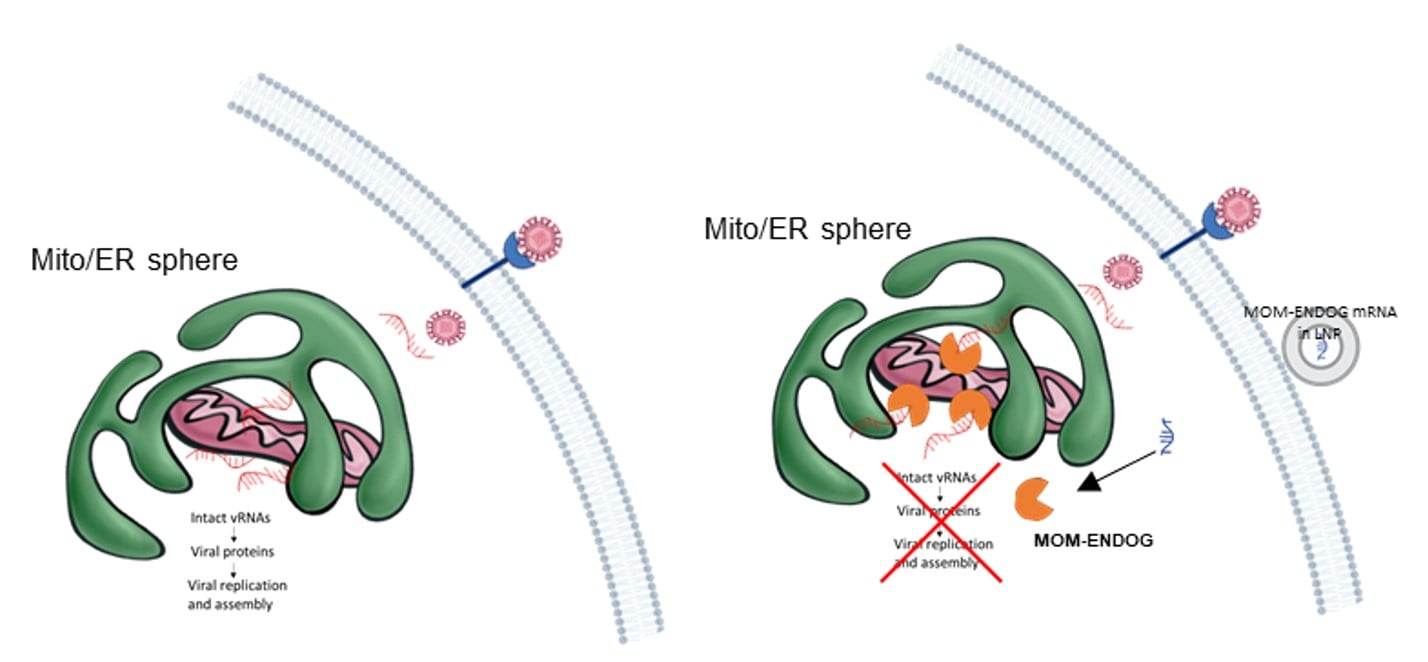

Researchers at National Taiwan University engineer an ENDOG anchoring on mitochondrial surface, namely MOM-ENDOG, which expression efficiently degrades the viral RNA transcripts synthesized at mitochondrial sites without causing nuclear DNA damages. Delivery of modified mRNA encoding wild-type but not catalytic-dead MOM-ENDOG markedly suppresses the propagation of VSV, Influenza, Dengue, and Zika virus.
National Taiwan University
The high frequency of RNA virus mutations and the outbreaks of emerging RNA viral infection are the challenging issues in public health. Developing a drug that can overcome viral mutations with a broad-spectrum anti-viral activity is an unmet need.
Scientists at National Taiwan University observe the RNA synthesis of RNA virus at mitochondria/endoplasmic reticulum (Mito/ER) spheres in the infected cells, accompanied by the leakage of a mitochondrial nuclease, ENDOG, to the cytosol. The study is published in Nature Communications.
ENDOG released from mitochondria is capable of degrading viral RNAs as an anti-viral factor. However, the dark side is that the released ENDOG is translocated to nuclei and causes nuclear DNA damages.
Researchers engineer an ENDOG anchoring on mitochondrial surface, namely MOM-ENDOG, which expression efficiently degrades the viral RNA transcripts synthesized at mitochondrial sites without causing nuclear DNA damages. Delivery of modified mRNA encoding wild-type but not catalytic-dead MOM-ENDOG markedly suppresses the propagation of VSV, Influenza, Dengue, and Zika virus.
“This modified mRNA encoding mitochondrial site-specific viral RNA degrader is a broad-spectrum anti-viral agent and its mode of action would not be affected by the viral mutations,” says corresponding author Zee-Fen Chang, chair professor at Center of Nucleic Acid Medicine, National Taiwan University College of Medicine.
Prof. Zee-Fen Chang's email: [email protected]
Advertisement