
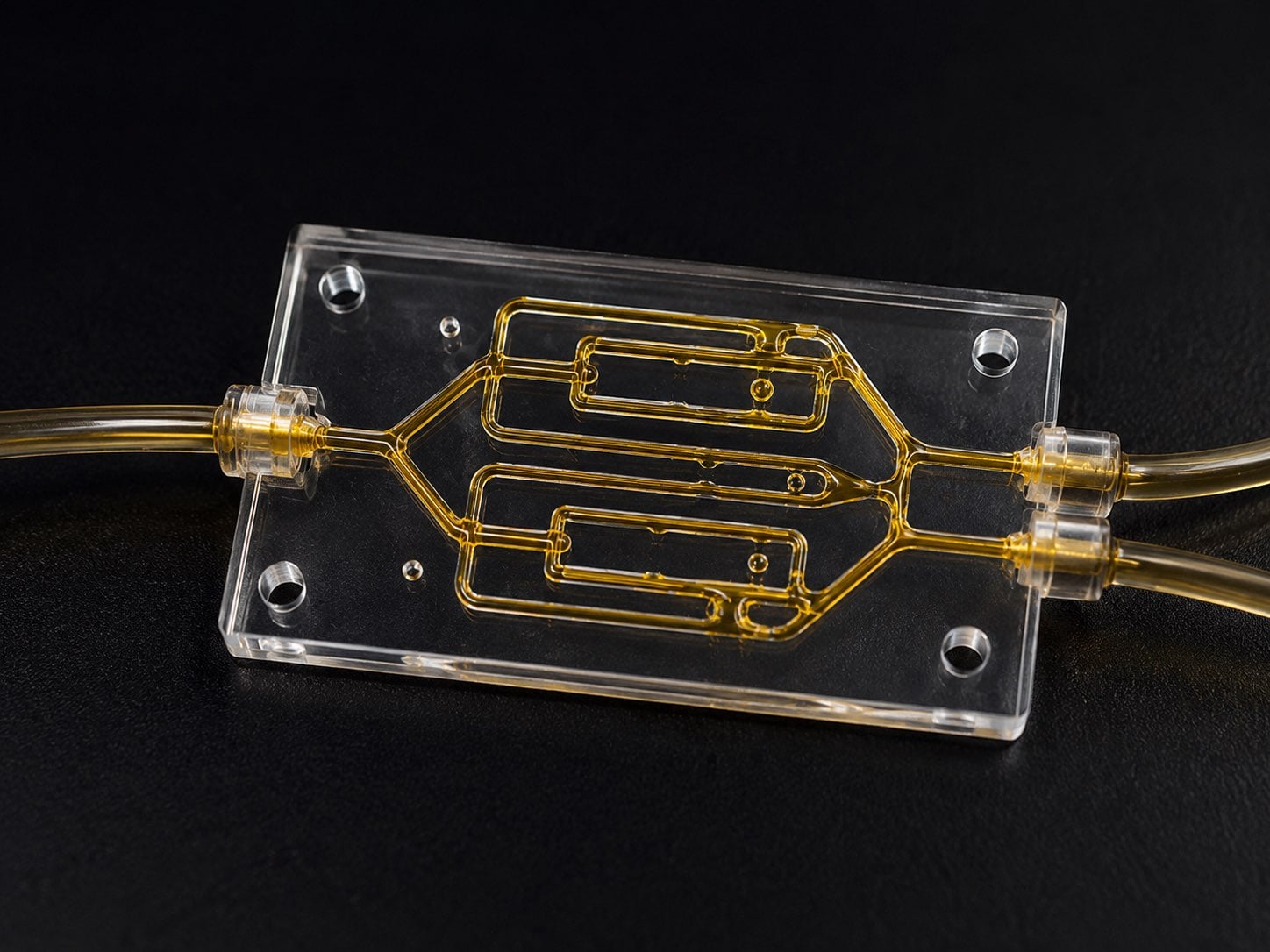
A transparent microfluidic device channels golden oil through a controlled two-phase system used to test the selectivity of an engineered lipase.
Food and pharmaceutical manufacturers increasingly seek lipids with carefully controlled fatty-acid compositions. However, natural oils usually contain mixtures of closely related fatty acids, and conventional enzymes often cannot distinguish reliably between them.
An international research team has now engineered a lipase that preferentially hydrolyses palmitic C16 acyl chains over oleic C18 acyl chains, even though the two differ by only two carbon atoms.
The work combines computational protein design, laboratory testing, molecular dynamics simulations and two-phase microfluidic experiments. The approach could support more precise modification of natural oils for nutritional, food-processing and pharmaceutical applications.
A more selective lipid-processing enzyme
Lipases are widely used to break down, rearrange or synthesise fats and oils. Their industrial value depends partly on how selectively they act on particular fatty acids.
Most conventional lipases distinguish only broadly between short-, medium- and long-chain fatty acids. Selectively targeting one long-chain fatty acid while leaving a closely related one largely untouched remains difficult.
The researchers started with a lipase from Ustilago trichophora. Computational modelling was used to identify amino-acid positions that might control how fatty-acid chains fit within the enzyme’s substrate-binding tunnel.
A small, targeted mutant library was then created and tested rather than screening thousands of possible variants. One variant, called I291Y, emerged as the strongest candidate. In this enzyme, isoleucine at position 291 was replaced with tyrosine.
Strong preference for C16 chains
Under the test conditions used for palmitic-acid substrates, the I291Y variant showed hydrolytic activity towards p-nitrophenyl palmitate, representing C16:0, that was 41.65 times its activity towards the corresponding oleic C18:1 substrate.
Compared with the original enzyme, the engineered variants increased selective catalytic activity towards C16:0 by between 0.79 and 28.48 times.
Kinetic analysis also showed that the maximum reaction rate of I291Y for the C16 substrate was 284.19% higher than for the C18 substrate. Its catalytic efficiency towards C16 increased by about 115% compared with the original enzyme.
The mutation also improved thermal stability. At 70°C, the half-life of I291Y when acting on the C16 substrate increased from about 24 minutes for the original enzyme to approximately 123 minutes.
This improved stability could be important for industrial processes that operate at elevated temperatures.
Reshaping the enzyme’s internal tunnel
The researchers used molecular docking and molecular dynamics simulations to investigate why the mutation changed selectivity.
Their analysis suggests that replacing isoleucine with the larger tyrosine residue remodelled the enzyme’s internal substrate-binding tunnel. The tunnel became shorter and less curved, allowing the straight, saturated C16 chain to fit more readily while creating greater steric hindrance for the longer and kinked C18:1 chain.
The simulations also indicated changes in the movement of the enzyme’s cap and flap regions, which control access to the catalytic site.
This mechanism remains a structural hypothesis and would require crystallographic confirmation. However, it is consistent with the measured shift in catalytic behaviour.
Testing the enzyme under an oil–water interface
Lipases normally act where oil and water meet. The researchers therefore moved beyond simplified laboratory substrates and tested the enzyme in a two-phase microfluidic system.
A flow-focusing microchip created small droplets and a controlled oil–water interface. The engineered enzyme was tested against glyceryl tripalmitate, containing C16 acyl chains, and glycerol trioleate, containing C18:1 chains.
The I291Y enzyme hydrolysed significantly more palmitic acyl chains from glyceryl tripalmitate than the original enzyme, while showing negligible activity towards the oleic chains in glycerol trioleate.
The researchers also tested silkworm pupae oil, which naturally contains both palmitic and oleic acids. The engineered enzyme significantly reduced the relative amount of palmitic acid at the sn-2 position of the oil.
Industry relevance
The ability to distinguish between closely related fatty-acid chains could help manufacturers tailor lipid composition more accurately.
Potential applications include:
- modifying edible oils without adding large amounts of external fatty-acid donors;
- producing structured and functional lipids with selected nutritional properties;
- selectively removing or redistributing saturated fatty acids;
- creating lipid ingredients for specialised foods and nutritional products;
- improving the value of insect oils and other underused natural lipid sources; and
- developing enzyme-based processing routes for pharmaceutical lipids.
The study also demonstrates an efficient enzyme-development strategy. Computational screening narrowed the search to a small number of promising mutations, reducing the need for very large experimental libraries.
For industrial biotechnology companies, this combination of virtual design and focused laboratory validation could shorten enzyme-development cycles and lower screening costs.
Further development needed
The research was conducted at laboratory and microfluidic scales. Additional work is needed to optimise the enzyme for real oil mixtures, larger reactors and continuous processing.
Industrial studies would also need to assess enzyme production costs, immobilisation and reuse, long-term stability, product separation, food-grade requirements and performance across a wider range of natural oils.
The enzyme also showed a trade-off: while its preference and catalytic efficiency towards C16 improved, its maximum reaction rate remained lower than that of the original enzyme under some conditions.
Nevertheless, the study provides a basis for what the researchers describe as “lipid editing”—the controlled modification of selected fatty-acid chains within complex lipids.
Paper details
The paper, “Engineered lipase enables selective hydrolysis of palmitic over oleic acyl chains at a two-phase microfluidic interface,” was published in Bioresource Technology in 2026.
DOI: 10.1016/j.biortech.2026.135431.
International collaboration
The research involved scientists from:
- Jiangsu University of Science and Technology, China;
- the Sericultural Scientific Research Center of the Chinese Academy of Agricultural Sciences, China;
- the Zhejiang Academy of Agricultural Sciences, China;
- Jiangsu University of Technology, China; and
- Newcastle University in Singapore.
For further details, contact Professor Jun Wang, Jiangsu University of Science and Technology, at [email protected], and Dr Jin Zheng Wang, at [email protected], or Professor Kheng-Lim Goh, Newcastle University in Singapore, at [email protected].
Advertisement