

Numerical model explains why increasing ultrasonic power reduces chemical reaction rates in sonochemistry
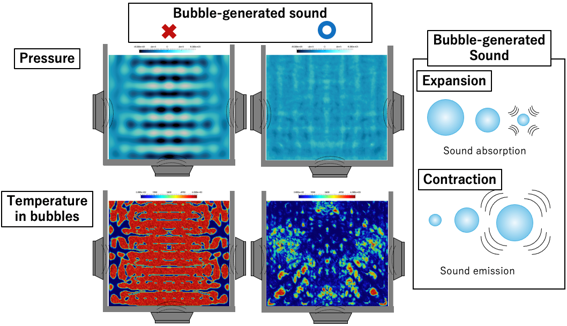
How bubble-generated sound disrupts ultrasonic chemistry: Tiny bubbles created by ultrasound normally collapse violently, reaching temperatures above 5,000 K that trigger chemical reactions. But at high ultrasonic power, the bubbles begin emitting their own sound waves, disrupting the ultrasound preventing the medium from reaching the temperatures needed for efficient chemistry.
Osaka Metropolitan University
Ultrasound is a powerful way to drive chemical reactions. When the high-frequency sound waves pass through a liquid, tiny bubbles form, which then violently collapse in a process called acoustic cavitation. During this collapse, gas particles are forced together, creating temperatures inside the bubbles that can exceed 5,000 K—hotter than the surface of the Sun—driving chemical reactions.
However, researchers have also found a curious feature of this process: at a certain point, increasing ultrasonic power reduces the accompanying chemical reactions instead of enhancing them, a process known as quenching.
Understanding why quenching occurs is a vital step towards optimizing their use in industry. Now, Associate Professor Takuya Yamamoto and Ryuya Hayashi at Osaka Metropolitan University Graduate School of Engineering have developed a new numerical model that explains this paradox.
“Sonochemical reactions can be classified into three distinct reaction regimes depending on the ultrasonic conditions,” Hayashi explained. “Previously, these three regimes had been observed experimentally, but there was no numerical model that could explain all of them. Our model links the quenching and the unique behavior of bubbles together into a unified physical explanation that successfully predicted all three regimes.”
The model showed that oscillating bubbles do more than simply respond to ultrasound, they also emit their own sound waves. As ultrasonic power increases, the sound emitted and absorbed by the oscillating bubbles distorts the ultrasonic field, generating unwanted noise.
“Our simulations reveal that the bubbles themselves are responsible for disrupting the ultrasound,” said Dr. Yamamoto. “They effectively create acoustic interference that limits the efficiency of sonochemical reactions.”
Because the model links ultrasound propagation, bubble oscillation, bubble-generated sound, and bubble temperature within a single framework, it could be used to predict when sonochemical reactors will reach their optimum operating conditions instead of relying on trial-and-error experiments.
“Having a working model would allow reactors to operate at maximum efficiency while minimizing energy consumption,” Dr. Yamamoto said. “Such a reactor could speed up the degradation of persistent hazardous organic compounds, the cleaning of semiconductor wafers, and synthesis of next-generation nanoparticles, which benefit from high temperatures.”
The findings were published in Ultrasonics Sonochemistry.
Declaration of competing interest
The authors declare that they have no known competing financial interests or personal relationships that could have appeared to influence the work reported in this paper.
###
About OMU
Established in Osaka as one of the largest public universities in Japan, Osaka Metropolitan University is committed to shaping the future of society through the “Convergence of Knowledge” and the promotion of world-class research. For more research news, visit https://www.omu.ac.jp/en/ and follow us on social media: X, Instagram, and LinkedIn.
Advertisement
Advertisement