
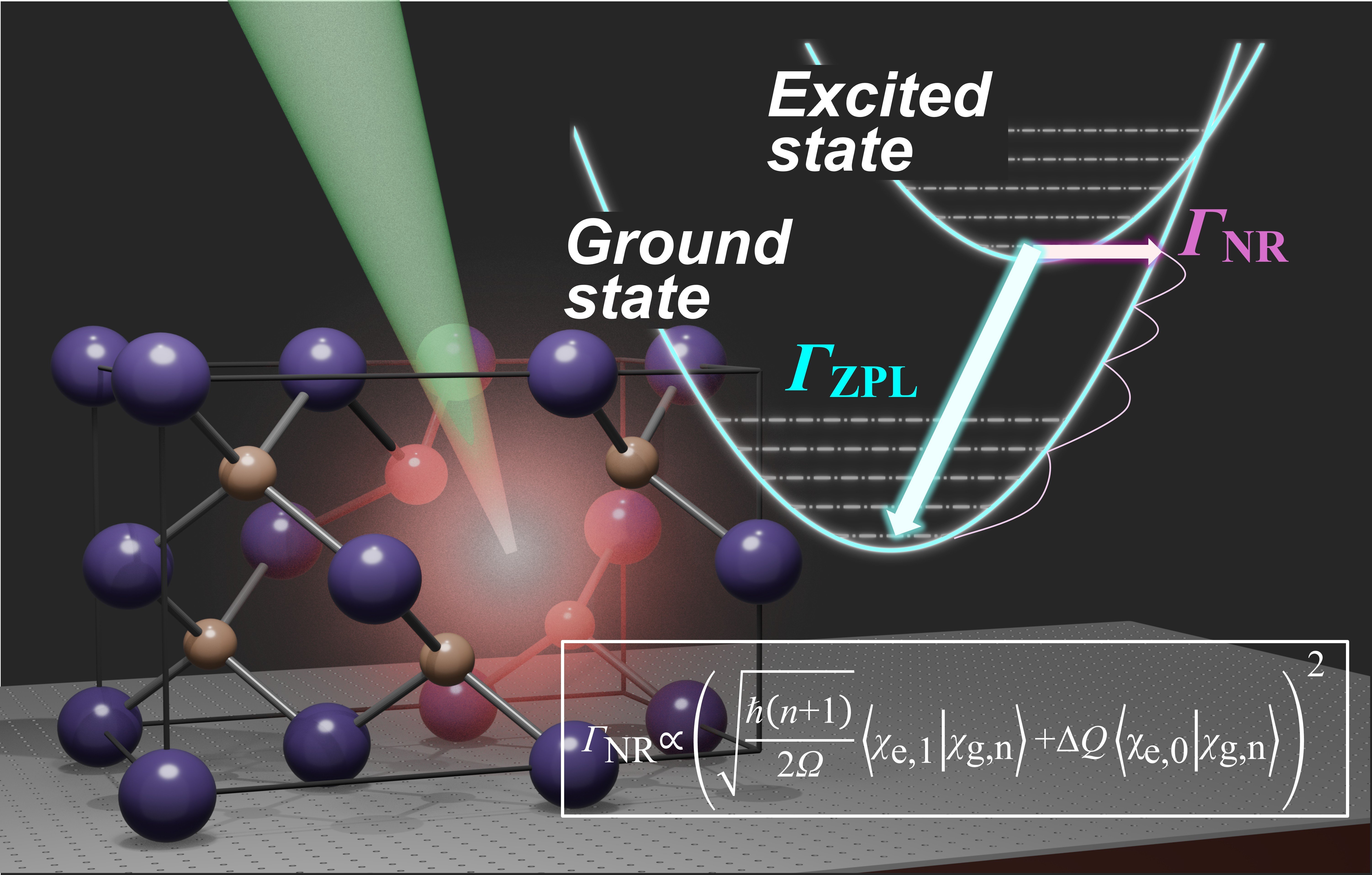
Fig. 1
Schematic illustration of emission process (ΓZPL) and the nonradiative loss process (ΓNR) of a color center.
Researchers from the University of Osaka develop a prediction framework that rapidly identifies high-performance color centers, supercharging the search for quantum materials
Osaka, Japan – The search for materials that can power future quantum technologies is accelerating, but identifying the most promising candidates remains painfully slow. Evaluating whether a material can efficiently emit quantum light requires computationally intensive simulations, making it difficult to screen the vast number of available materials.
Now, researchers from the University of Osaka have overcome this bottleneck with a prediction method that rapidly evaluates promising quantum materials without sacrificing accuracy. They have established a high-speed first-principles framework for evaluating atomic-scale color centers that emit single photons and store quantum information. The findings have recently been published in the journal npj Computational Materials.
Color centers are promising for quantum technologies such as communication, sensing, and computing because they can emit individual photons while preserving quantum information. However, identifying ideal candidates is challenging because evaluating their efficiency requires performing demanding calculations to determine how much energy is lost to vibrations inside the crystal rather than being emitted as light. Quantifying these losses traditionally requires computationally exhaustive simulations that hinder materials discovery.
Unlike laborious and expensive conventional approaches, the new method quickly predicts light-emitting efficiency by enabling the evaluation of optical losses using simplified theoretical expressions.
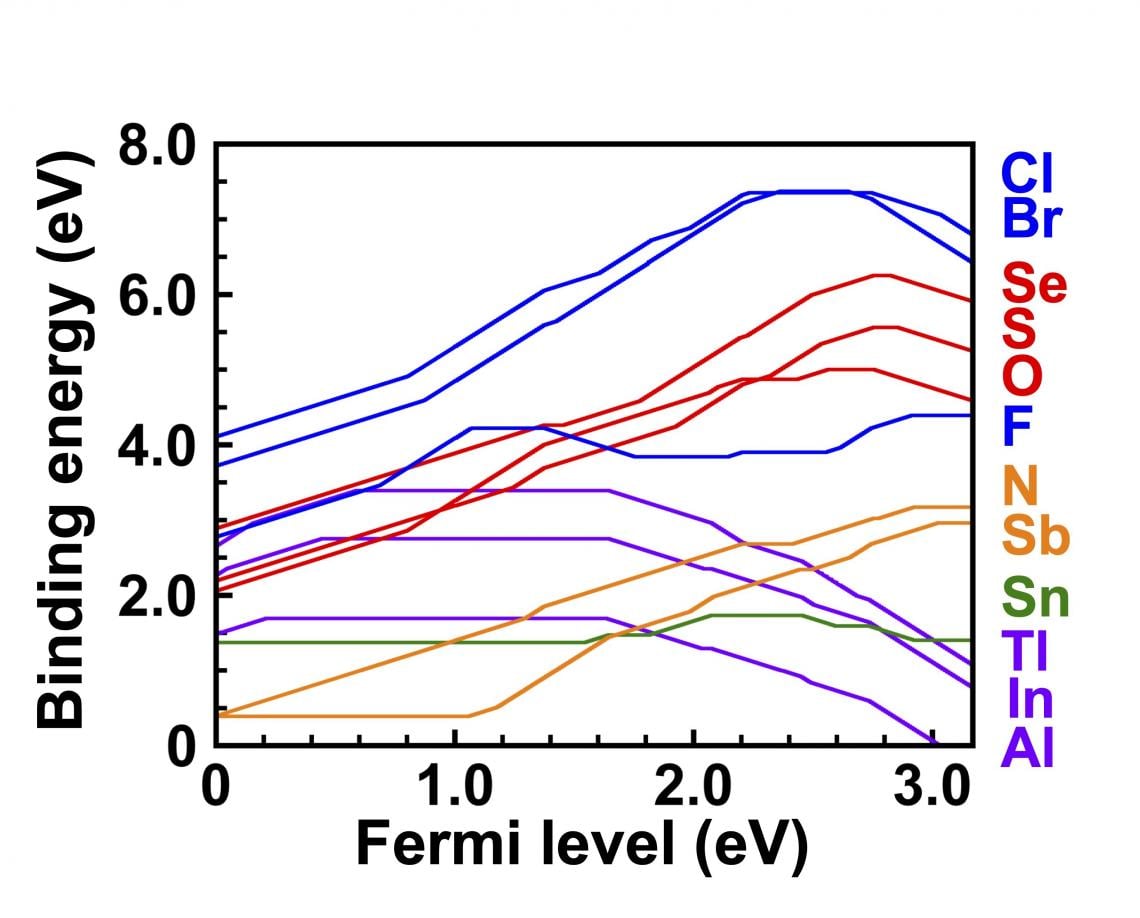
Fig. 2
Binding energies of impurity-vacancy pairs in SiC calculated as a pre-screening. Results are shown for each element, where a larger value indicates higher stability.
“To develop practical quantum technologies, we need a way to screen large numbers of candidates quickly,” says lead author Sosuke Iwamoto. “Our framework dramatically simplifies the calculations needed to evaluate optical processes, making searches much more tractable.”
The team broke through this computational barrier by deriving a compact theoretical formula that calculates complex optical losses caused by nonradiative processes and introducing an effective approximation that streamlines the calculation. The approach replaces many expensive calculations with just a few straightforward energy evaluations while maintaining excellent agreement with conventional methods.
“Our method is designed to be broadly applicable rather than limited to one material system,” explains senior author Takuma Kobayashi. “It provides a practical roadmap for discovering high-performance color centers across many semiconductor hosts.”
The research team demonstrated the framework by screening color centers in silicon carbide, a leading platform for quantum technologies. Using the new approach, they successfully identified several promising spin-qubit candidates – characterized by having sufficiently high spin – while also correctly identifying emitters that have already been demonstrated experimentally.
“Because the prediction method is independent of the host material, it can be used to efficiently evaluate color centers across a wide variety of semiconductors,” remarks Iwamoto. “It also applies to emitters spanning a broad spectral range, from ultraviolet to telecommunication wavelengths.”
By making it possible to rapidly identify bright, efficient quantum emitters while accounting for both light emission and optical losses, this new framework could dramatically accelerate the discovery of materials for quantum communication, sensing, and computing technologies, bringing practical quantum devices one step closer to reality.
###
The article, “Unified first-principles framework for predicting radiative and non-radiative processes in color centers,” will be published in npj Computational Materials at DOI: https://doi.org/10.1038/s41524-026-02267-8
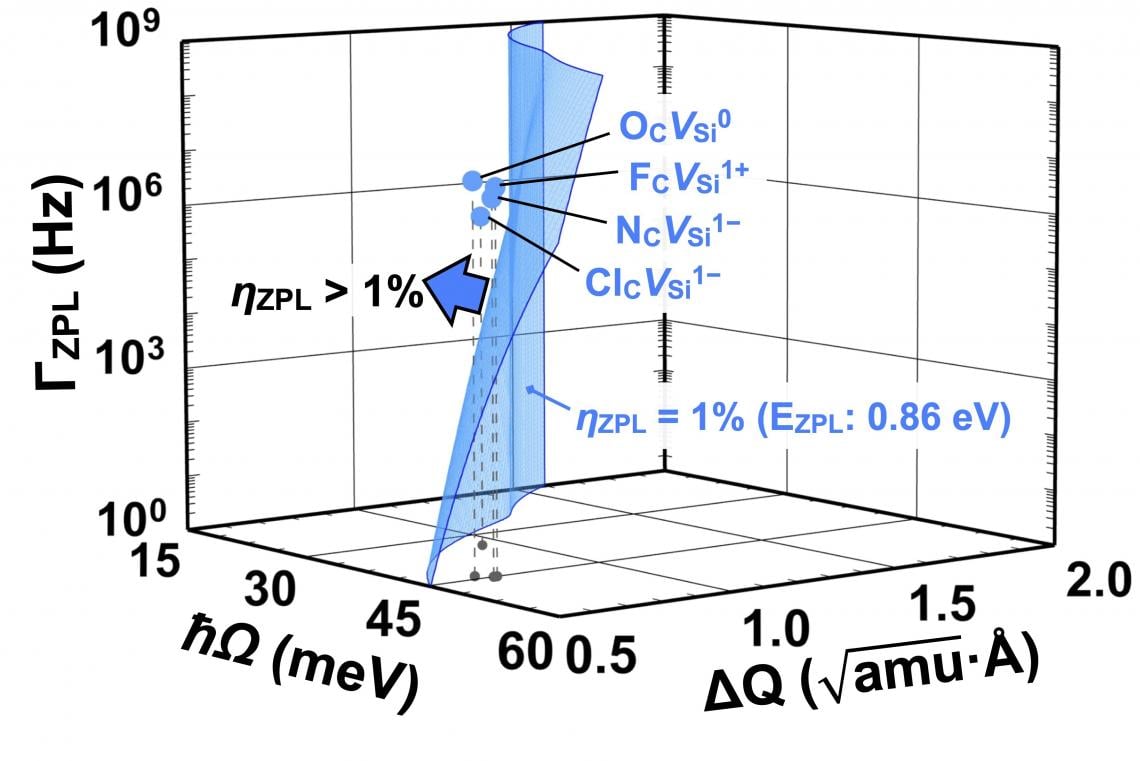
Fig. 3
Screening results for high-brightness color centers in SiC based on the proposed screening method. Out of approximately 300 impurity-vacancy pairs with different structures and charge states, four defect configurations were identified as promising candidates.
About The University of Osaka
The University of Osaka was founded in 1931 as one of the seven imperial universities of Japan and is now one of Japan's leading comprehensive universities with a broad disciplinary spectrum. This strength is coupled with a singular drive for innovation that extends throughout the scientific process, from fundamental research to the creation of applied technology with positive economic impacts. Its commitment to innovation has been recognized in Japan and around the world. Now, The University of Osaka is leveraging its role as a Designated National University Corporation selected by the Ministry of Education, Culture, Sports, Science and Technology to contribute to innovation for human welfare, sustainable development of society, and social transformation.
Website: https://resou.osaka-u.ac.jp/en