
Ovarian clear cell carcinoma (OCCC) has a higher prevalence among East Asian women and is characterized by poor clinical outcomes. An interdisciplinary team led by Professor Ruby Yun-Ju Huang at National Taiwan University College of Medicine has established a comprehensive spatial atlas of OCCC, revealing how distinct tumor cell populations are organized within the same tumor and identifying a key molecular regulator of tumor plasticity.
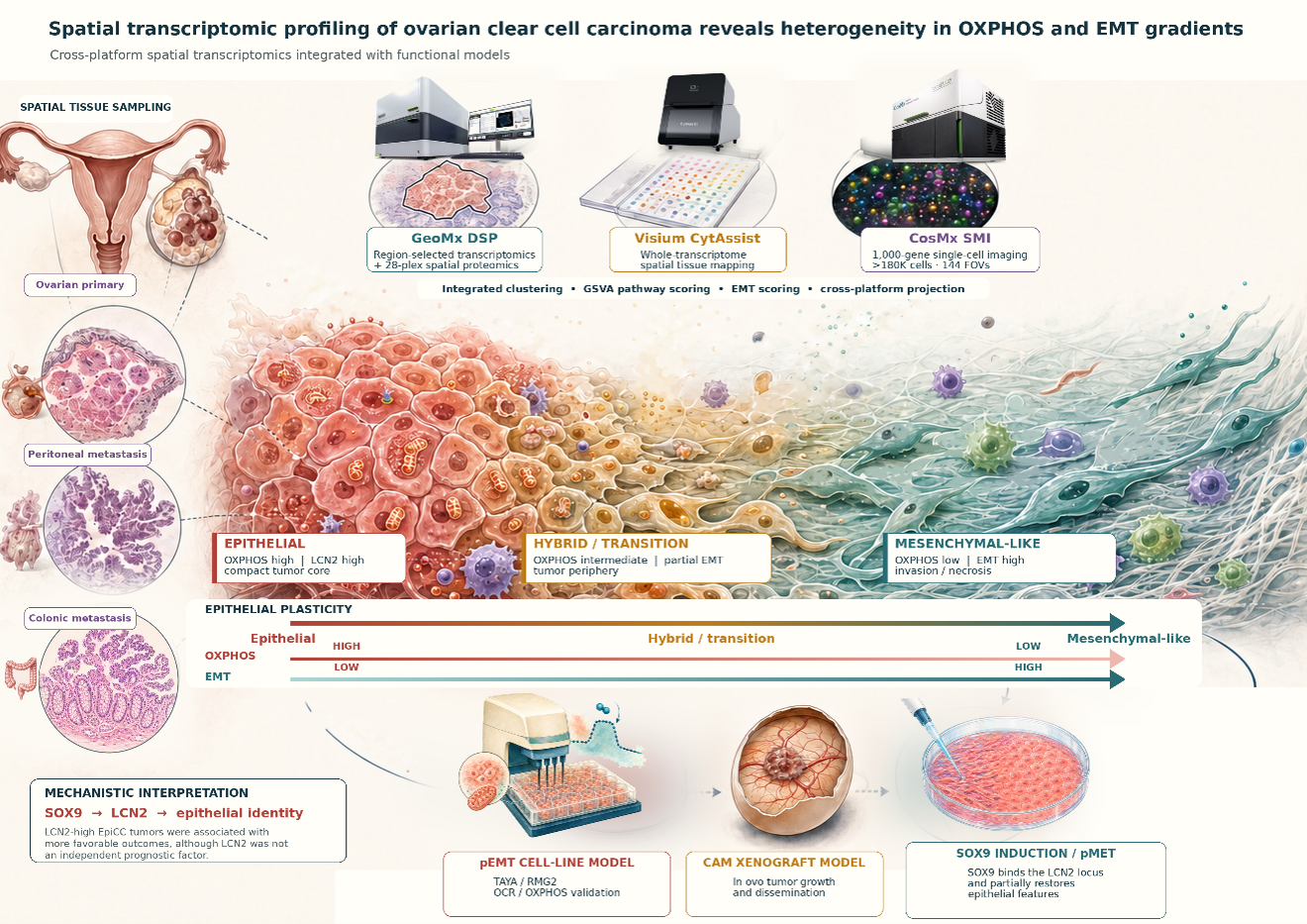
Figure legend: Schematic presentations of spatial transcriptomic profiling of ovarian clear cell carcinoma to reveal tumor heterogeneity in oxidative phosphorylation (OXPHOS) and epithelial-mesenchymal transition (EMT). (Figure generated under the assistance of generative AI).
National Taiwan University
Ovarian clear cell carcinoma (OCCC) has a higher prevalence among East Asian women and is characterized by poor clinical outcomes. An interdisciplinary team led by Professor Ruby Yun-Ju Huang at National Taiwan University College of Medicine has established a comprehensive spatial atlas of OCCC, revealing how distinct tumor cell populations are organized within the same tumor and identifying a key molecular regulator of tumor plasticity.
Published in Nature Communications, the study combines multiple spatial transcriptomics technologies (such as GeoMx, Visium, and CosMx) with cellular functional validation and the chick embryo chorioallantoic membrane (CAM) model to construct the first spatial map of OCCC aiming to provide new insights into disease progression and potential therapeutic strategies.
The team analyzed primary and metastatic OCCC samples and discovered significant differences between cancer cells located in the tumor center and those at the periphery regarding metabolism, epithelial-mesenchymal transition (EMT), and interactions within the tumor microenvironment.
Cancer cells in the tumor center exhibited higher oxidative phosphorylation (OXPHOS) activity and epithelial characteristics; conversely, cells closer to regions of invasion, necrosis, and hemorrhage displayed progressively lower metabolic activity and a higher degree of EMT, indicating that OCCC is not a uniform tumor but one characterized by high spatial heterogeneity.
Further analysis revealed the expression of the metabolism-related gene LCN2 was associated with higher OXPHOS activity and epithelial traits. Patient samples with high LCN2 expression—coupled with pronounced epithelial characteristics—were correlated with a relatively better overall prognosis.
Through CosMx single-cell spatial transcriptomics and functional assays, the team confirmed that the transcription factor SOX9 regulates LCN2 expression. These findings suggest that the SOX9–LCN2 axis may be a crucial mechanism governing cancer cell state transitions and tumor plasticity, offering the potential to develop more precise therapeutic strategies for OCCC.
The two co-first authors at National Taiwan University (NTU)— Lê Trương Thắng and Ducan Yi-Te Wang —bring diverse backgrounds to the project: Lê is a graduate of the Master’s Program in Smart Medicine and Health Informatics at International College and is currently pursuing a PhD in the Genome and Systems Biology Degree Program, Academia Sinica and National Taiwan University, while Wang is a graduate of School of Medicine currently undergoing postgraduate general medical training at NTU Hospital.
Their collaboration exemplifies how NTU’s interdisciplinary research teams bring together talents from varied educational backgrounds—spanning international and medical training systems—to engage in cutting-edge medical education and research, thereby providing vital clues for the discovery of new biomarkers and therapeutic targets.
Co-corresponding author Prof. Ruby Yun-Ju Huang’s email: [email protected]
Advertisement