
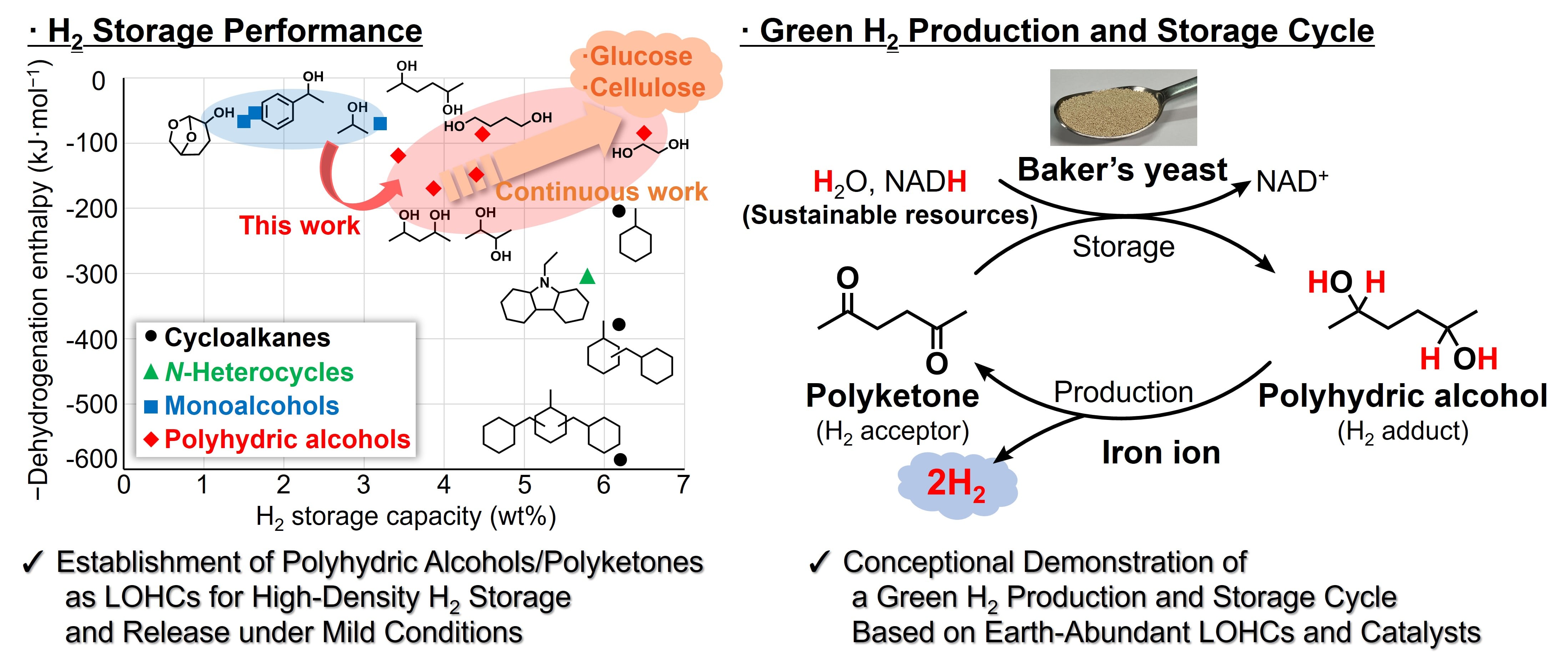
H₂ storage performance of polyhydric alcohols (LOHC) and the green H₂ production and storage cycle.
Hydrogen gas (H₂) is widely regarded as a promising clean energy source. By weight, it stores nearly three times more energy than gasoline, and its use does not directly release carbon dioxide (CO₂). Yet most H₂ is still produced from fossil fuels through CO₂-intensive processes. Storing and transporting this energy-rich gas are also costly and technically challenging. Therefore, developing sustainable methods for its production, storage, and safe transportation could lead to a cleaner energy future.
A research team from Tohoku University, in collaboration with Hokkaido University and Kyushu University, has taken a major step toward making this a reality by creating a new method for producing and storing H₂.
The method is based on a liquid organic hydrogen carrier (LOHC) system that can store and release H₂ through reversible chemical reactions. Their concept uses polyhydric alcohols and polyketones as LOHCs, with baker's yeast helping to store H₂ produced from sustainable resources and iron ions releasing it.
In the proposed cycle, a polyketone, with the help of baker's yeast, water, and NADH - a biological molecule (coenzyme) involved in fermentation - transforms into a H₂-rich polyhydric alcohol.
Unlike conventional methods, this approach does not require H₂ to be produced, purified, compressed, and then introduced into the LOHC. Instead, H₂ produced from sustainable resources is stored directly in the organic molecule during the yeast-assisted reaction. When H₂ is needed, the polyhydric alcohol is converted back into the polyketone.
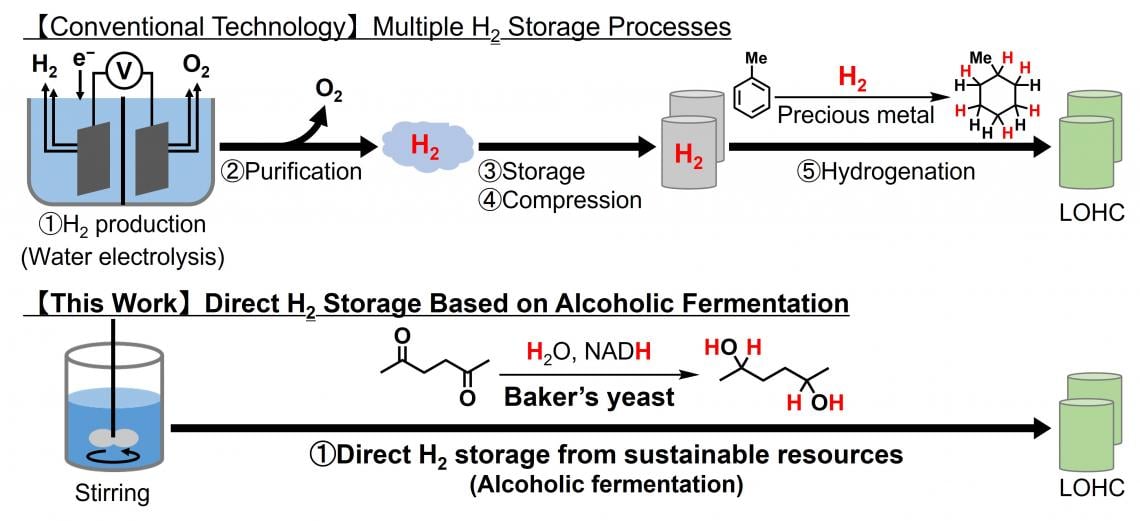
Comparison of the alcoholic fermentation-based direct H₂ storage process with conventional technology.
The team also demonstrated that light irradiation in the presence of iron ions can trigger H₂ release. Iron is inexpensive and abundant in the Earth's crust, making it a potentially more sustainable alternative to the precious-metal catalysts commonly used for this process.
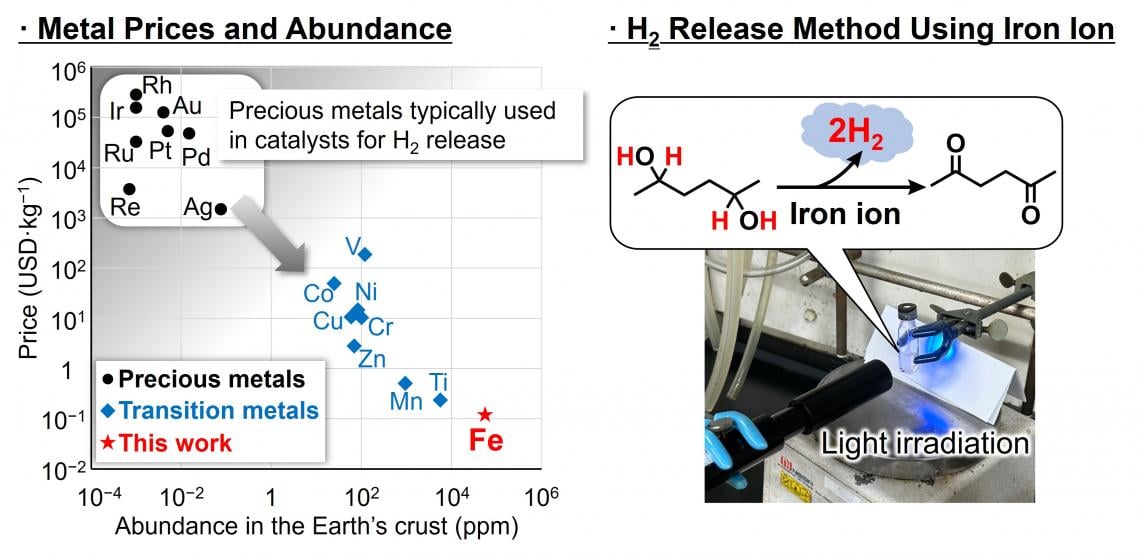
Photocatalytic H₂ release method using low-cost, Earth-abundant iron ions.
The work demonstrates a recyclable green H₂ production and storage cycle using earth-abundant materials and biocatalysts. Ongoing work will test the method with more suitable alcohols, such as ethylene glycol. The researchers will also work to improve H₂ storage and release for practical use.
The research was published online in Journal of Materials Chemistry A on August 24, 2026.