Fig. 1
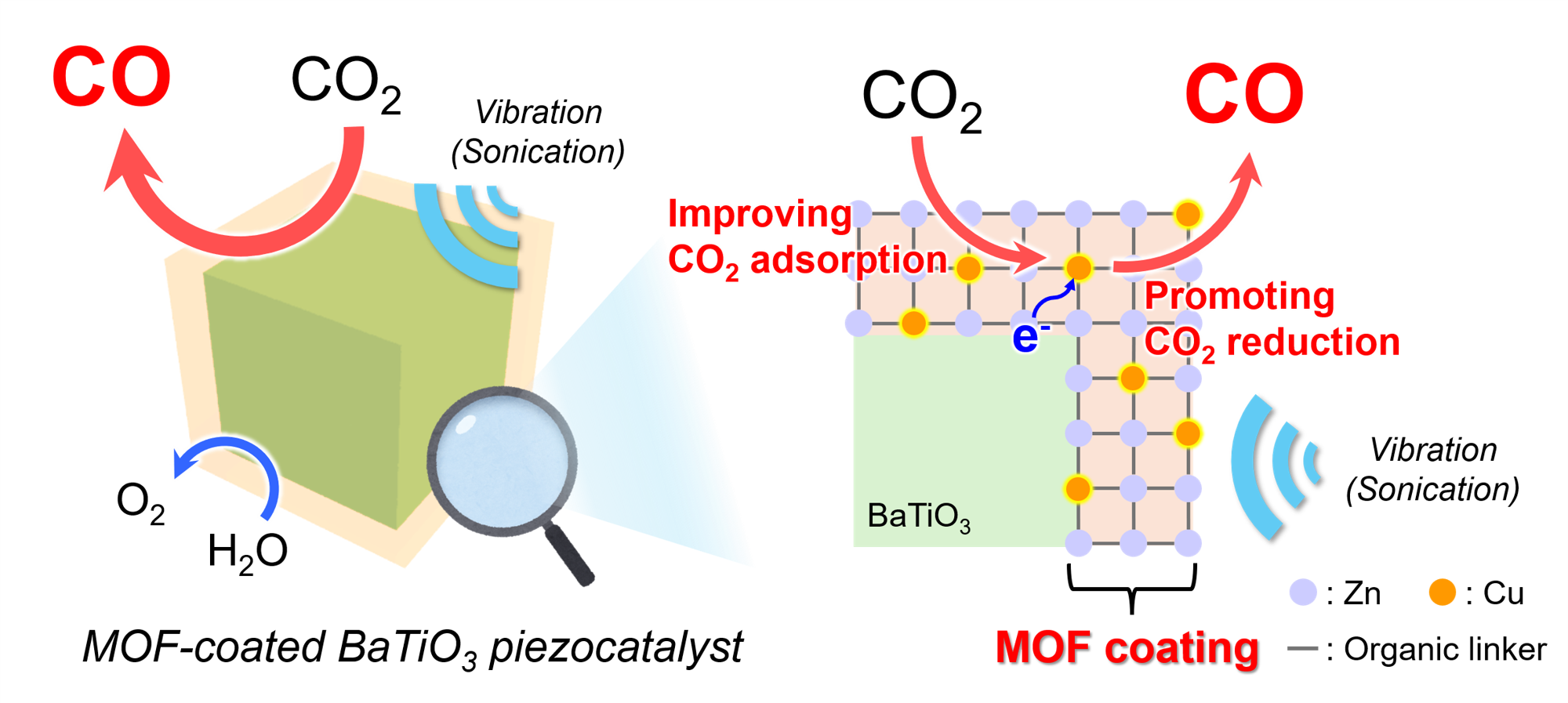
Schematic image of CO2 reduction using a MOF-coated BaTiO3 piezocatalyst.
A new MOF-coated piezocatalyst creates a local reaction environment that brings CO2 closer to copper single-atom reaction sites, enhancing convert CO2 into CO using ultrasonic vibration.
Osaka, Japan - Researchers at the University of Osaka have developed a catalyst that uses mechanical vibration to convert carbon dioxide (CO2) into carbon monoxide (CO), an important chemical feedstock. The catalyst consists of barium titanate (BaTiO3) coated with a metal–organic framework (MOF) —a porous material that captures and concentrates CO2 near the catalyst surface—and incorporates isolated copper (Cu) atoms as reaction sites. This design concentrates CO2 near the Cu sites and helps direct the electrical charges generated by vibration to where the reaction occurs. Under ultrasonic vibration, the catalyst produced CO at approximately five times the rate of pristine BaTiO3. The study was published in ACS Catalysis.
Piezocatalysis uses piezoelectric materials that convert mechanical energy, such as vibration, into electrical charges that can drive chemical reactions at room temperature. However, CO2 does not dissolve well in water, limiting the amount that can reach the catalyst surface. Conventional piezocatalysts may also have too few reaction sites and may not use the piezo-induced charges efficiently.
The team developed BaTiO3 nanocubes coated with ZIF-8, a hydrophobic MOF with a high capacity for adsorbing CO2. They then introduced isolated Cu atoms, as reaction sites, into the coating. This resulting core-shell catalyst, called Cu-ZIF-8/BT, concentrates CO2 near the Cu reaction sites and facilitates the transfer of piezo-induced electrons to these sites.
In water at room temperature and without sacrificial reagents, Cu-ZIF-8/BT produced CO at a rate of 114 μmol g-1 h-1 under ultrasonic vibration. Pristine BaTiO3 produced 24 μmol g-1 h-1 under the same conditions. This result indicates that the new catalyst increased the CO production rate by 4.8 times—approximately fivefold.
Coating BaTiO3 with ZIF-8 without Cu increased the rate to 56 μmol g-1 h-1. In contrast, simply mixing Cu-ZIF-8 and BaTiO3 produced only 16 μmol g-1 h-1. These results show that close contact between the BaTiO3 core and the Cu-ZIF-8 shell is important for improving the catalyst’s performance. CO was the only detected carbon-containing reduction product, and the catalyst maintained its activity over five consecutive reaction cycles.
The study demonstrates a new approach to catalyst design: creating a local reaction environment in which reactants, reaction sites, and piezo-induced charges can interact more effectively. This strategy could contribute to lower-energy CO2 recycling and may also be useful in photocatalytic and electrocatalytic systems.
Assist. Prof. Yoshifumi Kondo said the work represents an important step toward more efficient and energy-saving CO2 utilization technologies. He noted that precisely controlling the local reaction environment around the catalyst surface can significantly improve catalytic activity.
###
The article, “Unlocking Enhanced Piezocatalytic CO2 Reduction on BaTiO3 via Cu Single Atoms within a Hydrophobic Metal−Organic Framework Shell,” was published in ACS Catalysis at DOI: https://doi.org/10.1021/acscatal.6c02044
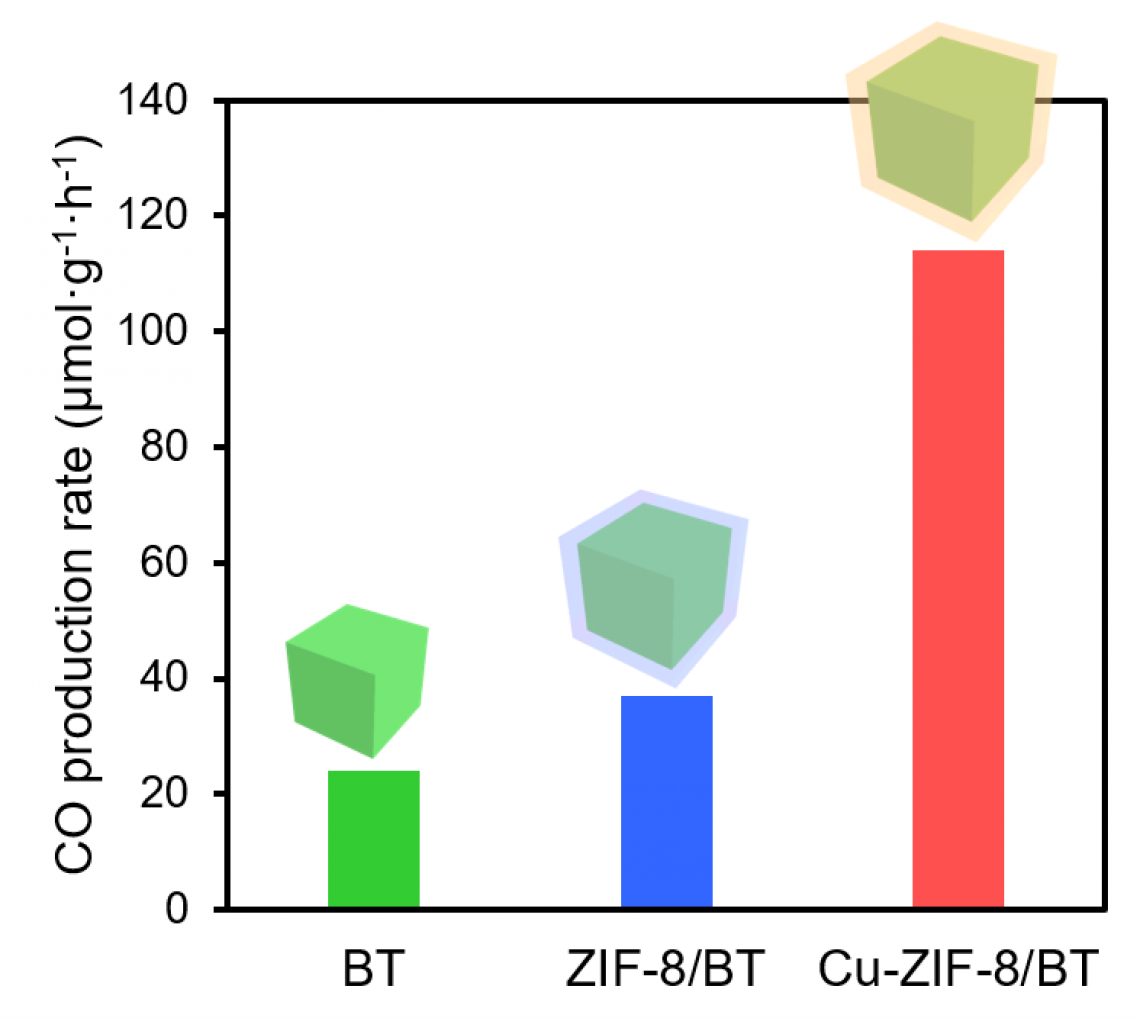
Fig. 2
CO production rates of developed catalysts under ultrasonic vibration.
About The University of Osaka
The University of Osaka was founded in 1931 as one of the seven imperial universities of Japan and is now one of Japan's leading comprehensive universities with a broad disciplinary spectrum. This strength is coupled with a singular drive for innovation that extends throughout the scientific process, from fundamental research to the creation of applied technology with positive economic impacts. Its commitment to innovation has been recognized in Japan and around the world. Now, The University of Osaka is leveraging its role as a Designated National University Corporation selected by the Ministry of Education, Culture, Sports, Science and Technology to contribute to innovation for human welfare, sustainable development of society, and social transformation.
Website: https://resou.osaka-u.ac.jp/en