
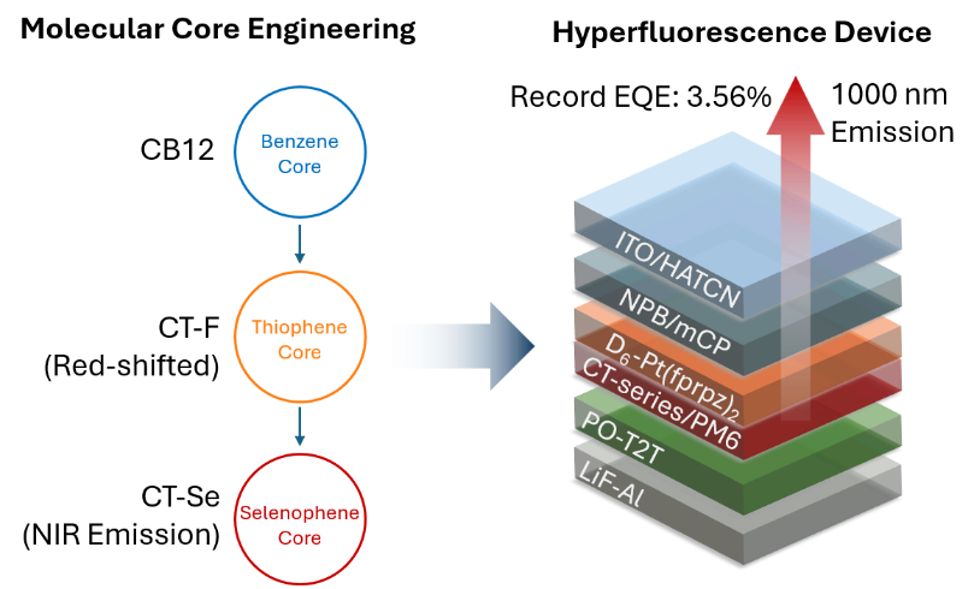
Electron-rich core engineering and a sensitized OLED architecture work together to produce near-1000-nm emission. The optimized CT-Se/PM6 device reaches a peak external quantum efficiency of 3.56% at 995 nm.
Near-infrared organic light-emitting diodes (OLEDs) that emit around 1000 nanometres could support biomedical and security technologies. Yet pushing organic light to these longer wavelengths usually causes a steep drop in efficiency. As the energy gap becomes smaller, molecular vibrations more readily turn excited-state energy into heat rather than light.
Researchers from National Taiwan University, National Yang Ming Chiao Tung University, National Taiwan Ocean University and Academia Sinica addressed this problem by redesigning the core of C-shaped organic dyes. They replaced a benzene-centred framework with more electron-rich sulfur- and selenium-containing cores. The stronger electron-rich character promotes intramolecular charge transfer, shifting emission toward 1000 nanometres, while the rigid C-shaped structure limits molecular relaxation and reduces non-radiative energy loss. The study is published in Advanced Materials.
Among the new dyes, CT-F reached a solid-state photoluminescence quantum yield of 14.3% at 970 nm. Selenium-containing CT-Se and CT-2Se pushed the emission further into the near-infrared. Importantly, CT-Se showed the most balanced electron and hole transport. This allowed charges to recombine more effectively in an OLED, even though CT-F was intrinsically the brighter fluorescent material.
The researchers then used a hyperfluorescent device design. A highly emissive deuterated platinum complex acted as an energy sensitizer, while the C-shaped dye was added as a separate layer by transfer printing. This preserved the sensitizer's favourable molecular packing and enabled energy transfer to the near-infrared emitter. The CT-Se device reached 3.07% external quantum efficiency with an emission maximum at exactly 1000 nm.
To reduce residual sensitizer emission, the team added a small amount of the conjugated polymer PM6 as an energy-transfer relay. The optimized device reached 3.56% external quantum efficiency at 995 nm, which the authors report as a record among metal-free organic emitters peaking around 1000 nm. The result shows that efficient deep-near-infrared OLEDs depend on coordinating molecular design, charge transport and interfacial energy transfer rather than optimizing any one property alone.
“By combining electron-rich molecular cores with careful control of energy transfer and charge balance, we can move organic OLED emission toward 1000 nanometres while limiting the efficiency losses that usually occur at these wavelengths,” says co-corresponding author Pi-Tai Chou, professor of chemistry at National Taiwan University.
Prof. Pi-Tai Chou’s email address:[email protected]
For further publications of Prof. Chou, please visit:
https://www.ch.ntu.edu.tw/en/chop.html
Advertisement