

Mapping interacting galaxies reveals how turbulence can suppress star formation
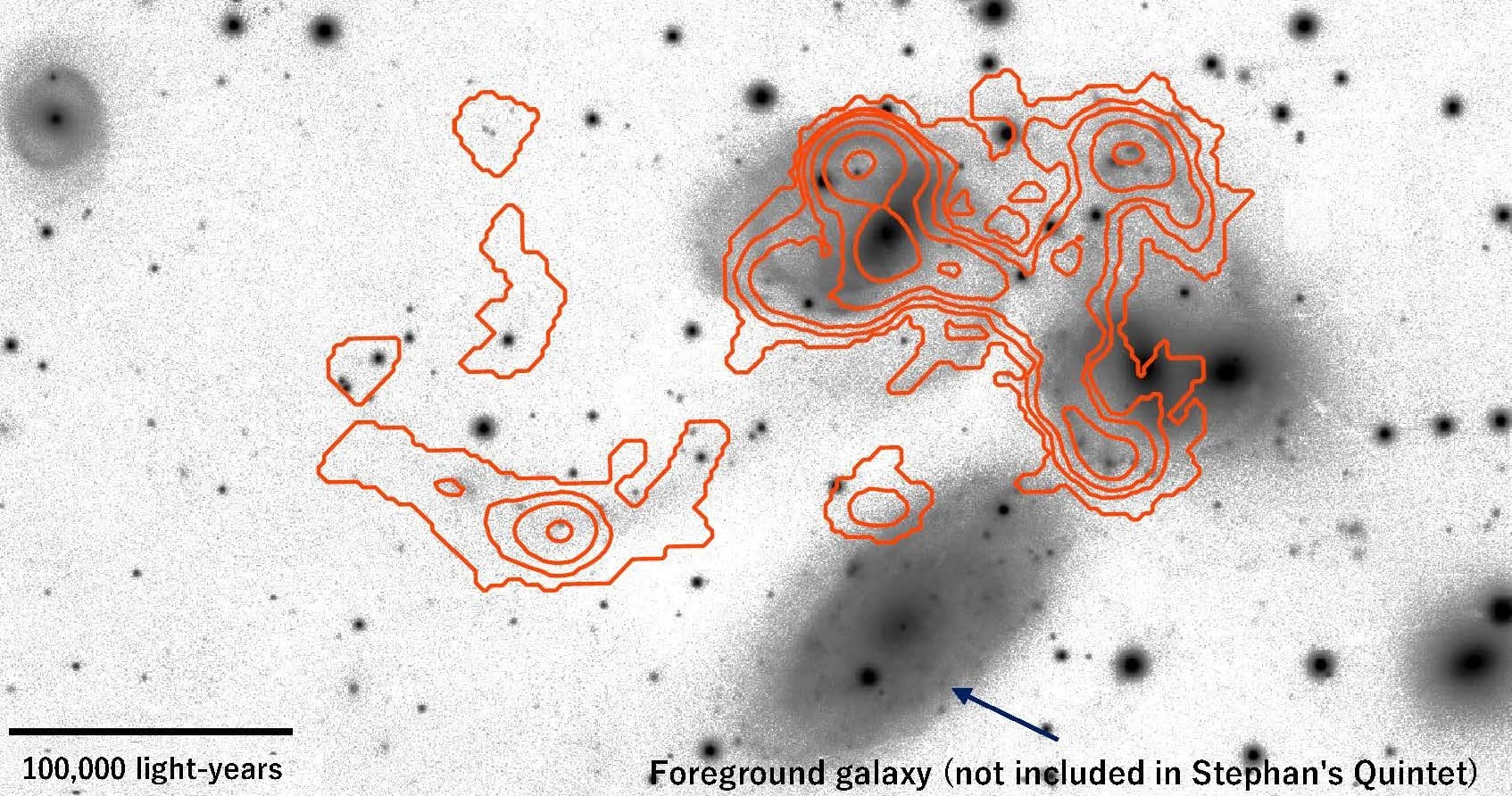
Optical image of Stephan’s Quintet galaxy group showing regions of abundant molecular gas: The contour lines show radio emissions from carbon monoxide molecules in Stephan’s Quintet, arranged like the contours on a topographic map. Just as higher contours on a map represent higher elevations, higher contour levels here represent stronger CO emission, indicating regions with more molecular gas.
Osaka Metropolitan University
Star formation in galaxies is closely linked to molecular gas. In the distant past, when galaxy interactions were more common, these encounters compressed molecular gas, causing dense clouds to collapse under their own gravity and form new stars.
However, a curious phenomenon occurs in some regions with abundant molecular gas. Despite having plenty of the raw material needed to make stars, they produce surprisingly few. Why a galactic collision can trigger star formation in some regions while suppressing it in others has long intrigued scientists.
To understand this phenomenon, a research team at Osaka Metropolitan University used the Atacama Compact Array, a network of radio telescopes in Chile, to create the first detailed map of the molecular gas throughout Stephan’s Quintet, a nearby group of interacting galaxies where some regions form stars far less efficiently than expected.
When the researchers compared the amount and motion of gas in different regions with how efficiently each region was forming stars, they found that regions where the molecular gas was moving more violently tended to form stars much less efficiently, even in the presence of abundant gas.
“Interactions between galaxies can both compress and disperse molecular gas, creating dramatic differences in star formation activity,” Misaki Yamamoto of the Graduate School of Science explained. “The findings pointed to turbulence as an important factor in regulating where stars can form.”
They propose a model where the turbulence generated by the galaxies’ interactions prevents the gas from settling and collapsing under its own gravity. If the gas is highly turbulent, its motions spread out the gas, preventing parts of the cloud from settling, becoming concentrated, and collapsing. This creates fewer opportunities to form stars.
“Star formation is one of the most fundamental processes in galaxy evolution. Studies like ours help refine our picture of the universe and encourage us to reflect on our place within it,” Associate Professor Kazuyuki Muraoka said. “Understanding how galaxy collisions and interactions in the early universe enhance or suppress star formation will allow researchers a better tool to trace the history of galaxy evolution across cosmic time.”
The findings were published in The Astrophysical Journal.
###
About OMU
Established in Osaka as one of the largest public universities in Japan, Osaka Metropolitan University is committed to shaping the future of society through the “Convergence of Knowledge” and the promotion of world-class research. For more research news, visit https://www.omu.ac.jp/en/ and follow us on social media: X, Instagram, LinkedIn.
Advertisement
Advertisement