
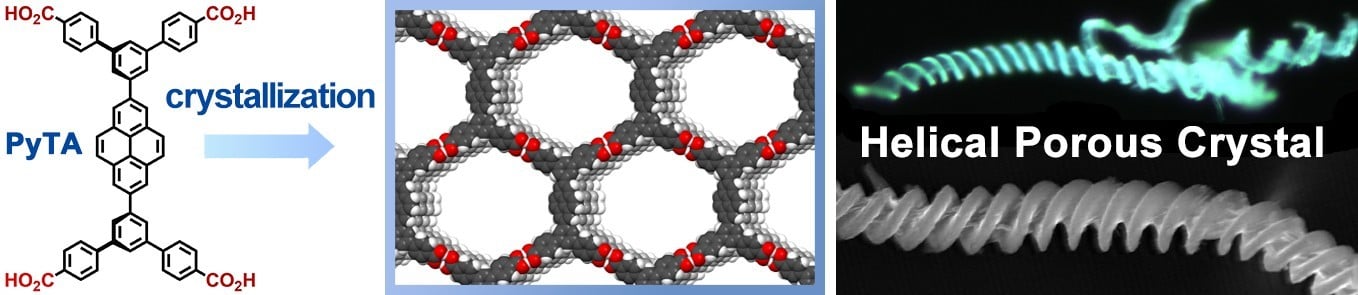
Fig. 1
The structures of the molecules used in this study, along with their crystal structures and crystal images.
A research team led by the University of Osaka creates spring-like porous crystals stretching and shrinking as solvent molecules move out and back in
Osaka, Japan – Crystals are usually imagined as rigid objects with flat faces and straight edges. A research team led by the University of Osaka has created a porous crystal that grows into a spring-like helix. The team also found that the crystal can change shape as solvent molecules move in and out of its internal spaces. The findings were published in Angewandte Chemie International Edition.
Helical or twisted crystals are known in some organic materials, but in porous materials they have mostly been reported as very small crystals, bundles, or aggregates. This has made it difficult to understand how a crystal’s internal arrangement is connected to its overall shape.
The team used an organic molecule based on pyrene and changed the crystallization conditions. At 60 °C, the material formed straight, needle-like crystals. At 120 °C, where the solvent evaporated more quickly, it formed helical crystals. X-ray measurements indicated that both forms have essentially the same porous internal structure.
The researchers propose that, during rapid crystal growth, small irregularities in the molecular arrangement may become trapped and cause uneven growth, producing the helical shape. This mechanism remains a hypothesis: direct observation during crystal growth is still needed, and other effects such as solvent effects and convection in the solution have not been ruled out.
The helical crystals have a measured surface area of 1,185 m² per gram, reflecting their high porosity, and retain their porous structure even when heated above 300 °C. When solvent molecules were removed from the pores, the helices loosened and extended; when solvent was reintroduced, they contracted slightly.
This combination of porosity and shape change could inspire microscale materials that move in response to chemicals, or materials that arrange molecules and ions along helical pathways.
“This finding grew out of careful observation by Yuzuki Murata, graduate student in my laboratory,” says correspondence author Ichiro Hisaki. “It overturned our assumption that crystals must be rigid and straight. By combining experimental findings with computational results, we were able to propose how these helical crystals may form.”
###
The article, “Helical Single Crystals of Porous Hydrogen-Bonded Organic Frameworks as a Candidate for Morphologically Functional Organic Materials
,” was published in Angewandte Chemie International Edition at DOI: https://doi.org/10.1002/anie.7959451
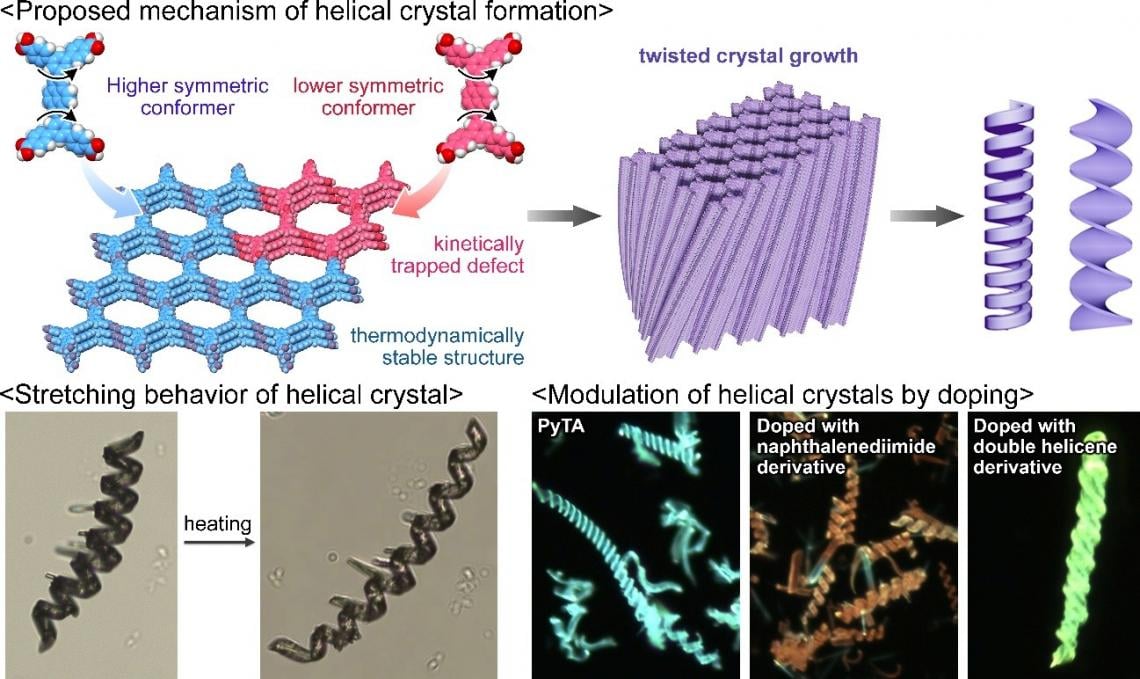
Fig. 2
The mechanism of helical crystal formation (top), the stretching behavior of the helical crystals upon heating (bottom left), and modulation of fluorescence color and morphology by doping with multiple components (bottom right).
About The University of Osaka
The University of Osaka was founded in 1931 as one of the seven imperial universities of Japan and is now one of Japan's leading comprehensive universities with a broad disciplinary spectrum. This strength is coupled with a singular drive for innovation that extends throughout the scientific process, from fundamental research to the creation of applied technology with positive economic impacts. Its commitment to innovation has been recognized in Japan and around the world. Now, The University of Osaka is leveraging its role as a Designated National University Corporation selected by the Ministry of Education, Culture, Sports, Science and Technology to contribute to innovation for human welfare, sustainable development of society, and social transformation.
Website: https://resou.osaka-u.ac.jp/en