

SKKU InfoLab develops a 4D fMRI AI model that analyzes brain activity across space and time while providing interpretable information for trustworthy computer-aided diagnosis
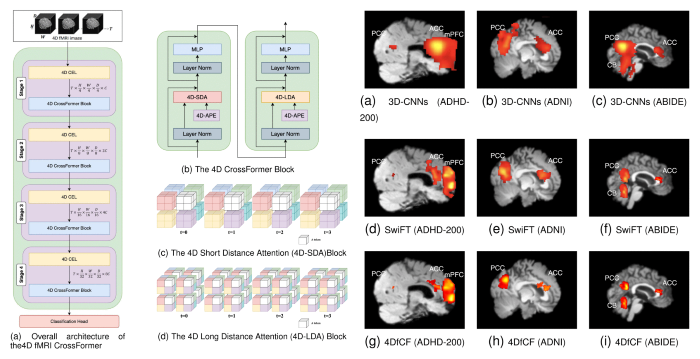
▲ 4DfCF and its explainable-AI analysis. Left: 4DfCF analyzes fMRI by learning brain-activity patterns across space and time. Right: explainability maps visualize brain regions that contributed to predictions for ADHD, Alzheimer's disease (ADNI), and autism spectrum disorder (ABIDE), providing interpretable information alongside the model's predictions. Recombined from Figs. 1 and 6 of the paper.
C. Zheng, S. El-Sappagh and T. Abuhmed, "4DfCF: 4D fMRI CrossFormer Vision Transformer," in IEEE Journal of Biomedical and Health Informatics, vol. 30, no. 6, pp. 5114-5127, June 2026, doi: 10.1109/JBHI.2025.3631655.
A research team at InfoLab, Sungkyunkwan University (SKKU), led by Prof. Tamer Abuhmed, has developed a new vision transformer architecture called the 4D fMRI CrossFormer (4DfCF) to analyze four-dimensional functional magnetic resonance imaging (fMRI) data. The research aims not only to improve AI-assisted diagnosis of brain disorders, but also to move toward a more transparent and trustworthy computer-aided diagnosis system, where clinicians can examine the evidence behind an AI prediction rather than relying only on a final result.
Unlike a single brain image, fMRI records a sequence of three-dimensional images, allowing researchers to observe how brain activity changes over time. This provides valuable information about brain function but also makes the data difficult to analyze because both where activity occurs and how it changes over time must be considered. 4DfCF was designed to analyze these spatial and temporal patterns together. It examines brain activity at different scales and learns both nearby and long-distance relationships between brain regions, helping the model capture complex patterns across the whole brain.
A key goal of medical AI is to help clinicians understand why a model has reached a particular decision. The researchers therefore applied an explainable AI technique to 4DfCF predictions. The resulting visual maps showed which brain regions contributed most strongly to the model's predictions. This means that instead of simply producing a label such as 'disease' or 'no disease,' the system can also provide visual information about which parts of the brain influenced the prediction. Such explanations do not replace a physician's judgment, but they can provide additional evidence for clinicians and researchers to review when evaluating an AI-assisted decision.
The researchers assessed 4DfCF using benchmark fMRI datasets containing scans from individuals with different neurological and neurodevelopmental disorders, including ADHD, Alzheimer's disease, and autism spectrum disorder. The model outperformed the comparison models evaluated in the study across the three datasets, achieving an F1-score of 96.28% on the ADNI Alzheimer's disease dataset. The study also showed that a model first trained on one fMRI dataset could learn another dataset faster and achieve improved performance. This suggests the possibility of developing reusable pretrained AI models that could eventually be adapted to different brain disorders and neuroimaging tasks.
4DfCF is also relatively lightweight. The main model contains approximately 10.34 million parameters, while the smaller 4DfCF-T version contains about 4.18 million, requiring considerably fewer computational resources than several large comparison models. This efficiency is important for processing large neuroimaging datasets and could make future deployment on hospital servers and research computing systems more practical.
The significance of 4DfCF therefore goes beyond diagnostic accuracy. The research brings together several important requirements for future medical AI: performance, efficiency, scalability, and explainability. By analyzing complex brain activity while also allowing researchers to visualize the regions that influenced its predictions, 4DfCF represents an effort toward medical AI systems that are not only accurate, but also more transparent and easier for human experts to evaluate.
The current results are based on benchmark research datasets rather than clinical deployment, so further validation across hospitals and patient populations will be necessary. Nevertheless, the work provides a foundation for developing trustworthy AI-assisted computer-aided diagnosis systems that support, rather than replace, medical professionals.
Advertisement