


Hiroshima University researchers investigated the effects of hydrogen supplementation on sleep quality in healthy human volunteers. While hydrogen supplementation had no significant effect compared to a placebo, individuals in the hydrogen-supplementation group reporting better sleep quality were discovered to have a lower abundance of hydrogen producing bacteria in their gut microbiome.
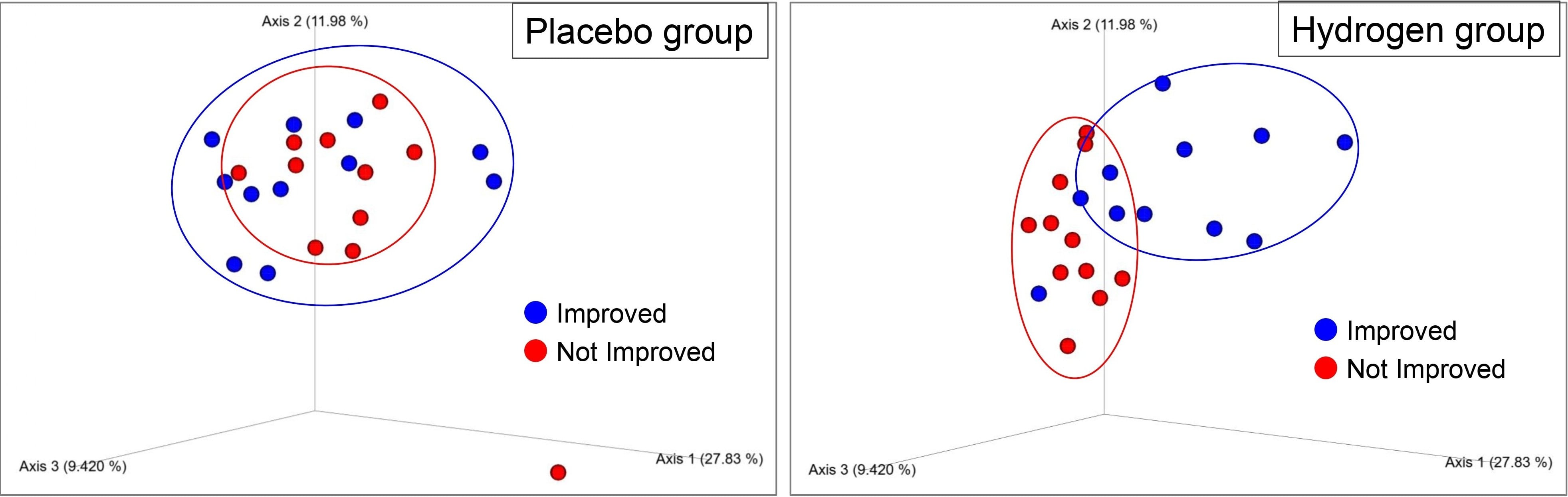
Principal coordinate analysis (PCoA) of the gut microbiome before the intervention. Placebo (left) and hydrogen (right) groups, respectively. In the hydrogen group, there is distinct clustering between individuals classified as ‘improved’ or ‘not improved’ based on whether their mean change in sleep-quality VAS (Visual Analog Scale) indicated greater or lesser improvement than the median. (Fumiko Higashikawa, Keishi Kanno. Scientific Reports. July 27, 2026)
Fumiko Higashikawa, Keishi Kanno. Scientific Reports. July 27, 2026
A Hiroshima University-led randomized, double-blind clinical trial found that hydrogen supplementation did not significantly improve sleep quality compared to a placebo; however, exploratory analyses suggest that differences in the abundance of hydrogen-producing gut bacteria may be associated with individual differences in sleep-related responses.
Hydrogen has been discovered to possess antioxidant, anti-inflammatory and anti-apoptotic (programmed cell death) biological activities, all of which have been confirmed in animal and clinical studies in the last 20 years. Experiments have demonstrated that hydrogen supplementation improves memory consolidation during sleep in mice and sleep quality in humans with long-COVID or obesity. The antioxidant properties of hydrogen are responsible, as sleep disturbances are linked to oxidative stress—cell damage caused by the build-up of peroxides and free radicals from biological processes.
Their findings were published in the journal Scientific Reports on July 27, 2026.
“Molecular hydrogen has attracted attention for its potential antioxidant and anti-inflammatory properties, but its effects on sleep quality have not been sufficiently evaluated in randomized clinical trials,” says Fumiko Higashikawa, associate professor (special designation) at Hiroshima University Hospital and first and corresponding author of the study. “In addition, humans naturally produce hydrogen through gut microbial fermentation, yet the capacity for hydrogen production varies greatly among individuals. This variation has rarely been considered in studies of exogenous hydrogen. [Our] study aims to clarify not only whether hydrogen is beneficial for sleep, but also whether the gut microbiome may help explain individual differences in response to hydrogen.”
The 8-week, randomized, double-blind, placebo-controlled trial was conducted between January and May 2024; 44 participants, 16 male and 28 female completed the trial. The participants were divided equally into hydrogen-supplementation- and placebo groups. Each participant consumed three sealed packets of hydrogen-containing jelly (air for the placebo group) daily, at intervals longer than two hours. The total dose of hydrogen (air) consumed was 0.9 mg per day; jelly consumption, health, medication and supplements were recorded daily; food and beverage consumption were recorded for all three days before each clinic visit. Sleep quality was assessed weekly by four surveys. Fecal samples were collected before and after the trial for gut microbiome profiles.
“In the overall analysis, there was no statistically significant difference in sleep improvement between the hydrogen group and the placebo group,” says Higashikawa. “However, exploratory analyses suggested that participants with lower levels of gut hydrogen-producing bacteria showed greater improvements in sleep quality and mental stress after hydrogen intake. The most important message of this paper is that the effects of hydrogen-rich jelly may not be uniform across all individuals, and that differences in gut hydrogen-producing bacteria may influence individual responses. These findings provide a new perspective for future hydrogen research: individual differences in the gut microbiome should be considered when evaluating the effects of hydrogen.”
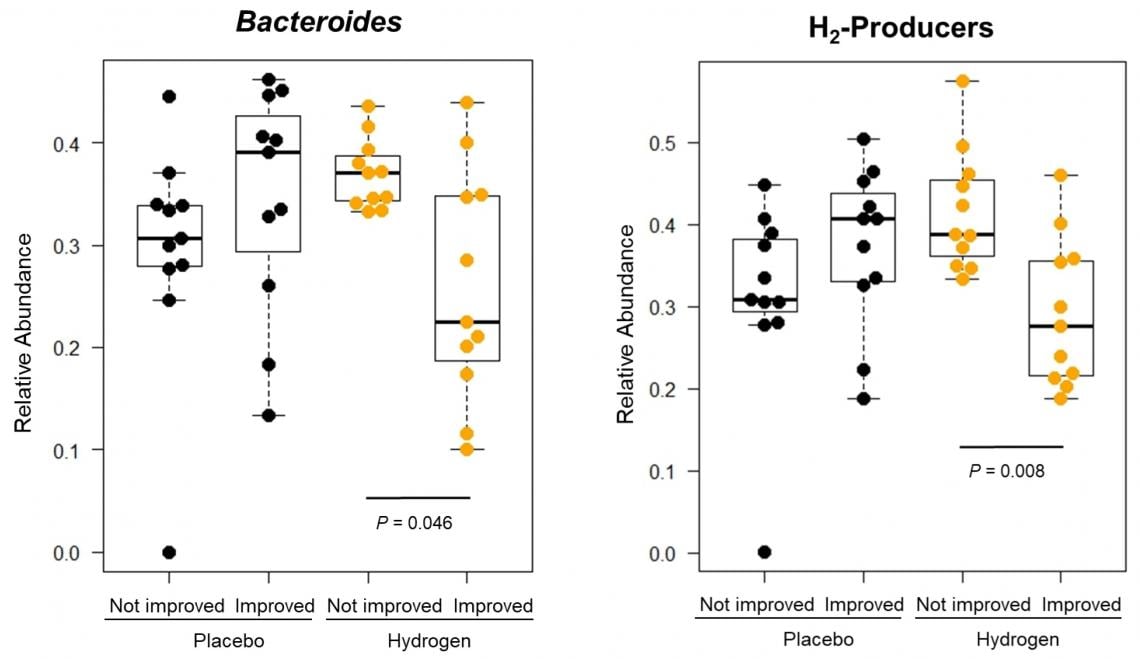
Differences between the two subgroups, ‘improved’ or ‘not improved’, in the relative abundance of hydrogen-producing bacteria at baseline. Left, Bacteroides; right, the combined abundance of four hydrogen-producing genera. (Fumiko Higashikawa, Keishi Kanno. Scientific Reports. July 27, 2026)
Fumiko Higashikawa, Keishi Kanno. Scientific Reports. July 27, 2026
A striking finding of the study was the large interindividual variation in gut hydrogen-producing bacteria among participants. The combined relative abundance of four major hydrogen-producing genera used as a proxy for hydrogen-producing potential ranged from 0.1% to 57.5%, suggesting that participants differed greatly in their baseline capacity to produce hydrogen in the gut. Another notable aspect was that distinct gut microbiome profiles between participants in the hydrogen group classified as ‘improved’ and ‘not improved’ appeared to be related to the abundance of hydrogen-producing bacteria, including taxa such as Bacteroides.
“A useful metaphor is that hydrogen may be like a whisper in a room,” Higashikawa explains. “In a quiet room, even a small whisper can be heard clearly. Similarly, in people with low baseline hydrogen production in the gut, exogenous hydrogen may be more noticeable and may have a greater effect. In contrast, in people whose gut microbiome already produces a large amount of hydrogen, additional hydrogen may be like a whisper in a noisy room: it may be harder to detect or feel its effect.”
This study represents an important first step toward a more personalized approach to hydrogen-based interventions, in which individual gut environments may help identify who is more likely to benefit. The next step is to investigate the relationship between breath hydrogen concentration and the gut microbiome, to clarify the mechanisms underlying individual responsiveness to hydrogen. In addition, tests must be conducted in larger and more diverse populations using objective sleep measures.
“Beyond sleep, we aim to apply this microbiome-informed approach to other health targets for which hydrogen may have potential benefits, and to evaluate its effectiveness more broadly,” Higashikawa concludes. “Our ultimate goal is to contribute to a society in which supplement choices and dietary strategies can be optimized based on individual gut microbiome characteristics.”
Fumiko Higashikawa and Keishi Kanno at Hiroshima University Hospital co-authored the study.
The study was funded by Shinryo Corporation, which also provided the jellies used in the study.
###
About Hiroshima University
Since its foundation in 1949, Hiroshima University has striven to become one of the most prominent and comprehensive universities in Japan for the promotion and development of scholarship and education. Consisting of 12 schools for undergraduate level and 5 graduate schools, ranging from natural sciences to humanities and social sciences, the university has grown into one of the most distinguished comprehensive research universities in Japan. English website: https://www.hiroshima-u.ac.jp/en
Advertisement