
Researchers uncover a new mechanism for moving boron through plant roots.
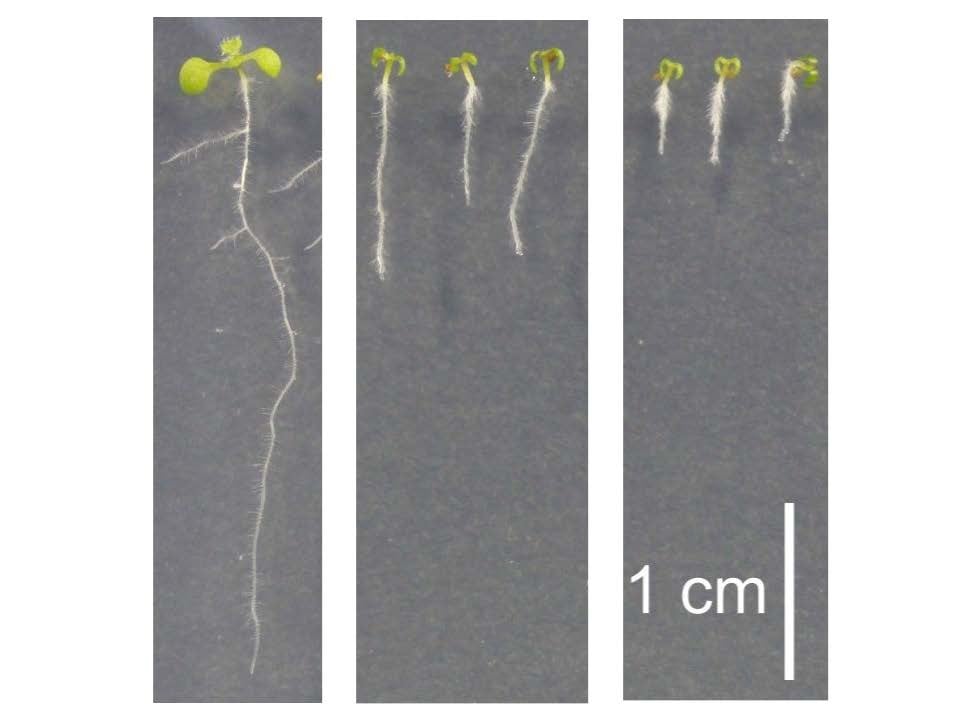
Growth of Arabidopsis thaliana in normal plants and those lacking BOR. From left to right: wild-type A. thaliana; a mutant lacking BOR1 and BOR2; and a mutant lacking BOR1, BOR2, and BOR3.
Osaka Metropolitan University
How plants harness energy from sunlight through their leaves has long fascinated scientists. But what happens at the other end of the plant, in the roots, is no less remarkable.
Many important nutrients, including boron, are taken up from the soil into the inner tissues of roots through a network of channels and transporter proteins. A study led by Osaka Metropolitan University expands on this by revealing a counterintuitive mechanism in which an apolar distribution of boron transporters works with diffusion to drive boron inward through plant tissues.
Boron is an essential element for plant growth. Boron deficiency can inhibit the expansion of young leaves, reduce root elongation, and impair fertility. Unlike mobile nutrients, such as potassium and magnesium, that can move throughout a plant via the phloem, boron in most plants is mainly transported through the xylem—a one-way pathway that carries nutrients from roots to leaves.
It has traditionally been thought that for such directional transportation, clear polar localization of transporters within cells—meaning a concentration of transporter proteins on one particular side (pole) of the cell—is a must.
But is it always the case?
The team investigated the boron transporter BOR3 in the flowering plant Arabidopsis thaliana using a combination of gene analysis, physiological experiments, and mathematical modeling. Whilst the closely related transporters BOR1 and BOR2 have been well characterized, BOR3’s biological function had remained unclear.
“We aimed to determine whether BOR3 contributes to boron uptake and to test the long-standing assumption that directional transport in multicellular tissues requires transporters to be polarly localized,” Naoyuki Sotta, assistant professor at Osaka Metropolitan University’s Graduate School of Agriculture and lead author of the study, said.
The results show that plants grown lacking BOR1, BOR2, and BOR3 had significantly shorter roots than those lacking only BOR1 and BOR2, strong evidence of a role for BOR3 in boron uptake and transport through the roots.
However, BOR3’s distribution posed a puzzle. Unlike BOR1 and BOR2, which are positioned unevenly within root-cell membranes in a way that supports boron movement in one direction, BOR3 is not noticeably polarized. This raised the question of why BOR3 was so different.
Modeling how boron moves through root tissues, the evidence suggested a combination of apolar and polar processes.
“Directional transport can emerge even when a transporter is not polarly localized,” Sotta said. “BOR3 is distributed largely uniformly on the plasma membrane, yet it still contributes to directional boron transport through cooperation with polarly localized channels.”
The researchers call this mechanism diffusive alliance transport (DAT).
DAT relies on the interplay between membrane transporters and diffusion through the apoplast—the network of spaces outside plant cells, including cell walls and the spaces between cells. Through polarly localized channels, boron first accumulates in the apoplast next to one cell and then diffuses into a neighboring inner cell, where BOR3 exports it into the surrounding apoplast on both sides of the cell.
This process increases boron levels in the more internal apoplastic compartment, creating a difference in concentration between neighboring compartments. Repeating this process from cell to cell gradually produces a net inward flow of boron, allowing higher concentrations to build up deeper inside the root.
The mechanism unearthed by the research team may offer a broader perspective on how plants organize the movement of nutrients. The team’s next step is to investigate whether DAT operates in other biological transport systems and to test how the mechanism functions in even more complex tissues.
“We hope to uncover general principles by which multicellular organisms generate directional transport and complex biological functions from the coordinated action of simple molecular processes,” Sotta said.
The results were published in Plant Physiology.
###
About OMU
Established in Osaka as one of the largest public universities in Japan, Osaka Metropolitan University is committed to shaping the future of society through the “Convergence of Knowledge” and the promotion of world-class research. For more research news, visit https://www.omu.ac.jp/en/ and follow us on social media: X, Instagram, LinkedIn.
Advertisement