


Metabolic-dysfunction-associated steatotic liver disease (MASLD) affects approximately 38% of the global population. The present study evaluated the therapeutic efficacy of a hepatocyte spheroid-laden composite hydrogel comprising a chitosan–phenol self-healing hydrogel (CPDP), decellularized liver matrix (DLM), and tannic acid (TA), assessing its effects in both in vitro and in vivo rat models of MASLD. This design combined the rapid gelation, self-healing ability, and injectability of CPDP, the antioxidant properties of TA, the high biocompatibility of DLM and the ability of hepatocyte spheroids to mimic the liver microenvironment and maintain hepatic function. The study underscores the short-term therapeutic efficacy of the hepatocyte spheroid-laden composite self-healing hydrogel for MASLD therapy.
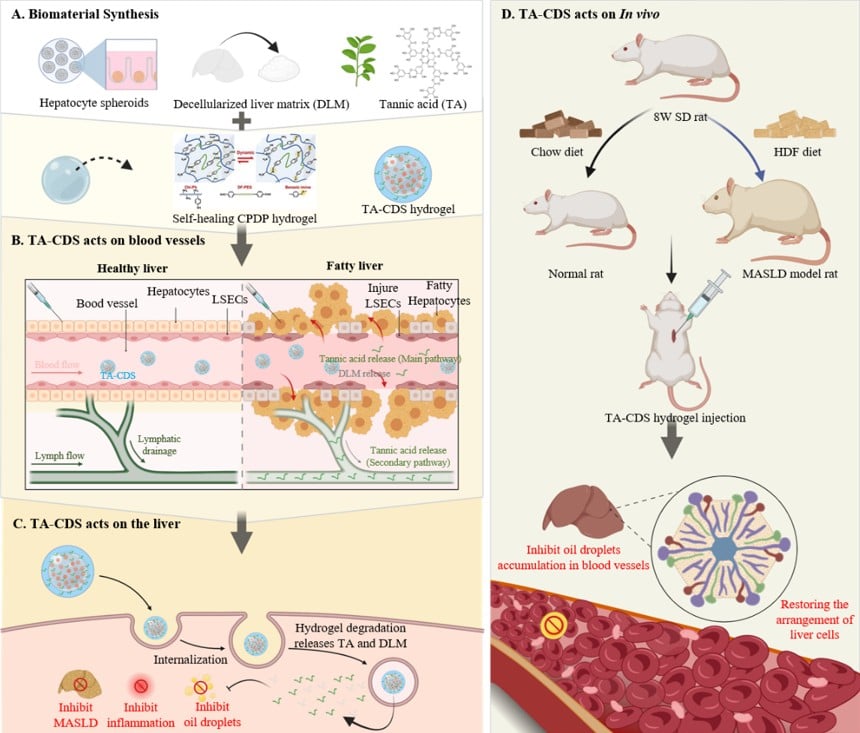
Schematic illustration of the TA-CDS composite self-healing hydrogel for MASLD treatment.
(A) The TA-CDS hydrogel is fabricated by integrating tannic acid (TA), decellularized liver matrix (DLM), and hepatocyte spheroids into a self-healing CPDP hydrogel scaffold, collectively recapitulating key biochemical and structural features of the native hepatic microenvironment; (B) Following injection into the liver, the hydrogel gradually degrades, releasing tannic acid (TA), which may subsequently enter the hepatic circulation; (C) Released TA and DLM act on the liver suppressing hepatic lipid accumulation, attenuating inflammation, and restoring hepatocyte architecture in fatty liver tissue. (D) In an 8-week Sprague-Dawley rat MASLD model induced by a high-fat diet (HFD), TA-CDS injection significantly ameliorated steatotic liver pathology, demonstrating the therapeutic efficacy of this minimally invasive biomaterial strategy.
National Taiwan University
Metabolic dysfunction-associated steatotic liver disease (MASLD) affects approximately 38% of the global population, with prevalence continuing to rise in parallel with the global burden of metabolic syndrome. Although several pharmacological agents are currently under clinical investigation, approved therapeutic options remain limited in both efficacy and scope.
To address this unmet clinical need, researchers at National Taiwan University have developed a novel injectable self-healing hydrogel engineered to recapitulate the native hepatic microenvironment and restore liver function in MASLD. The findings were published in Advanced Healthcare Materials.
The CPDP self-healing hydrogel, developed by Professor Shan-hui Hsu at National Taiwan University’s Institute of Polymer Science and Engineering, is formed through reversible Schiff-base crosslinking between the amine groups of chitosan-phenol (Chi-Ph) and the benzaldehyde groups of difunctionalized polyethylene glycol (DP-PEG). These dynamic bonds can break and reform, allowing the hydrogel to recover its structure after damage and exhibit self-healing properties.
To more faithfully recapitulate the native hepatic microenvironment, decellularized liver matrix (DLM) was incorporated into the hydrogel framework. DLM is derived by removing cellular components from liver tissue via portal vein perfusion decellularization while preserving the structural integrity and biochemical composition of the extracellular matrix (ECM).
This liver-derived matrix provides both architectural scaffolding and organ-specific biochemical cues that support hepatocyte spheroid viability and promote a physiologically relevant culture environment.
Tannic acid (TA), a naturally occurring plant-derived compound, was incorporated to reduce lipid accumulation and enhance the hydrogel's mechanical properties through additional molecular interactions. The researchers found that incorporating 0.1 wt% TA produced mechanical properties similar to those of native liver tissue while preserving the hydrogel's self-healing ability.
More importantly, the resulting composite hydrogel, termed 0.1% TA-CDS (tannic acid, CPDP self-healing hydrogel, decellularized liver matrix, and hepatocyte spheroids), demonstrated significant therapeutic effects in an in vitro MASLD model. The therapeutic platform was further validated using human induced pluripotent stem cell (iPSC)-derived hepatocyte-like cell spheroids (HLS), established in collaboration with Professor Kenji Osafune of Kyoto University (CiRA), supporting the translational relevance of the system.
Consistent with these findings, animal experiments demonstrated that 0.1% TA-CDS significantly improved liver function, lipid metabolism, serum biochemical markers, and liver tissue characteristics after just two weeks of treatment. These results highlight the potential of the composite hydrogel as a promising therapeutic approach for MASLD.
“This study is significant not only in demonstrating the short-term therapeutic potential of a hepatocyte spheroid-laden composite self-healing hydrogel for MASLD, but also in introducing a biomaterial platform designed to closely recapitulate the native hepatic microenvironment,” said co-corresponding author Professor Yung-Te Hou of the Department of Biomechatronics Engineering, National Taiwan University.
Prof. Yung-Te Hou’s email address: [email protected]
Prof. Yung-Te Hou’s Biomaterial and Tissue Engineering Lab: https://sites.google.com/view/ntubmtelab/home
Advertisement
Advertisement