

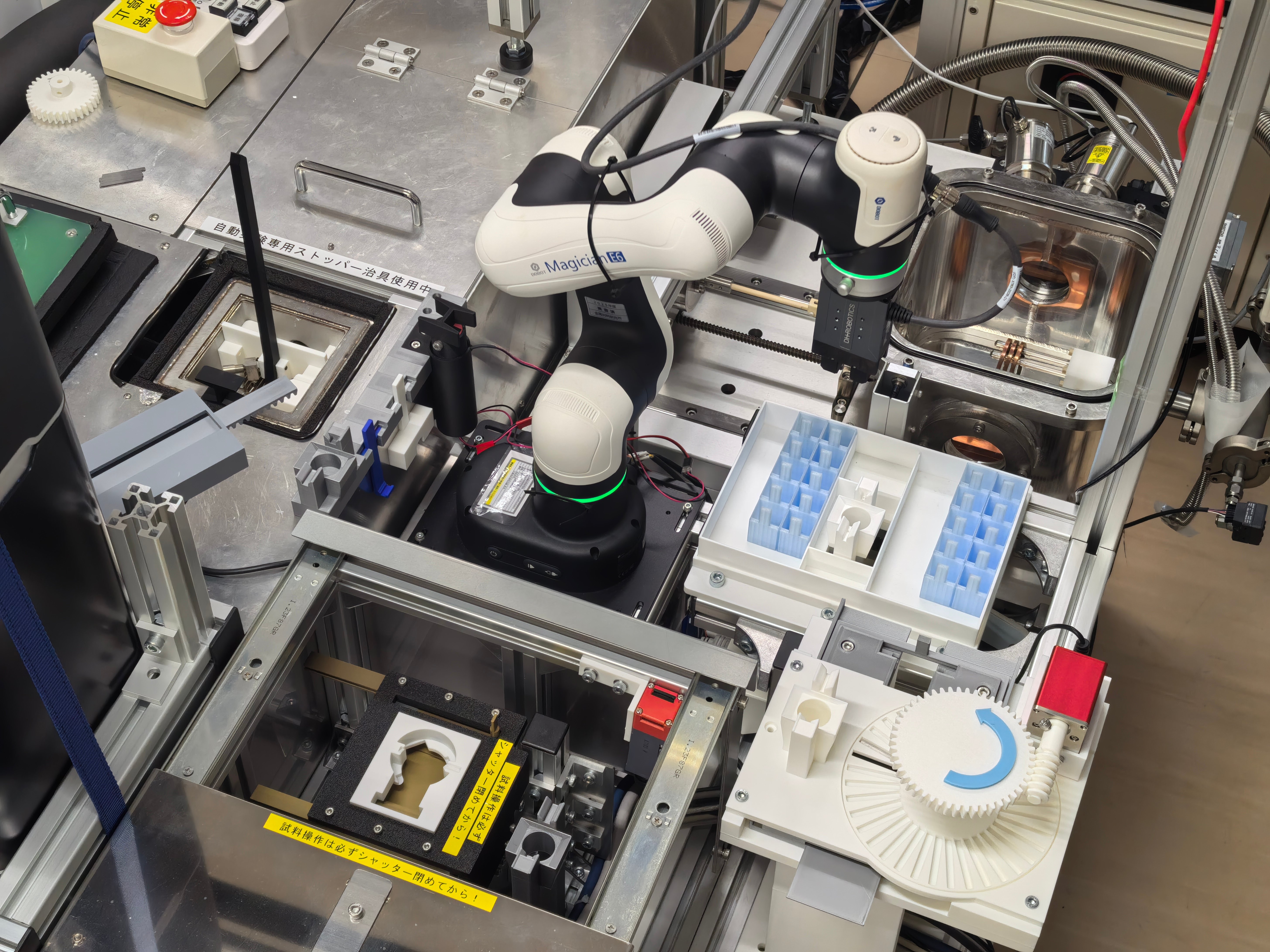

A new system that heats, X-rays, and tests structural metals paves the way for AI to design its own experiments.
The new, automated platform conducts experiments on bulk metallic materials in various ways, and measures their structures and properties during the processing.
Miyamoto laboratory
A new autonomous experimental platform enables fully automated experiments on the structural properties of metallic materials. The system, described in a study published in Science and Technology of Advanced Materials: Methods (STAM-M), offers a basis for closed-loop autonomous optimization of these materials, which will make it easier to develop better structural metals.
Materials science research involves testing a variety of formulations under a range of conditions and measuring many parameters. The number of combinations quickly balloons, and human experimenters can test only a small fraction of those possibilities. That makes autonomous, automated experiments an attractive approach in materials research, but the systems to carry out such experiments need to be developed.
Platforms have been developed to do autonomous, automated experiments with liquids, powders, and thin films, but working with bulk metallic materials has proven challenging. The new system is designed to meet that precise need. “Solid metal specimens are difficult to handle automatically, and the experimental equipment often requires considerable space,” explained Yulin Xie of Tohoku University, the study’s lead author. “Our platform addresses this challenge by integrating heat treatment, structural analysis, and mechanical testing into a single automated workflow.”
The team developed a robotic platform that heats solid metal specimens, examines their structure with X-rays, tests their mechanical properties, and then recovers them. The automated handling, treatment, and recovery of each specimen takes about 13 minutes, not including the time for the heat treatment. All manipulation and measurements are performed automatically. “The platform records how processing affects structure and properties, generating data for AI-based materials development,” said Xie.
The researchers tested the platform with automated experiments measuring the properties of an alloy after one- and two-step tempering. The results were consistent with measurements in manual experiments, validating the automated experimental platform. Xie said the team also demonstrated AI-assisted adjustment of the furnace controls, laying the groundwork for closing the automation loop.
The next step is to enable an AI system to set the platform’s heat-treatment conditions based on the results of the previous experiment. That would create a closed loop where the results of automated experiments guide the design of the next experiment. “Building on the furnace-control optimization we already demonstrated, we aim to establish an autonomous laboratory that discovers promising heat-treatment routes and accelerates the development of stronger and tougher structural metals,” said Xie.
Further information
Yulin Xie
Institute for Materials Research, Tohoku University
[email protected]
Paper: https://doi.org/10.1080/27660400.2026.2735657
About Science and Technology of Advanced Materials: Methods (STAM-M)
STAM Methods is an open access sister journal of Science and Technology of Advanced Materials (STAM), and focuses on emergent methods and tools for improving and/or accelerating materials developments, such as methodology, apparatus, instrumentation, modeling, high-through put data collection, materials/process informatics, databases, and programming. https://www.tandfonline.com/STAM-M
Dr. Kazuya Saito
STAM Publishing Director
[email protected]
Advertisement
Advertisement