

Computer Science Algorithms
News
02 Oct 2026
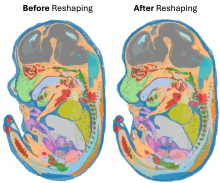
A new computational method aligns spatial transcriptomics data while retaining cell-level measurements.
29 Jul 2026
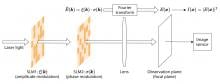
Researchers at the University of Osaka have developed a new mathematical framework that helps identify optimization problems that can be solved efficiently using optical computing hardware. The approach allows complex, high-dimensional problems to be transformed into forms compatible with spatial photonic Ising machines and can also accelerate computation using fast Fourier transforms. These findings could broaden the applications of optical computing to areas such as logistics, data analysis, and infrastructure optimization.
01 Jul 2026
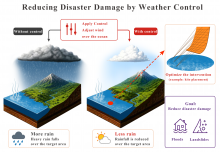
Black-box optimization, particularly Bayesian optimization, is a practical approach for weather-intervention design, achieving meaningful rainfall reduction even under a very limited budget of expensive weather simulations, finding effective actions with only a small number of trials.

15 Jun 2026
South-facing green walls help lower temperatures in indoor and outdoor environments

11 Jun 2026
Researchers from The University of Osaka developed a computational imaging method that combines coded-aperture optics with diffusion-model-based artificial intelligence to recover both depth and sharp color images from a single photograph. The approach improves robustness across imaging conditions while reducing reconstruction errors commonly seen in existing methods.
08 May 2026
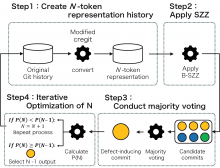
Researchers from The University of Osaka, Kyushu University, and the University of Victoria have developed MV-SZZ, a new method that accurately identifies defect-inducing software commits. By combining detailed code tracking with a majority voting system, the approach reduces false positives and outperforms existing techniques. This improvement could help developers debug software more efficiently and build more reliable systems.
27 Feb 2026
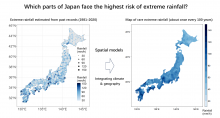
An Osaka Metropolitan University-led research team used hourly precipitation data from 1981 to 2020 and spatial modeling to predict extreme precipitation events for the next 100 years in Japan.
27 Jan 2026
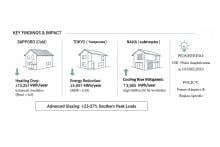
Region-specific residential buildings solution optimizes energy-efficiency and thermal comfort

21 Jan 2026
The largest ever reported database of dielectric material properties could speed up development of electronics like smartphones and energy storage systems.

21 Jan 2026
Researchers have developed a machine learning approach to predict the mechanical behaviour of new alloys, offering potential savings in both costs and experiment time.

21 Jan 2026
Understanding how tree-like structures that form in thin films could be the key to next-generation materials for beyond-5G communications technologies.

21 Jan 2026
By identifying the ideal manufacturing conditions, machine learning reduces the need for expensive and time-consuming experimentation.

21 Jan 2026
Innovative approaches in cancer screening, drug development, and radioactive hazard protection are accelerating healthcare solutions.
30 Oct 2025
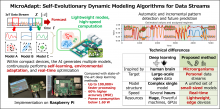
Researchers from SANKEN at The University of Osaka have successfully developed a groundbreaking “self-evolving” edge AI technology that enables real-time learning and forecasting capabilities directly within compact devices. This innovation, termed MicroAdapt, achieves unprecedented speed and accuracy. It processes data up to 100,000 times faster and achieves up to 60% higher accuracy compared to conventional state-of-the-art deep learning methods. This achievement represents a major advance toward next-generation real-time AI applications across manufacturing, automotive IoT, and medical wearables, addressing critical limitations of existing cloud-dependent AI.

03 Apr 2025
New machine learning model cuts fluid simulation time from 45 minutes to 3

02 Dec 2024
By identifying the ideal manufacturing conditions, machine learning reduces the need for expensive and time-consuming experimentation.

30 Oct 2024
Edge computing on a smartphone has been used to analyze data collected by a multimodal flexible wearable sensor patch and detect arrhythmia, coughs and falls.

08 Jul 2024
Potential benefits of method include subjecting patients to fewer exams and reducing health care costs
14 May 2024
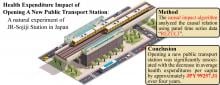
Time series data and causal impact algorithm reveal the effectiveness of a new transit station over a four-year period
09 Jan 2024
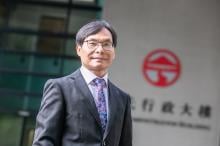
Prof Sam Kwong Tak-wu, Associate Vice-President (Strategic Research) and Chair Professor of Computational Intelligence of Lingnan University, co-authored the research paper that has received the Best Paper, Chester W. Sall Memorial Awards 2024 from the Institute of Electrical and Electronics Engineers (IEEE), the world's largest technical professional organisation dedicated to advancing technology for the benefit of humanity. This honour was published in their monthly peer-reviewed scientific journal “IEEE Transactions on Consumer Electronics”. Only three Best Paper Awards are given each year, and the competition is extremely fierce.

10 Mar 2023
Machine learning algorithms allow analysis and characterization of the atomic arrangement of silicon surface superstructures without the need for human expertise.
08 Feb 2023
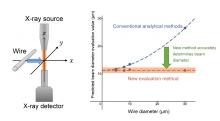
A research group at Osaka Metropolitan University has derived a new evaluation method for the measuring the size X-ray microbeams (diameter) through mathematical analysis. The group then verified the validity of the mathematically derived evaluation method by measuring the diameter of X-ray microbeams using metal wires of various diameters with an X-ray fluorescence analysis system for small areas and found that it was possible to calculate the beam diameter more accurately than the previous conventional evaluation method.
17 Oct 2022
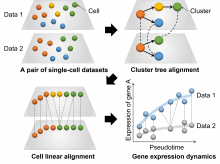
Researchers from Osaka University have developed a computational analysis tool called CAPITAL for comparative analysis of single-cell RNA sequencing data with complicated branching trajectories. As cells undergo a dynamic process, they can be placed on a “pseudotime trajectory” to analyze the gene expression changes throughout the process. While previously only straightforward linear trajectories could be compared, CAPITAL is proven to be able to accurately compare branching trajectories, significantly advancing the field of high-throughput single-cell sequencing.
26 Nov 2021
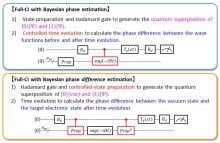
In a continuing effort to improve upon previous work, a research team at the Graduate School of Science, Osaka City University, have applied their recently developed Bayesian phase difference estimation quantum algorithm to perform full configuration interaction (full-CI) calculations of atoms and molecules without simulating the time evolution of the wave function conditional on an ancillary qubit. Superior to conventional methods in terms of parallel execution of quantum gates during quantum computing, this new algorithm is expected to be much easier to implement in actual quantum computers.
30 Jul 2021
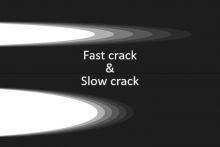
Researchers from The University of Tokyo Institute of Industrial Science develop an experimentally supported mathematical model that defines the velocity jump mechanism in crack propagation

19 Jul 2021
Researchers from The University of Tokyo Institute of Industrial Science report a machine learning-based model for predicting the bonding properties of materials

17 Mar 2021
Researchers improve their newly established quantum algorithm, bringing it to one-tenth the computational cost of Quantum Phase Estimation, and use it to directly calculate the vertical ionization energies of light atoms and molecules such as CO, O2, CN, F2, H2O, NH3 within 0.1 electron volts of precision.
19 Jan 2021
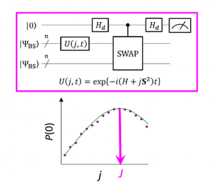
Researchers at Osaka City University use quantum superposition states and Bayesian inference to create a quantum algorithm, easily executable on quantum computers, that accurately and directly calculates energy differences between the electronic ground and excited spin states of molecular systems in polynomial time.
19 Nov 2020
Scientists devise a 2D-material–based stacked structure with applications in reducing computing power consumption

03 Nov 2020
A group of students, affiliated with South Korea's Ulsan National Institute of Science and Technology (UNIST) has created a map to help track the spread of the COVID-19 in Ulsan region.
Events
Sorry, nothing coming up for this discipline
Researchers

Mahmudul Hasan Shoron is an independent Bangladeshi researcher specializing in Jurimetrics, Computational Linguistics, and Structural Data Architecture. He develops breakthrough scientific models using a smartphone.

Angel Investor and a Vision-driven entrepreneur/executive with career-long record of business growth and innovation.

Jia Liu is the Director of the Center for Data-Driven Discovery and associate professor at CMB Group at Kavli IPMU. Her research integrates data science techniques in the study of large-scale structures of the universe (dark matter, halos, filaments, voids).
Giants in history
Sorry, nothing coming up for this discipline