

Applied Physics Letters
About Applied Physics Letters
Applied Physics Letters emphasizes rapid dissemination of key data and new physical insights, offering prompt publication of new experimental and theoretical papers related to applications of physics phenomena in all branches of science, engineering, and modern technology.
- Website: https://pubs.aip.org/aip/apl
- Current Issue: https://pubs.aip.org/aip/apl/issue
News
30 Jul 2026
The University of Osaka
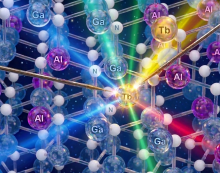
Researchers developed a terbium-doped aluminum gallium nitride LED that produces blue, green, yellow, and red light from the same area at room temperature. The emission wavelengths remained highly stable as the current changed. Increasing the aluminum content improved energy transfer and efficiency, while using an aluminum nitride base layer enhanced crystal quality and device performance. With further improvements, this approach could simplify the production of full-color micro-LED displays and contribute to compact displays, wearable devices, and white-light sources.
12 May 2026
The University of Osaka
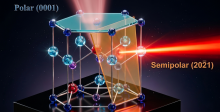
Researchers in Japan showed that growing Eu-doped GaN on a semipolar GaN plane selectively forms highly efficient Eu luminescent centers while suppressing inefficient Eu clusters. The approach increased room-temperature red emission by 3.6 times, reduced efficiency droop, and points to brighter, wavelength-stable red LEDs for monolithically integrated full-color micro-LED displays using the GaN materials platform.

21 Apr 2026
Singapore University of Technology and Design
Researchers reveal a powerful new way to precisely tune quantum defects, opening the door to ultra-sensitive next-generation sensors

29 Jan 2026
Tohoku University
Iternational researchers have improved an ultrasonic phased array system, making it possible to see hidden defects in aging concrete infrastructure and potentially strengthening the efficiency of infrastructural maintenance.
01 Sep 2025
The University of Osaka
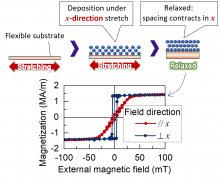
Scientists at The University of Osaka and Tohoku University have developed a groundbreaking technique for creating nanoscale magnetic thin films with embedded functionality. By leveraging the stretchability of flexible substrates, they can precisely control the atomic spacing within these nanofilms, effectively “programming” desired magnetic properties directly into the material. This innovative approach, published in Applied Physics Letters, overcomes limitations of conventional deposition methods and paves the way for advancements in various fields, from electronics to fundamental materials science.

03 Jul 2025
The University of Osaka
Researchers from SANKEN, The University of Osaka, have revealed a technique for exploiting the catalytic action of hydrogen in platinum to reverse the degradation of magnetization. This method can be used to increase the robustness of next-generation computer chips based on thin magnetic films.

17 Feb 2025
The University of Osaka
A multi-institutional research team led by Osaka University has introduced a piezoelectric device that can measure acceleration and pressure simultaneously. The device can be manufactured at room temperature and is made from inexpensive materials, which makes it a promising candidate for a wide range of applications, including the maintenance of industrial machinery and disaster mitigation.

10 Jun 2024
The University of Osaka
Researchers from Osaka University used omnidirectional photoluminescence measurements to study the effect of carbon impurities in pure gallium nitride crystals. They found that the type of energy losses depends can switch at a critical value, which can help in the manufacture of more efficient devices.

06 Jun 2024
Tohoku University
A new material developed by researchers at Tohoku University may be the key to quickly flag damaged infrastructure. This material offers a way to reduce the manpower required to regularly monitor structures that undergo daily use such as bridges. Compared to previous methods, this environmentally friendly material boasts the ability to operate without a power supply, and store information about previous incidents of mechanical stress. The application of this mechanoluminescent material is expected to make it easier and less costly to assess the safety of structures we may use in our everyday lives.
23 Apr 2024
Tohoku University
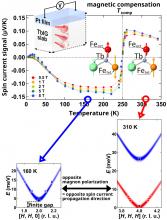
Using neutron scattering and voltage measurements, a group of researchers have discovered that a material's magnetic properties can predict spin current changes with temperature. The finding is a major breakthrough in the field of spintronics.
26 Jul 2023
The University of Osaka
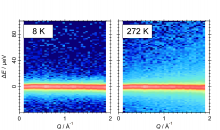
Researchers from Osaka University use quasi-elastic neutron scattering to get a close look at the behavior of water molecules in a semiclathrate hydrate crystal. They found that the molecules showed fast reorientation with an activation energy similar to that of cleaving a hydrogen bound. This rapid relaxation time in the solid electrolyte is expected to lead to efficient, cost-effective, and safe applications for semiclathrate hydrates in batteries and thermal storage materials.
12 May 2023
Tohoku University
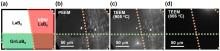
An international research group has developed a new surface coating technology that is capable of significantly increasing electron emission in materials. Their breakthrough is expected to improve the production of high-efficiency electron sources, and lead to increased performances in electron microscopes, electron beam lithography systems, and synchrotron radiation facilities.
29 Nov 2022
Osaka Metropolitan University
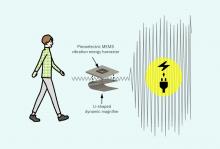
A research team at Osaka Metropolitan University has developed a microelectromechanical system (MEMS) piezoelectric vibration energy harvester, which is only about 2 cm in diameter with a U-shaped metal vibration amplification component. The device allows for an increase of approximately 90 times in the power generation performance from impulsive vibration. Since the power generation performance can be improved without increasing the device size, the technology is expected to generate power to drive small wearable devices from non-steady vibrations, such as walking motion.
05 Jan 2022
Kanazawa University
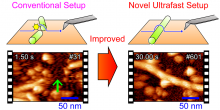
Researchers at Kanazawa University report in Applied Physics Letters the design of an ultrafast amplitude detector for use in high-speed atomic force microscopy. The detector will enable the real-time recording of fast dynamical processes of biomolecules.
29 Oct 2020
Tohoku University
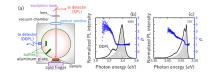
Tohoku University researchers have revealed more details about omnidirectional photoluminescence (ODPL) spectroscopy - a method for probing semiconducting crystals with light to detect defects and impurities.
25 Sep 2020
Tohoku University
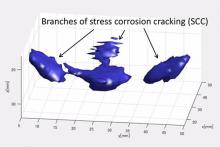
A two-in-one technology provides 3D images of structural defects, such as those that can develop in aircraft and power plants.
30 Jul 2020
Tohoku University
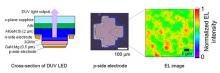
Researchers have solved a major problem for optical wireless communications - the process by which light carries information between cell phones and other devices. Light-emitting diodes (LEDs) pulse their light in a coded message that recipient devices can understand.
01 Nov 2019
The Chinese University of Hong Kong (CUHK)
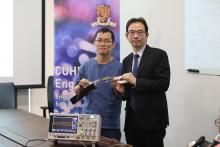
A research team led by Professor Wei-Hsin Liao from the Department of Mechanical and Automation Engineering, The Chinese University of Hong Kong (CUHK) has developed a lightweight smart materials-based energy harvester for scavenging energy from human motion, generating inexhaustible and sustainable power supply just from walking. Specifically, the device can capture biomechanical energy from the motion of the human knee and then convert it to electricity which can be used to power wearable electronics such as pedometers, health monitors, and GPS. This work has been published in Applied Physics Letters and recommended as a featured article by editors.
25 Feb 2019
Tohoku University
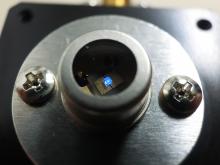
Deep ultraviolet light-emitting diodes (DUV-LEDs) made from aluminium gallium nitride (AlGaN) efficiently transfer electrical energy to optical energy due to the growth of one of its bottom layers in a step-like fashion. This finding, published in the journal Applied Physics Letters, can lead to the development of even more efficient LEDs.

28 Jan 2019
King Abdullah University of Science and Technology (KAUST)
Combining a polymer and microparticles enables a new type of capacitor that could mimic the way the brain processes information.

31 Oct 2006
Tokyo University of Science
The research team from a joint research program of Tokyo University of Science (TUS)and the Japan Science and Technology Agency have succeeded in producing hydrogen from water through the use of gallium nitride (GaN) crystals for the first time.