

- Professor Yu Seong-woon’s team identifies a novel role of the “p53” gene that controls chronic stress-induced brain disorders
- Successful prevention of depression and memory impairment using the anticancer drug “RITA”: a novel concept of mental disorder treatment is expected
- Published in “Autophagy”—the world’s leading academic journal in the field of autophagy
□ A research team led by Professor Yu Seong-woon of the Department of Brain Sciences at DGIST (President Lee Kunwoo) has, for the first time in the world, elucidated the paradoxical protective mechanism of the “p53” gene, which prevents the death of neural stem cells in the brain under chronic stress conditions.
□ Chronic stress is a major risk factor of mental disorders—depression, anxiety disorders, etc.—and degenerative brain diseases. Professor Yu’s team has reported, for the first time in the world, that chronic stress induces “autophagic cell death”—the process of self-destruction of cells in neural stem cells of the hippocampus, which controls learning and memory. Additionally, the team has made a novel discovery: the p53 gene serves as the key brake regulating this process of cell death.
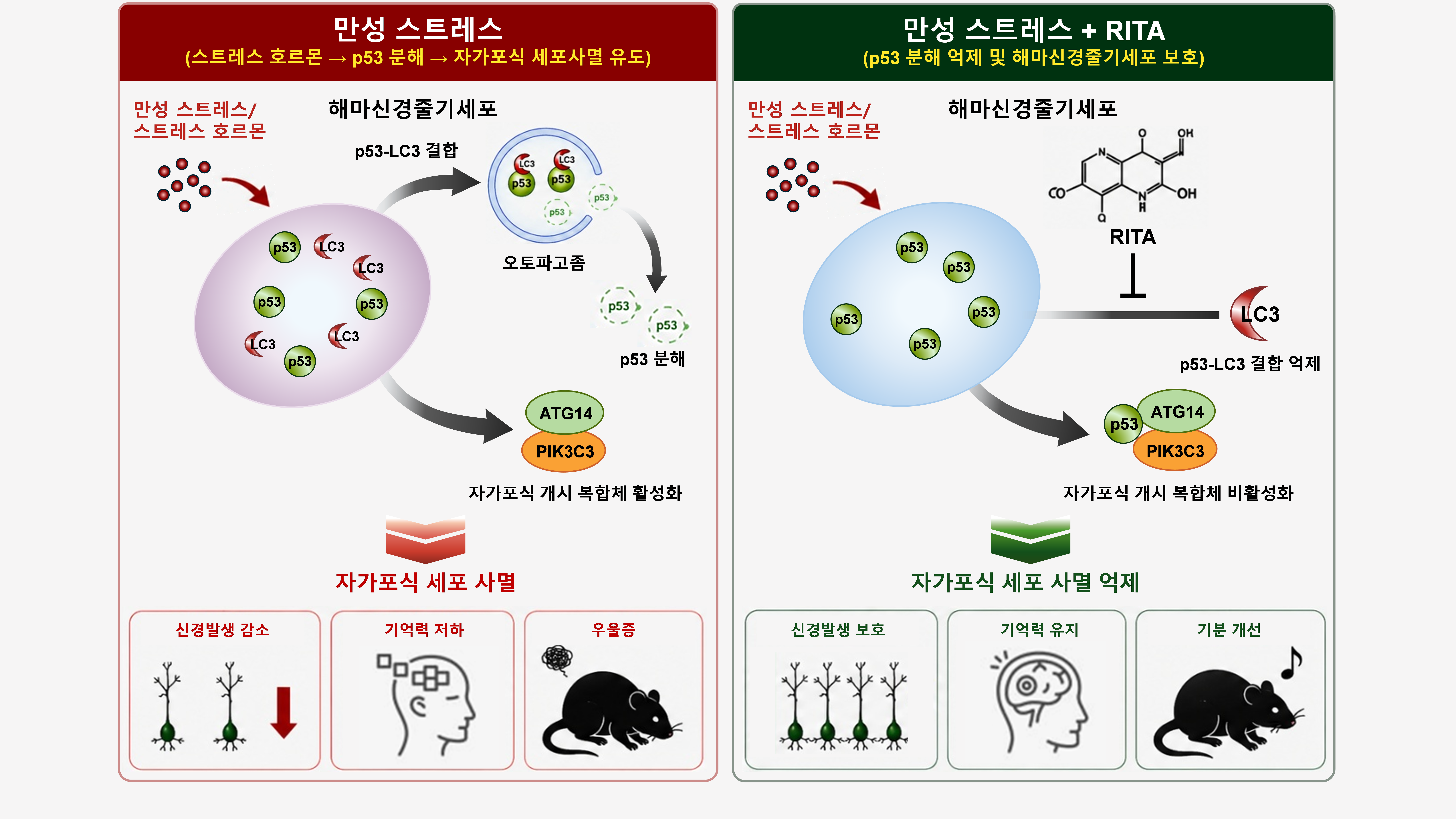
□ Originally, p53 is known as a typical “death gene” (apoptosis gene) that inhibits cancer development by removing damaged cells. However, the research team has confirmed that in adult hippocampal neural stem cells, p53 plays a paradoxical role: it functions as a “survival factor” by suppressing the activity of the autophagy initiation complex, thereby preventing the death of neural stem cells.
□ Observation of mice in which p53 was selectively removed only from neural stem cells revealed their extreme vulnerability to chronic stress, leading to rapid death of neural stem cells and significantly more severe memory impairments and depression- and anxiety-like behaviors. Inside neural stem cells exposed to stress hormones, “LC3”—a key protein in autophagy—bound to the protective factor p53, thereby degrading p53 itself; eventually, the cells, without the protective barrier, died because of excessive autophagy.
□ In contrast, when RITA—an existing anticancer drug that activates p53—was administered at a low dose, it interfered with the binding of LC3 and p53, successfully preventing p53 degradation even under stressful conditions. In the mice treated with this drug, neural stem cell death was suppressed even in a chronic stress environment, and cognitive function decline and depressive and anxious behaviors were prevented. This discovery is recognized as a significant clue for the development of new antidepressants, and patents for RITA’s antidepressant efficacy have been registered in both South Korea and the United States.
□ “We have demonstrated for the first time that p53, which is known to promote cell death, actually functions as a protective barrier that saves cells from stress in hippocampal neural stem cells,” said Professor Yu of the Department of Brain Sciences at DGIST. “The inhibition of p53 degradation could inform the development of novel treatments for mental disorders that operate through mechanisms distinct from those of existing antidepressants.”
□ This study was conducted with support from the Ministry of Science and ICT and the National Research Foundation of Korea’s Mid-Career Researcher Support Program and the Leading Brain Science Convergence Technology Development Program. The research findings were recognized as a groundbreaking discovery that offers a new direction for the treatment of stress-induced brain disorders. The paper, with Dr. Jeong Seong-hee and Dr. Jeong Hyun-jeong of the Department of Brain Sciences at DGIST serving as co-first authors, was published in “Autophagy”—the world’s leading academic journal in the field of autophagy.
Advertisement