
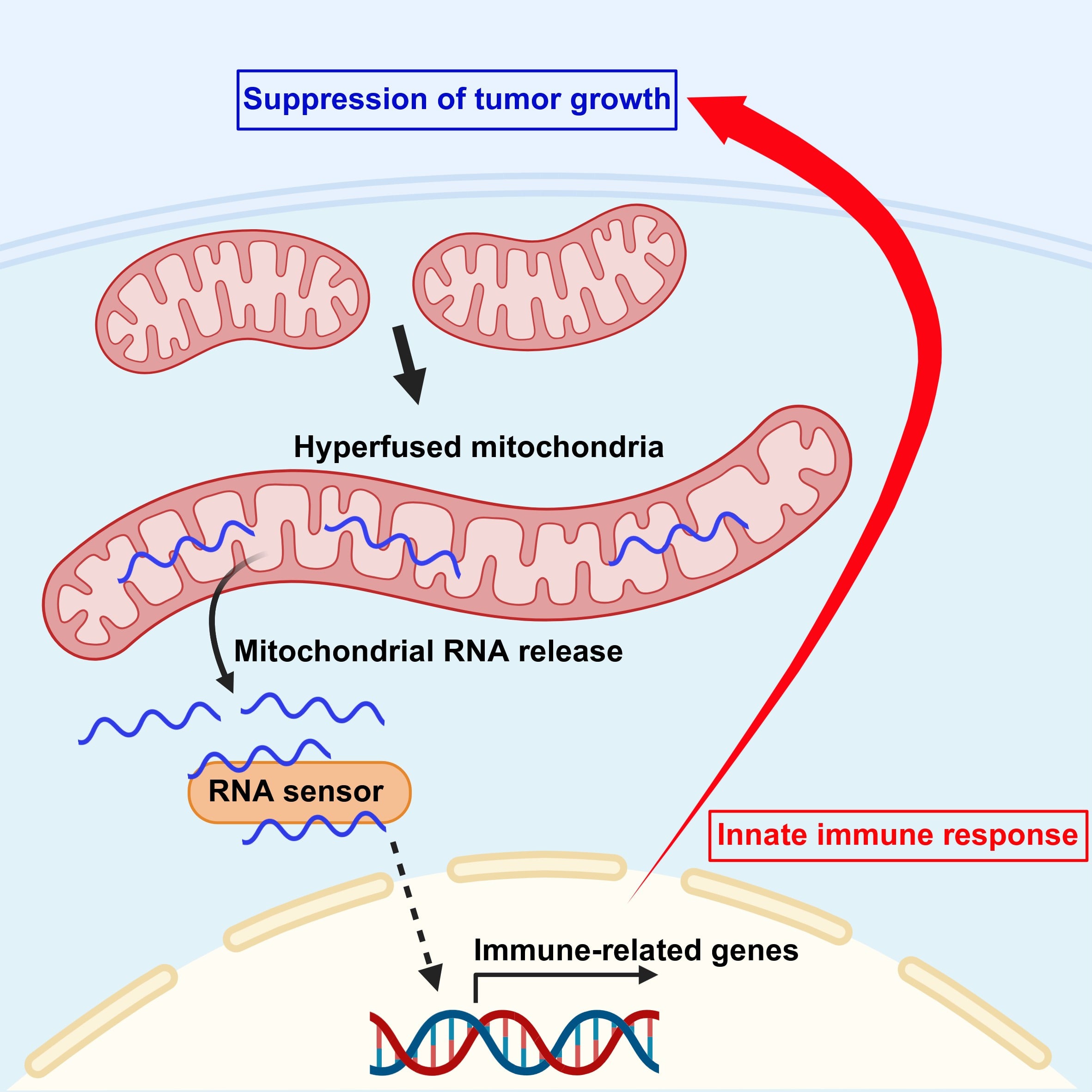

Researchers from the University of Osaka have demonstrated that mitochondrial hyperfusion, when induced by low levels of DRP1 or cellular stress, activates an immune response through the RIG-I–MAVS pathway. Dependent on the involvement of the BAX protein, the release of mitochondrial RNA into the cytosol enhanced natural killer cell cytotoxicity and reduced tumor growth in a xenograft model. The findings provide new possibilities for cancer research and treatment.
Fig. 1
Mitochondrial hyperfusion triggers innate immune responses.
Original content, Only noncommercial uses of the work are permitted (CC BY-NC 4.0)., Naotada Ishihara
Researchers from the University of Osaka uncover a novel mechanism linking mitochondrial hyperfusion to innate immunity activation via mitochondrial RNA release, with implications for anti-tumor immunity
Osaka, Japan – Mitochondria are constantly dividing and fusing within our cells, reshaping themselves to keep up with the cell’s changing needs. Sometimes, though, things go awry and mitochondria can grow abnormally long. Are these long mitochondria harmful, or might they serve a purpose?
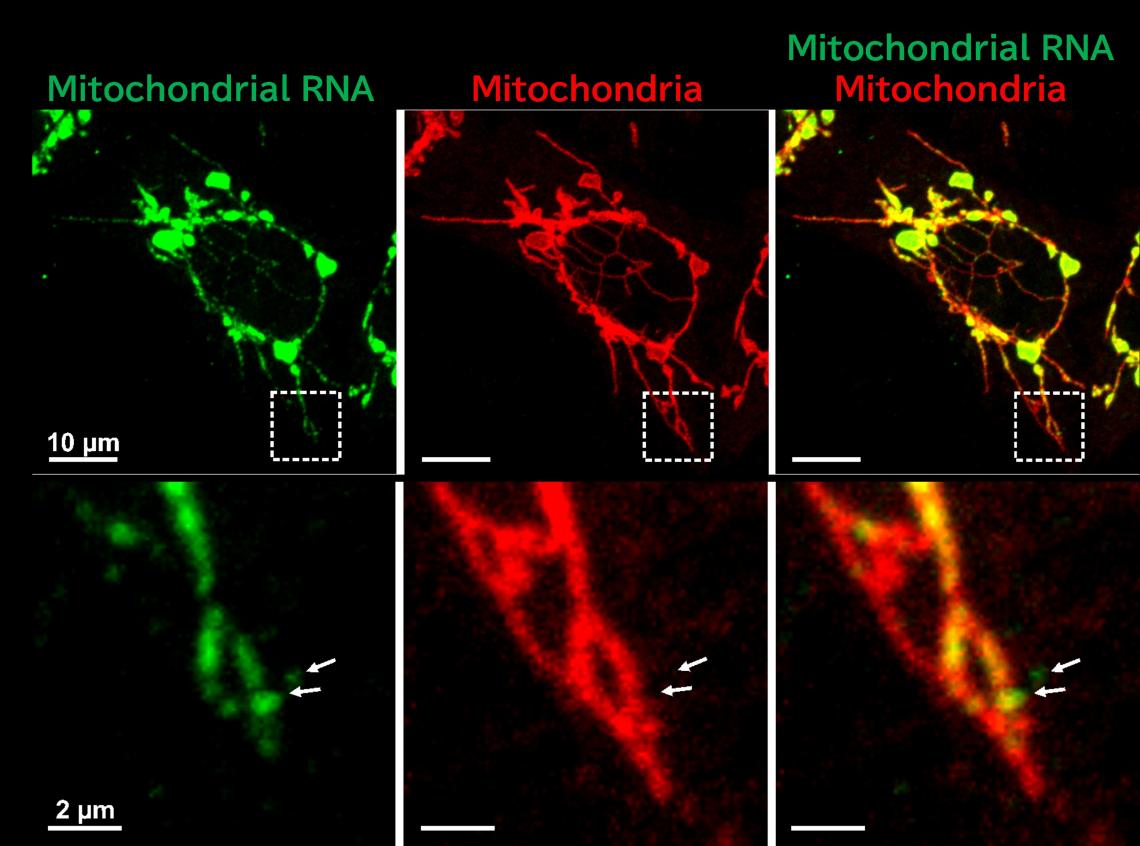
Mitochondria are famously known as the powerhouse of the cell, but their functions go beyond energy generation: they also act as signaling centers, helping the cell to sense and respond to trouble. When mitochondria are ‘hyperfused’, i.e., the stressed, abnormally long state described above, they release their genetic material into the cytosol, where the cell treats it as a warning sign in the same way it would treat a virus.
Recent studies have highlighted that mitochondrial DNA and RNA released into the cytosol can activate innate immune signaling. However, how changes in mitochondrial morphology influence the release of mitochondrial RNA (mtRNA) and the resulting innate immune response has remained poorly understood. Researchers from the University of Osaka set out to clarify these mitochondrial mysteries, and their findings have now been published in Cell Reports.
By using cells engineered to lack DRP1 – preventing mitochondria from dividing – the team triggered hyperfusion and explored the subsequent gene activity. The RNA sequencing analysis demonstrated that genes activated during a typical immune response, interferon-stimulated genes, were upregulated. However, when the hyperfused mitochondria were restored to their normal morphology, the expression of these immune-related genes returned to baseline levels.
“We determined that the trigger was mtRNA leaking into the cytosol, activating RNA-sensing proteins, such as RIG-I and MDA5, which also activate when detecting RNA viruses,” explains lead author Tatsuki Yasuda. “Given the evolutionary origin of mitochondria as descendants of ancient bacteria, it is fascinating that mitochondrial RNA can activate the same surveillance pathways that normally detect invading pathogens.”
These results point to other settings where mitochondrial hyperfusion can arise, including some cancers. Exploring existing cancer datasets, the researchers found that tumors with low DRP1 levels showed higher activity of the same immune-activating genes. In the lab, cancer cells with hyperfused mitochondria were more readily destroyed by natural killer immune cells and failed to grow efficiently after implantation in mice, pointing to a mitochondrial route for stronger anti-tumor immunity.
“Our study identifies a previously unknown molecular mechanism linking mitochondrial morphology to innate immune activation,” says senior author Naotada Ishihara. “We hope these findings will stimulate further research into how mitochondrial dynamics regulate immune responses. Because mtRNA release may contribute to cancer as well as inflammatory and age-related diseases, this mechanism could have broad implications across a range of human disorders.”
The team hopes these findings open new avenues for research into mitochondrial biology and innate immunity. By revealing how mitochondrial shape influences immune signaling, the study provides a new framework for understanding not only cancer but also inflammatory and age-related diseases associated with mitochondrial dysfunction.
###
The article, “Disrupted mitochondrial dynamics activate RNA sensing innate immunity through mitochondrial RNA release”, was published in Cell Reports at DOI: https://doi.org/10.1016/j.celrep.2026.117607.
Fig. 2
Mitochondrial hyperfusion causes mitochondrial RNA release into the cytosol.
Licensed content, Only noncommercial uses of the work are permitted (CC BY-NC 4.0)., Naotada Ishihara
About The University of Osaka
The University of Osaka was founded in 1931 as one of the seven imperial universities of Japan and is now one of Japan's leading comprehensive universities with a broad disciplinary spectrum. This strength is coupled with a singular drive for innovation that extends throughout the scientific process, from fundamental research to the creation of applied technology with positive economic impacts. Its commitment to innovation has been recognized in Japan and around the world. Now, The University of Osaka is leveraging its role as a Designated National University Corporation selected by the Ministry of Education, Culture, Sports, Science and Technology to contribute to innovation for human welfare, sustainable development of society, and social transformation.
Website: https://resou.osaka-u.ac.jp/en
Advertisement