

Professor Ogawa, Mr. Echigo (PhD student), and their colleagues in Kanazawa University report in Eur J Nucl Med Mol Imaging that combination of an At-211-labeled agent with immune checkpoint blockade significantly enhances its therapeutic effect. This strategy represents a promising advancement in the development of next-generation cancer therapies that combine targeted alpha therapy and immunotherapy.
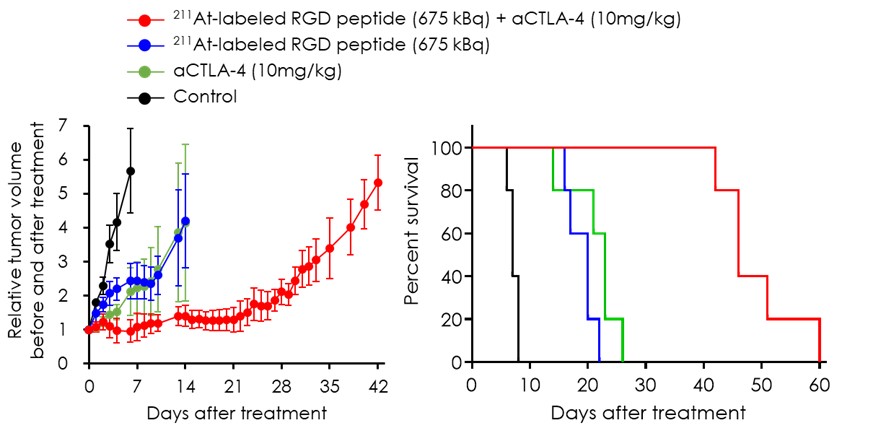
Combination therapy with At-211 labeled RGD peptide and immune checkpoint inhibitor (anti-CTLA-4 antibody) resulted in greater tumor growth suppression and improved survival compared to monotherapies in tumor-bearing mice. (Figure modified from Original by the author.)
Echigo H et al., Eur. J. Nucl. Med. Mol. Imaging, https://doi.org/10.1007/s00259-025-07498-3. Licensed under CC BY 4.0 (https://creativecommons.org/licenses/by/4.0/).
Targeted alpha therapy (TAT) using astatine-211 (211At), an alpha-emitting radionuclide, has gathered much attention as a next-generation cancer treatment that offers high selectivity and minimal side effects. In Japan, a domestic production system for 211At has been established, accelerating the development of 211At -labeled therapeutic agents for clinical application.
We have developed an 211At-labeled RGD peptide that has high affinity for αvβ3 integrin expressed on the surface of cancer cells. In tumor-bearing model mice, we confirmed that 211At-labeled RGD peptide exhibits high tumor accumulation and significant tumor growth inhibition. In this study, we focused on the potential of combining 211At-labeled RGD peptide therapy with immunotherapy to enhance its therapeutic efficacy.
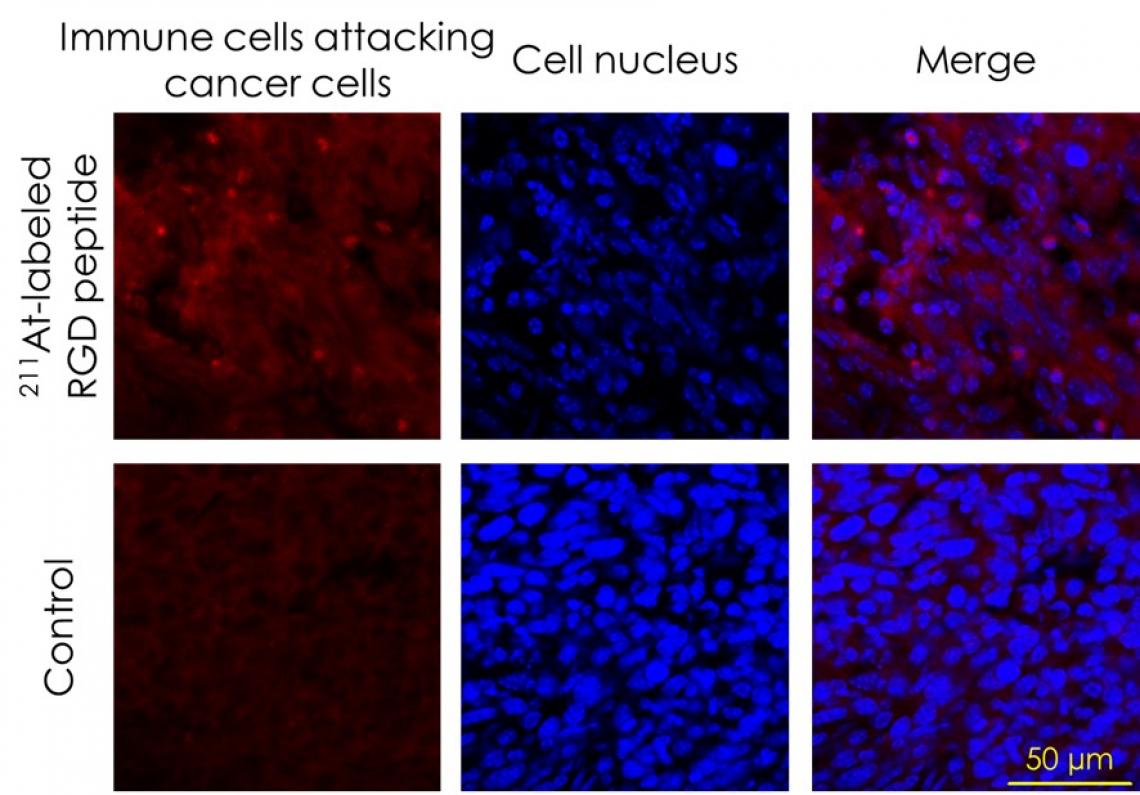
We evaluated the therapeutic efficacy of combination therapeutic efficacy with 211At-labeled RGD peptide and an immune checkpoint inhibitor (anti-CTLA-4 antibody, αCTLA-4) using tumor-bearing mice. The results showed that the combination therapy significantly enhanced tumor growth inhibition and prolonged survival compared to each monotherapy. Furthermore, even with an 211At-labeled RGD peptide monotherapy, increased infiltration of immune cells, such as T cells, into the tumor tissue was observed, indicating that an anti-tumor immune response was induced. These findings suggest the potential of a synergistic treatment strategy that enhances therapeutic efficacy through anticancer immunity by combining 211At-labeled RGD peptide with immune checkpoint blockade.
These findings demonstrate the potential of a novel cancer therapy that combines TAT by 211At with immunotherapy. Further research is expected to focus on elucidating the detailed mechanisms of antitumor immune response and expanding preclinical studies.
Distribution of immune cells in tumor tissues. (Figure modified from Original by the author. (labels changed).)
Echigo H et al., Eur. J. Nucl. Med. Mol. Imaging, https://doi.org/10.1007/s00259-025-07498-3. Licensed under CC BY 4.0 (https://creativecommons.org/licenses/by/4.0/).
Advertisement