


Researchers from the University of Osaka uncovered the first steps of disease development in ANCA-associated autoimmune glomerulonephritis. Injured kidney cells send signals to attract immune cells, including neutrophils, and induce inflammation. The researchers tested the effects of modified antibodies on halting disease progression in a mouse model, showing that the modified antibodies successfully reduced kidney injury. The findings offer hope for a potential treatment aimed at stopping the disease at its earliest stage.
Fig. 1
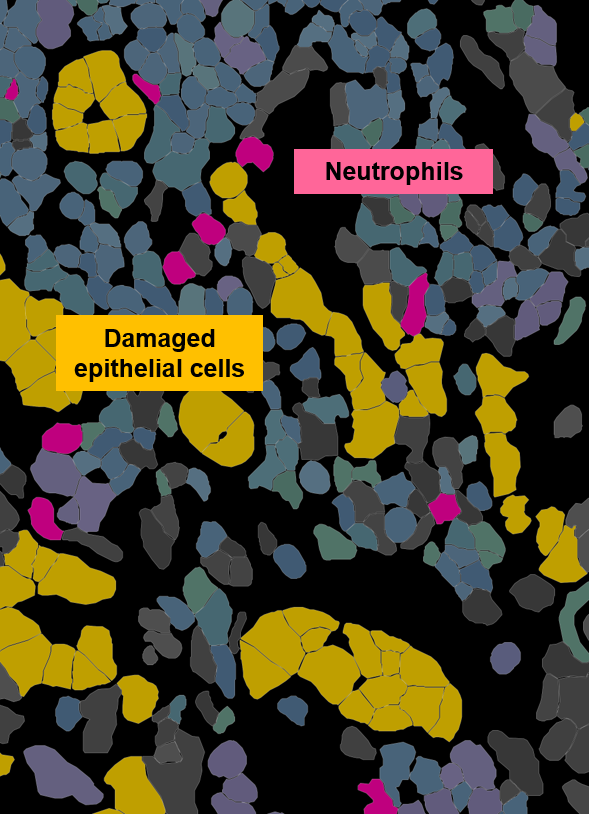
Neutrophil–epithelial niches in the kidney in ANCA-associated vasculitis
A spatial transcriptomic cell map showing neutrophils (pink) accumulating around injured proximal tubular epithelial cells (yellow), forming a local pathogenic microenvironment termed a “neutrophil–epithelial niche.” Other colors represent other renal and immune cell populations.
Original content, Credit must be given to the creator. Only noncommercial uses of the work are permitted., Masayuki Nishide
Researchers at the University of Osaka uncover early changes seen in ANCA-associated glomerulonephritis and investigate a treatment to stop it in its tracks
Osaka, Japan – When immunity works well, the body steers clear of infection and disease. However, when the immune system goes awry, healthy cells can often end up in the firing line. This can occur in autoimmune diseases like anti-neutrophil cytoplasmic antibody (ANCA)-associated glomerulonephritis, a kidney disease in which ANCAs trigger destructive inflammation. However, there has been little information about the sequence of events associated with the early stages of disease.
Now, researchers from the University of Osaka have uncovered the first steps in the development of ANCA-associated glomerulonephritis. The researchers found that injured kidney cells send signals that attract immune cells, including neutrophils, which drive the spread of inflammation in the early stages. The findings were published this month in the Journal of Experimental Medicine.
Despite improvement in treatment options, current treatments for ANCA-associated glomerulonephritis carry risks ranging from side effects of prolonged use to treatment failure. Targeted treatments could offer better health outcomes for patients. However, to do so, researchers would need to clarify how the disease process starts to tackle the problems head on.
“In ANCA-associated glomerulonephritis, the kidneys are frequently involved,” explains lead author, Masayuki Nishide. “This makes it an excellent candidate for studying the initial steps of the autoimmune disease process.”
The researchers compared kidney samples from healthy donors and from patients with ANCA-associated glomerulonephritis who did not receive treatment. Using cutting-edge technology, they studied the sequence of events in disease progression while preserving cellular organization in the tissue samples.
“Our goal was to investigate how exactly the disease unfolds in the early stage so that we could attempt to stop it before significant damage is done,” says senior author, Atsushi Kumanogoh. “We were surprised to see that despite the normal appearance of the tissue, we could still detect changes at the cellular level.”
After finding that diseased organs displayed more damage compared to normal kidneys, the researchers aimed to replicate and treat the injury using a mouse model. The researchers found that excessive neutrophil activation is a key aspect of early disease, leading researchers to attempt to decrease neutrophil activation. In turn, researchers modified antibodies and tested whether they could minimize stimulation of Fcγ receptors, which are integral to the development of the inflammatory process.
The results were promising, and the modified antibodies successfully reduced kidney injury in the model. These findings point to a potential new therapeutic strategy aimed at stopping the disease at its earliest stage, before severe kidney damage develops. It is hoped that continued developments in this area can offer patients new hope for potentially safer treatments with fewer side effects.
###
The article, “Epitope-diverse autoantibodies induce neutrophil–epithelial niches driving kidney injury in ANCA–associated glomerulonephritis,” will be published in the Journal of Experimental Medicine at DOI: https://doi.org/10.1084/jem.20260506
About the University of Osaka
The University of Osaka was founded in 1931 as one of the seven imperial universities of Japan and is now one of Japan's leading comprehensive universities with a broad disciplinary spectrum. This strength is coupled with a singular drive for innovation that extends throughout the scientific process, from fundamental research to the creation of applied technology with positive economic impacts. Its commitment to innovation has been recognized in Japan and around the world. Now, the University of Osaka is leveraging its role as a Designated National University Corporation selected by the Ministry of Education, Culture, Sports, Science and Technology to contribute to innovation for human welfare, sustainable development of society, and social transformation.
Website: https://resou.osaka-u.ac.jp/en
Advertisement