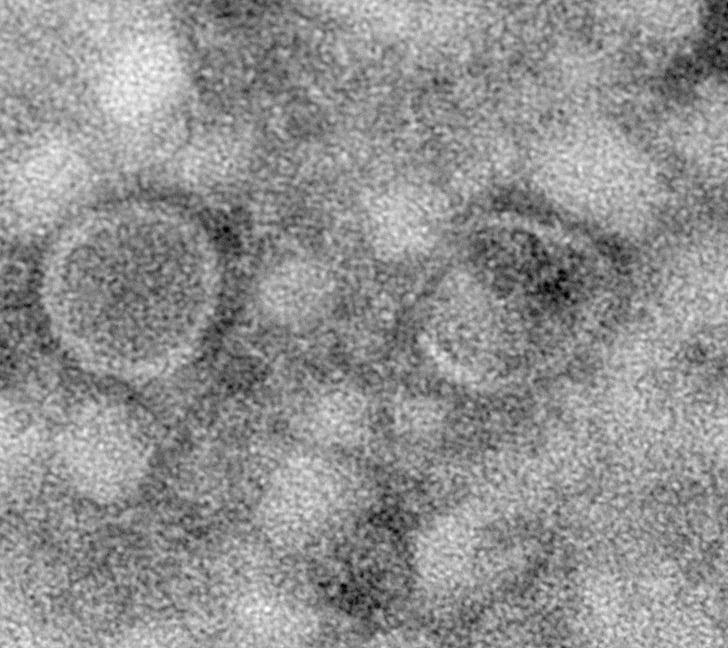
An electron microscopy image of extracellular vesicles secreted by muscles.

The research team (from right): Dr Kenon Chua, Ong Shi Chee, Asst Prof Tang Hong-Wen, Dr Goh Kah Yong, Priscillia Choy Sze Mun and Dr Priya Gopal Krishnan.
SINGAPORE, 17 JUNE 2026—Duke-NUS scientists have discovered that ageing muscle may contribute to cancer growth by releasing fewer extracellular vesicles, tiny particles that cells use to communicate with one another. Their study also found that composition of these particles changes with age, weakening protective signals that help suppress tumour development. Encouragingly, exercise appears to restore this protective function. Published in Nature Communications, the findings offer fresh insights into healthy ageing and cancer prevention, as well as point to potential biomarkers and therapies tailored to older adults.
The effects of ageing muscle are especially evident in sarcopenia, a condition marked by loss of skeletal muscle mass and strength as one gets older. In Singapore, it affects nearly one in three seniors aged 60 and above, impacting mobility, independence and quality of life[1].
Working with collaborators from Singapore General Hospital and Cardiff University, the scientists found that sarcopenic muscle secretes fewer extracellular vesicles. As muscle ages, these vesicles also contain lower levels of miR-7a-5p—a microRNA or a very small RNA molecule that helps regulate gene expression by controlling the types and amounts of proteins cells produce. miR-7a-5p plays a role in restraining tumour growth.
Importantly, the team also discovered that the release of extracellular vesicles from muscle is controlled by a biological pathway that declines with age but can be reactivated through exercise.
Assistant Professor Tang Hong-Wen from the Cancer & Stem Cell Biology Signature Research Programme at Duke-NUS Medical School, and senior author of the study, said:
“Muscle cells use extracellular vesicles to send messages and influence how other cells behave, but exactly how these messages are delivered and received is not fully understood. Our research uncovers this hidden process, showing that as muscles weaken with age, these signals can change in ways that can promote tumour growth.”
Dr Kenon Chua, Consultant, Department of Orthopaedic Surgery at Singapore General Hospital and one of the authors of the study, said:
“Clinically, we observe an association between advanced cancer and low muscle mass. This is a novel study which illustrates how healthy muscle can potentially inhibit tumour growth. We observe that healthy muscles secrete many physiologically important molecules. With advanced age, it is even more important to engage in regular resistance and aerobic exercises in order to maintain healthy muscle volume. This is important not only for function and mobility, but also for general health. We hope that the insights from our research can help us develop new targeted therapies for our patients; as well as convince more people of the benefits of regular exercise.”
With their study, the scientists have established a direct biological link between aged muscle and tumour growth. Together, the findings reveal a muscle-to-tumour communication pathway that could be targeted to develop new therapies aimed at preventing cancer progression.
Professor Lok Shee Mei, Interim Vice-Dean for Research at Duke-NUS Medical School, said:
“This study opens new avenues for therapeutic strategies to preserve muscle health and reduce cancer risk, while also underscoring the importance of physical activity in ageing. We hope that policymakers in Singapore and across the region will use this evidence to support greater investment in healthy ageing programmes and exercise-based interventions.”
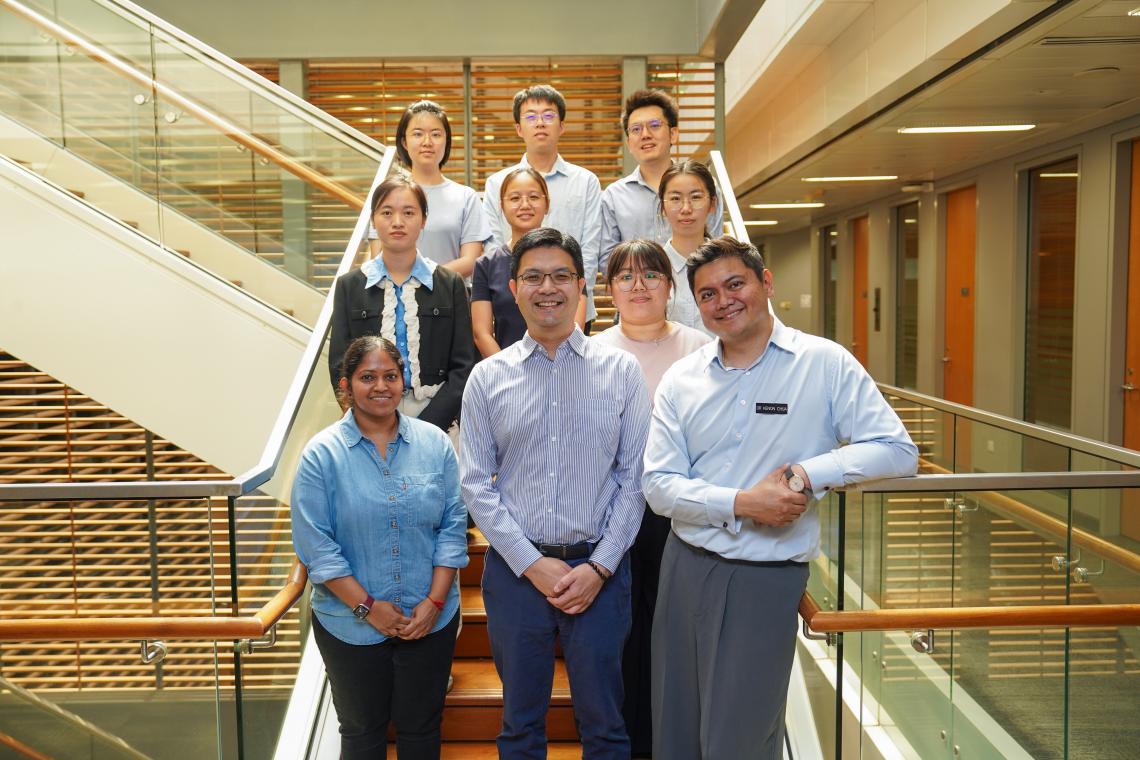
Caption: Members of Asst Prof Tang Hong-Wen’s laboratory
(from top row left): Peng Chi, Jiang Qizhou, Dr Goh Kah Yong;
(from middle row left): Dr Wang Yuanli, Priscillia Choy Sze Mun, Ong Shi Chee, Jiang Weiyi;
(from front row left): Dr Priya Gopal Krishnan, Asst Prof Tang Hong-Wen and Dr Kenon Chua.
Next, the scientists plan to validate their findings in human samples and determine whether extracellular vesicles—particularly the miR-7a-5p they carry—could serve as biomarkers for assessing cancer risk associated with sarcopenia.
This research was supported by:
- the Singapore Ministry of Education
- the Diana Koh Innovative Cancer Research Award
- National Academy of Medicine grant
- the National Research Foundation, Singapore under the National Medical Research Council (NMRC) Open Fund-Individual Research Grant (MOH-001208 and MOH-001885) and Open Fund-Young Individual Research Grant (MOH-001831) and administered by the Singapore Ministry of Health through the NMRC Office, MOH Holdings Pte Ltd.
The study is conducted by the HEAL (Healthy aging, Executive function and Ambulatory Longevity) programme, a Singapore General Hospital, Duke-NUS research initiative to improve function and quality of life in the elderly.
[1] Chen L-K, Woo J, Assantachai P, et al. Asian Working Group for Sarcopenia: 2019 Consensus Update on Sarcopenia Diagnosis and Treatment, of the American Medical Directors Association. 2019;21(3):300-307.e2.
About Duke-NUS Medical School
Duke-NUS is Singapore’s flagship graduate entry medical school, established in 2005 with a strategic, government-led partnership between two world-class institutions: Duke University and the National University of Singapore (NUS). Through an innovative curriculum, students at Duke-NUS are nurtured to become multi-faceted ‘Clinicians Plus’ poised to steer the healthcare and biomedical ecosystem in Singapore and beyond. A leader in ground-breaking research and translational innovation, Duke-NUS has gained international renown through its five Signature Research Programmes and ten Centres. The enduring impact of its discoveries is amplified by its successful Academic Medicine partnership with Singapore Health Services (SingHealth), Singapore’s largest healthcare group. This strategic alliance has led to the creation of 15 Academic Clinical Programmes, which harness multi-disciplinary research and education to transform medicine and improve lives.
For more information, please visit www.duke-nus.edu.sg
About the National Medical Research Council (NMRC)
The NMRC was established in 1994 to oversee research funding from the Ministry of Health and support the development and advancement of biomedical research in Singapore, particularly in the public healthcare clusters and medical schools. NMRC engages in research strategy and planning, provides funding to support competitive research grants and core research enablers, and is responsible for the development of clinician scientists through awards and fellowships. The council’s work is supported by the NMRC Office which is part of MOH Holdings Pte Ltd. Through its management of the various funding initiatives, NMRC promotes healthcare research in Singapore, for better health and economic outcomes.
About the National Research Foundation (NRF)
The National Research Foundation, Singapore (NRF), set up on 1 January 2006, is a department within the Prime Minister’s Office. The NRF sets the national direction for research and development (R&D) by developing policies, plans and strategies for research, innovation and enterprise. It also funds strategic initiatives and builds up R&D capabilities by nurturing research talent. Learn more about the NRF at www.nrf.gov.sg.