

This story is featured in the Asia Research News 2026 magazine. Book space in the next issue now.
Get the news in your inbox
Formaldehyde is a hidden hazard in everyday life. Despite being a known carcinogen, it’s found in paints, textiles, furniture, and construction materials.
Long-term exposure has been linked to cancer, heart disease, and neurological disorders. However, detecting low levels of formaldehyde, especially in the air, is a difficult and expensive task that often requires lab-based instruments.
Researchers at the Indian Institute of Science Education and Research (IISER) Kolkata have developed a fluorescent polymer sensor that can detect formaldehyde in both water and air. The sensor provides a clear visual signal under ultraviolet (UV) light, making it a promising tool for environmental monitoring and point-of-care detection.
“We wanted something that works outside the lab, something fast, affordable, and easy to use,” says the study’s first author, Subhadip Roy of the Department of Chemical Sciences at IISER Kolkata.
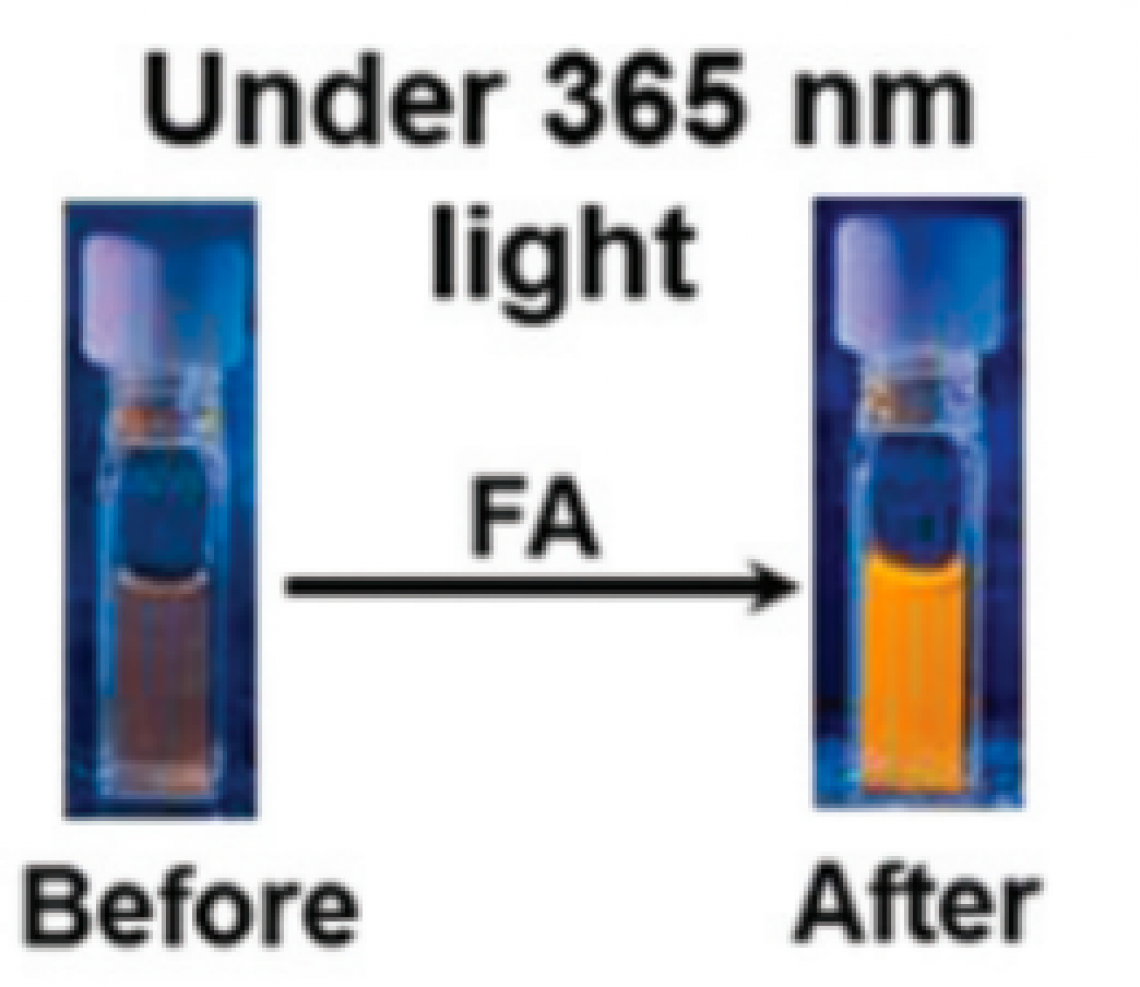
A fluorescent, water-soluble polymer detects formaldehyde in water and air within one minute at nanomolar levels, resulting in visible fluorescence changes under UV light before (left) and after (right) FA addition.
The sensor is made of a water-soluble polymer that includes a naphthalimide-based fluorescent dye. When the polymer interacts with formaldehyde, a chemical reaction occurs that activates a strong fluorescent signal. This “turn-on” response is visible to the naked eye under 365 nm UV light and happens within one minute. In water, the sensor can detect formaldehyde at levels as low as 1.36 nanomoles, making it one of the most sensitive polymer-based systems so far.
Because the sensor is embedded in a stable polymer backbone, it doesn’t have the common problem of the dye leaching or fading. It is also highly selective. Molecules similar to formaldehyde do not interfere with its response, reducing the chances of false positives.
The research team also created a paper-based version of the sensor. They coated filter paper with the polymer solution, then used UV light to fix it in place. When exposed to formaldehyde vapour, the paper strip changes colour from light yellow to deep orange under UV light. The colour change becomes more intense with longer exposure, allowing quick and easy detection without any instruments.
“The visual response is immediate and easy to interpret,” explains Roy. “That is key for real-world use.”
The sensor is also reusable. After detecting formaldehyde, it can return to its original state by adding sodium bisulfite and be used again, which makes it both cost-effective and environmentally friendly.
The team is now working to expand this sensing platform to detect other hazardous chemicals. They are also exploring industrial collaborations to develop coatings, smart labels, and portable detection tools for everyday safety.
“Chemical safety should be simple,” says Roy. “Our goal is to turn advanced sensing into something anyone can do, anytime and anywhere.”
Read the paper
Science and Technology of Advanced Materials: https://doi.org/10.1080/14686996.2025.2469493
Further information
Subhadip Roy
[email protected]
Indian Institute of Science Education and Research Kolkata
STAM Inquiries
[email protected]
STAM Editorial Office
Download this story

Advertisement