
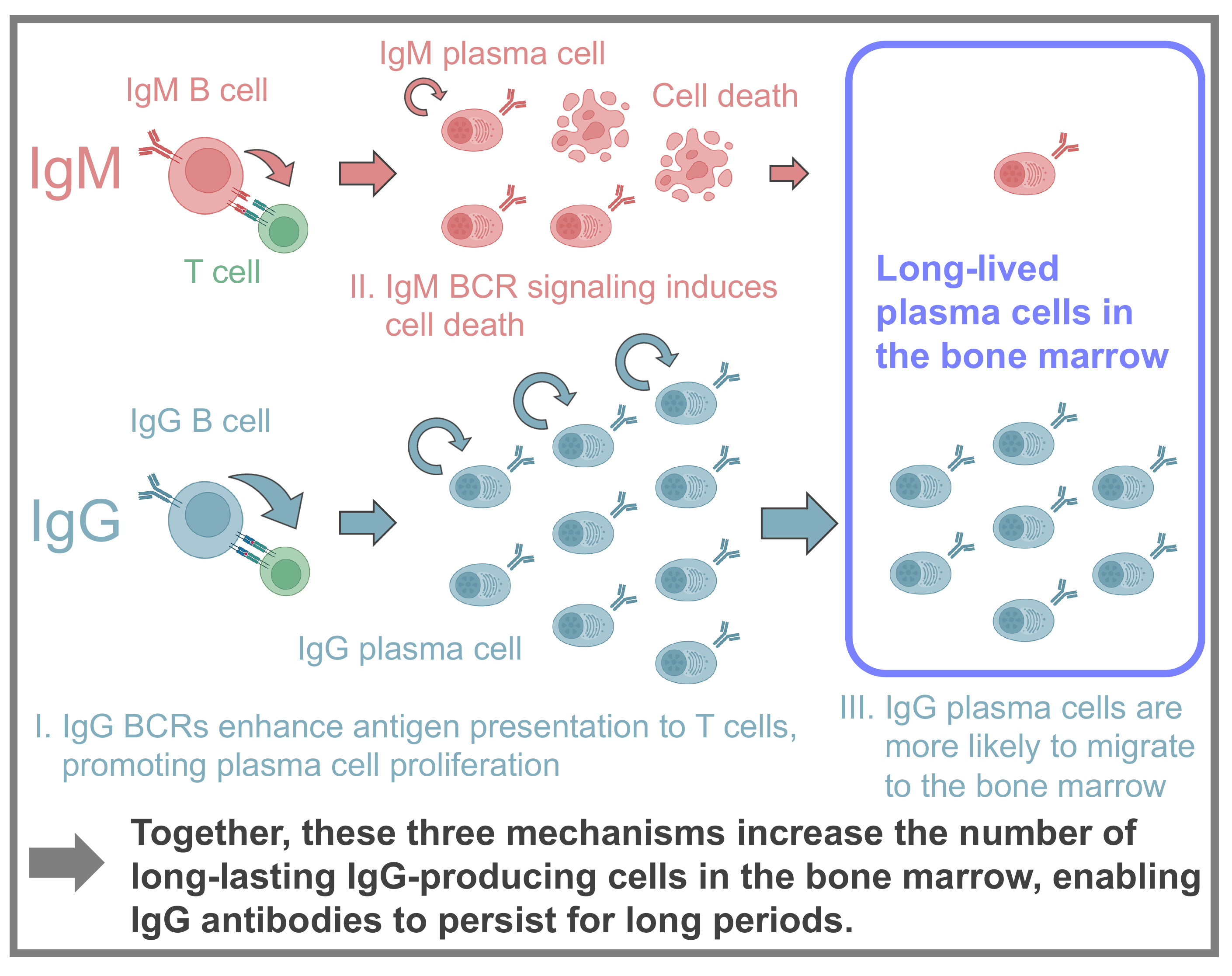

A team led by the University of Osaka researchers discovered that cells producing IgG1 antibodies multiply more, are less prone to cell death in the spleen, and migrate more efficiently to the bone marrow, where long-lived antibody-producing cells can become established. Understanding how these cells gain these advantages could help researchers design vaccines that provide longer-lasting protection against infection.
Fig. 1
Mechanisms underlying the long-term maintenance of IgG antibodies
Original content, Credit must be given to the creator., Takuya Koike, created with BioRender.com
A team led by investigators from the University of Osaka uncovers cellular mechanisms that favor long-lived antibody responses, providing insights that may help researchers design vaccines that provide longer-lasting protection against infection
Osaka, Japan – When an infection strikes, the immune system produces antibodies to help fight it off. Some antibody responses can protect us for years, while others fade much sooner. A team led by The University of Osaka researchers, using a mouse model, uncovered several ways by which cells that produce IgG1, a subclass of IgG type antibody commonly associated with long-lasting immune responses, might help establish lasting immune protection.
B cells are immune cells that can develop into specialized antibody-producing cells called plasma cells. Early in an infection, B cells usually produce a type of antibody known as IgM. However, some B cells switch to producing another type, IgG1, before developing into plasma cells. Some of these plasma cells then move to the bone marrow, where they can survive for years and continue releasing antibodies into the blood.
“IgG antibodies are essential for protection against repeat infections and generally persist for longer than IgM antibodies,” says lead co-author Yuki Tai. “We wanted to understand why cells producing IgG are more likely to establish these long-lasting antibody responses.”
The team compared immune cells that produce IgM antibodies with those that produce IgG1 antibodies. “We found that the IgG1-producing cells had several advantages,” says lead co-author Takuya Koike. “Before developing into plasma cells, the B cells that switched to IgG1 were better at presenting antigens of pathogens such as viruses to T cells, which in turn helped the newly formed IgG1 plasma cells multiply.”
IgG1 plasma cells also had a survival advantage before reaching the bone marrow. Their IgM-producing counterparts in the spleen were more prone to apoptosis, the body's natural process for removing cells that are no longer needed. Finally, IgG1 plasma cells were better able to leave the spleen and travel to the bone marrow, which provides an environment where plasma cells can survive and continue producing antibodies for long periods.
“We found that IgG1-producing cells have several advantages over IgM-producing cells,” explains senior author Tomohiro Kurosaki. “They multiply more readily, survive for longer, and reach the bone marrow more efficiently, where they can become established as long-lived antibody-producing cells.”
Switching from IgM to IgG1 changes not only the type of antibody a cell produces but also how the cell behaves and its fate, helping explain why IgG1 responses often lead to long-term immune protection. This study specifically examined the IgG1 antibody subclass, and similar mechanisms may extend to other antibody isotypes such as IgA and IgE. Understanding how the immune system naturally favors long-lived IgG1-producing cells could open new possibilities for developing vaccines that provide longer-lasting protection against infection.
###
The article, “Positive selection of IgG over IgM plasma cells through BCR isotype-specific antigen presentation and signaling,” was published in Science Immunology at DOI: http://doi.org/10.1126/sciimmunol.aee8841
About The University of Osaka
The University of Osaka was founded in 1931 as one of the seven imperial universities of Japan and is now one of Japan's leading comprehensive universities with a broad disciplinary spectrum. This strength is coupled with a singular drive for innovation that extends throughout the scientific process, from fundamental research to the creation of applied technology with positive economic impacts. Its commitment to innovation has been recognized in Japan and around the world. Now, The University of Osaka is leveraging its role as a Designated National University Corporation selected by the Ministry of Education, Culture, Sports, Science and Technology to contribute to innovation for human welfare, sustainable development of society, and social transformation.
Website: https://resou.osaka-u.ac.jp/en
Advertisement