
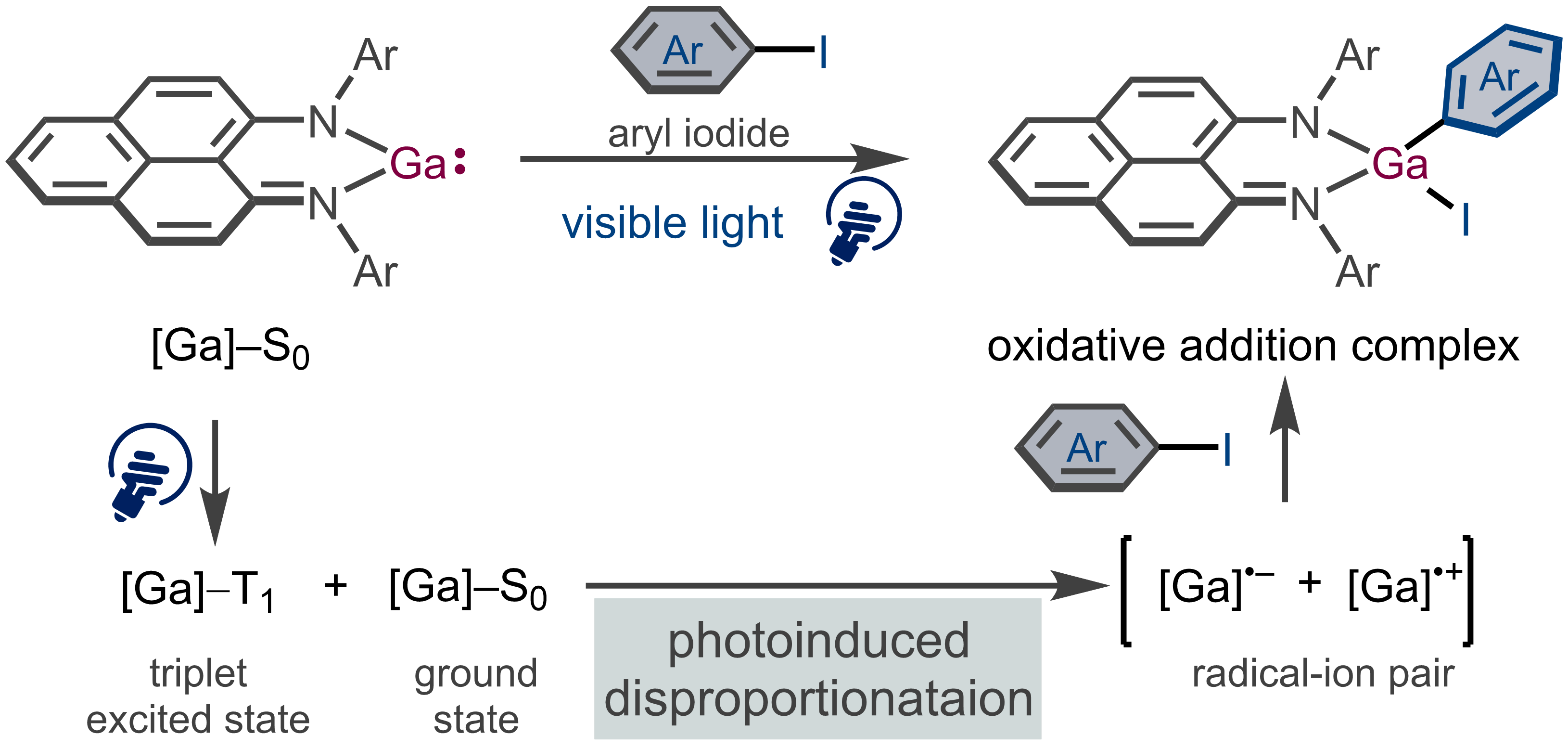

Oxidative addition is often carried out using transition metals and is challenging to perform at centers of more abundant main-group elements, particularly group 13 elements. Researchers at The University of Osaka, led by Takuya Kodama, achieved oxidative addition of an aryl iodide to a group 13 (gallium) center. The reaction is initiated by visible light. The reaction proceeds via a novel mechanism, photoinduced disproportionation, whereby photoexcited gallium exchanges electrons with ground-state gallium.
Fig. 1
Oxidative addition of aryl iodides at gallium(I) center via photoinduced disproportionation.
Original content, Only noncommercial uses of the work are permitted, Takuya Kodama
Researchers at the University of Osaka use visible light to enable transition-metal-like bond activation at a main-group element
Osaka, Japan – Cross-coupling reactions have revolutionized the synthesis of complex pharmaceuticals and polymers from simpler, commercially available products. An important first step in these reactions is oxidative addition, which is often facilitated using transition metals such as palladium and nickel. However, achieving the same transformation with more abundant main-group elements, found in groups 1–2 and 13–18 of the periodic table, remains a major challenge for many important substrates, particularly aryl halides.
Now, researchers at the University of Osaka have used visible light to enable oxidative addition of aryl halides at a group 13 element, gallium. These findings were published in the Journal of the American Chemical Society.
Oxidative addition is a reaction whereby a metal inserts into a chemical bond and forms two new bonds. Transition metals have traditionally been the metals of choice for this process. However, making use of these metals can be challenging, as they are relatively rare and expensive.
Main-group elements are abundant, but using them as an alternative to transition metals is not always straightforward. Although oxidative addition at main-group centers has advanced rapidly in recent years, reactions involving aryl halides, aromatic organic compounds containing a carbon–halogen bond, remain particularly difficult, especially for group 13 elements.
“The only known case of oxidative addition with a group 13 center is for aryl fluoride,” explains lead author, Nijito Mukai. “However, we were able to perform the reaction with an aryl iodide, an important species in chemical synthesis.”
The team discovered that visible light could unlock oxidative addition of aryl iodides at a gallium center, group 13 element.
The reaction was found to proceed via a novel mechanism, photoinduced disproportionation. In a disproportionation reaction, an element in the reactant is transformed into both higher and lower oxidation states. The result can then be used in further organic reactions.
“In our strategy, photoexcited gallium exchanges electrons with ground-state gallium to produce a radical ion pair,” reports senior author, Takuya Kodama. “Photoinduced disproportionation could represent a distinct activation mode for achieving transition-metal-like oxidative addition at main-group centers.”
This discovery could open new opportunities for developing novel sustainable catalytic processes involving main-group elements. This, in turn, may reduce the need to use rare and expensive transition metals.
###
The article, “Photoinduced Disproportionation Enables Oxidative Addition of Aryl Iodides at a Gallium(I) Center,” will be published in the Journal of the American Chemical Society at DOI: https://doi.org/10.1021/jacs.6c08303.
About The University of Osaka
The University of Osaka was founded in 1931 as one of the seven imperial universities of Japan and is now one of Japan's leading comprehensive universities with a broad disciplinary spectrum. This strength is coupled with a singular drive for innovation that extends throughout the scientific process, from fundamental research to the creation of applied technology with positive economic impacts. Its commitment to innovation has been recognized in Japan and around the world. Now, The University of Osaka is leveraging its role as a Designated National University Corporation selected by the Ministry of Education, Culture, Sports, Science and Technology to contribute to innovation for human welfare, sustainable development of society, and social transformation.
Website: https://resou.osaka-u.ac.jp/en
Advertisement