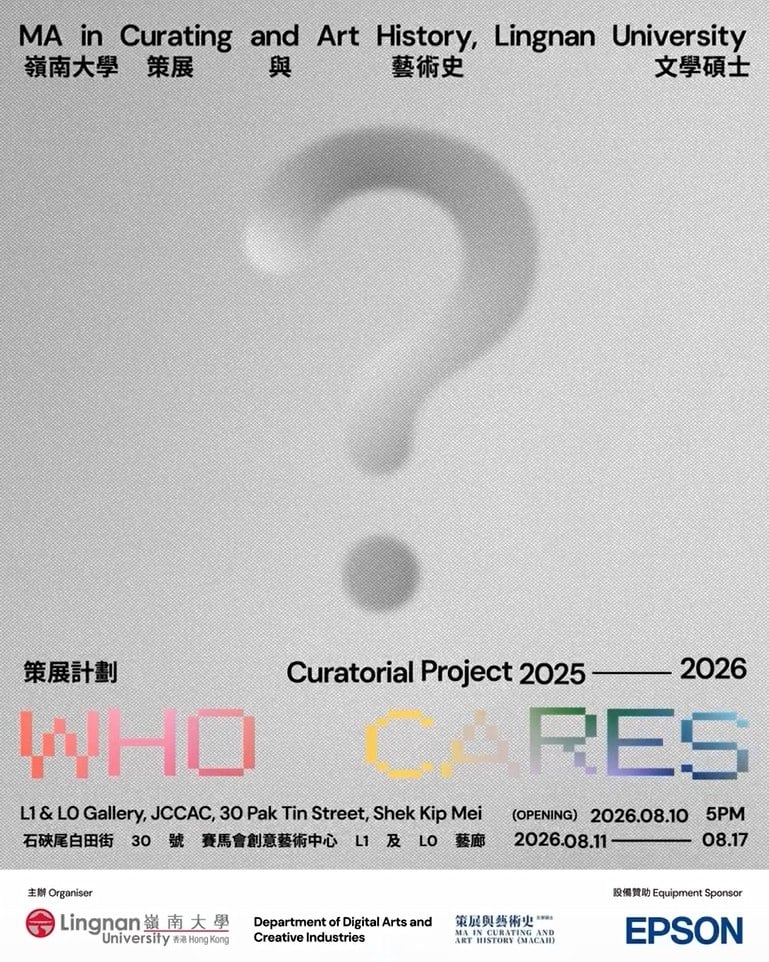
Lingnan University Master’s students present "Who Cares?", an exhibition of diverse perspectives on care curated by a new generation of art professionals.
Several key works reflect the high-pressure emotional dilemmas prevalent in contemporary society. Renowned Chinese contemporary artistMr Yang Zhenzhong’s I Will Die (Photo 2), which he started in 2000, has people of different ages and backgrounds facing the camera and sharing their fears of mortality. Hong Kong artist MsChloë Cheuk’s I am fine, I am good, I am happy(Photo 3) uses a printer to print continuously positive statements until the machine gradually wears out, showing the absurd predicament of how people experiencing anxiety, exhaustion, and sorrow are forced to put on a brave face. The endless jumping in visual artist Mr Tung Wing-hong’s Hundred Jumps (Photo 4) suggests the inescapable pressures of life, while the scorched text in Ms Xiao Jing’s Scorched Longing (Photo 5) conveys the helplessness and silence of sudden loss.
Mr Gordon Lo, teaching staff for the MACAH programme at Lingnan University and consulting curator for the exhibition, noted that "care" has long been a core premise defining the role of the curator, and comes from the Latin word curare, which means to look after or to attend to. He pointed out, "This exhibition aims to enable students, while curating, to return to this origin and rethink what care means, closely connecting art with their own experiences as well as social issues. Through six sub-themes, the exhibition explores different perspectives of care, inviting audiences to embark on a journey of emotional categorising and self-reflection."
Mr Lo added that the exhibition not only highlights the curatorial potential of the younger generation, but also allows young people to practise the vital roles and duties of a curator. Starting from the premise of care, they use curatorial interpretations to explore self-care, emotional displacement, loss, memory, and everyday labour. The six sub-themes are:
- Wrinkles of Mind focuses on self-care. Drawing on the physical phenomenon of wrinkles formed by external forces, it serves as a metaphor for shifts in inner states. Through video, installation, and mixed-media artworks, viewers are invited to initiate a sensory dialogue on self-exploration.
- ME=me me≠ME . Who cares about me? is about reclaiming inner agency. It asks viewers to confront the personal feelings often neglected in modern life, and to reveal the complex tension between social expectations and the preservation of self.
- After Loss examines grief. Rather than treating mourning as a temporary stage before “returning to normal", it presents grief as a circuitous and recurring process, encouraging viewers to imagine continuing to live with absence after farewell.
- The Echo of Memory treats memory as an act of care. Viewers are reminded through ceramics, cyanotype photography, painting, and installation art that caring and paying attention are choices, and that this is how a memory becomes a memory.
- The Lingering Warmth of Everyday seeks traces of the warmth left behind in daily life. Beginning with familiar objects such as childhood toys, faded photographs, and worn belongings, visitors are invited to rediscover the emotional residue embedded in everyday experiences.
- Gazing in Ink: Seeing People, Seeing Emotions explores the relationship between ordinary people and the city through traditional Chinese ink artworks. It extends the question of care into urban life and labour, highlighting the connection between workers and urban realities.