Conventional strategies often lead to the uncontrolled diffusion of ligand molecules into the perovskite bulk or their severe loss during solvent washing, failing to form an effective ligand layer. The research team proposes a novel strategy that successfully immobilises the ligand molecules onto the SAM molecules, constructing a localised 2D/3D structure.
The joint research team, comprising Prof Chen Xi, Dean of the WJYSIS and Chair Professor of Interdisciplinary Studies at Lingnan University; Prof Wu Shengfan, Assistant Professor (Presidential Early Career Scholar) of the WJYSIS at Lingnan University, and colleagues from the City University of Hong Kong, has developed a novel method to form a localised 2D/3D structure within the perovskite solar cell, reducing energy loss and improving charge extraction efficiency and interfacial contact. At the same time, by utilising tandem solar cell technology, in which the top material absorbs short-wavelength light and the bottom material absorbs long-wavelength light. This arrangement substantially improves light utilisation efficiency.
The team explained that this innovative technology optimises the solar cell in multiple ways. Firstly, it improves the quality of the thin film, allowing this light-absorbing material to grow more uniformly, thereby reducing intrinsic defects. Secondly, the technology greatly reduces defect density at the interfaces, suppressing undesirable energy loss and thus minimising voltage loss. The technology also improves the energy level alignment at the interface, enabling more efficient charge extraction.
The research team has successfully developed highly efficient and stable wide-bandgap perovskite solar cells, setting multiple cell performance records. The cell demonstrated excellent performance during long-term operational testing, maintaining over 95 per cent of its efficiency even after continuous operation for 700 hours. According to the team’s projections, the efficiency of this cell can still be maintained at over 90 per cent after 1,800 hours of long-term operation. Meanwhile, based on this technology, the power conversion efficiency of the perovskite-organic tandem solar cell reaches 27.11 per cent, among the highest efficiencies for this type of tandem solar cells.
Prof Wu, co-corresponding author of the paper, said “This achievement builds upon our sustained and in-depth exploration of interface engineering and tandem photovoltaic devices. It provides a reliable foundation for future large-scale applications. We will continue to drive the advancement of related technologies toward commercialisation, transforming efficient and stable energy solutions into commercial products to address climate challenges and energy security needs, contributing to societal sustainable development.”
Prof Chen Xi commended the outcome highly, saying “Lingnan has been actively promoting interdisciplinary research in recent years. This breakthrough demonstrates the University’s strengths and commitment to tackling global energy challenges and developing clean energy technologies. Our team will continue to transform innovative research achievements into practical solutions, supporting the global transition towards a green and low-carbon future.”
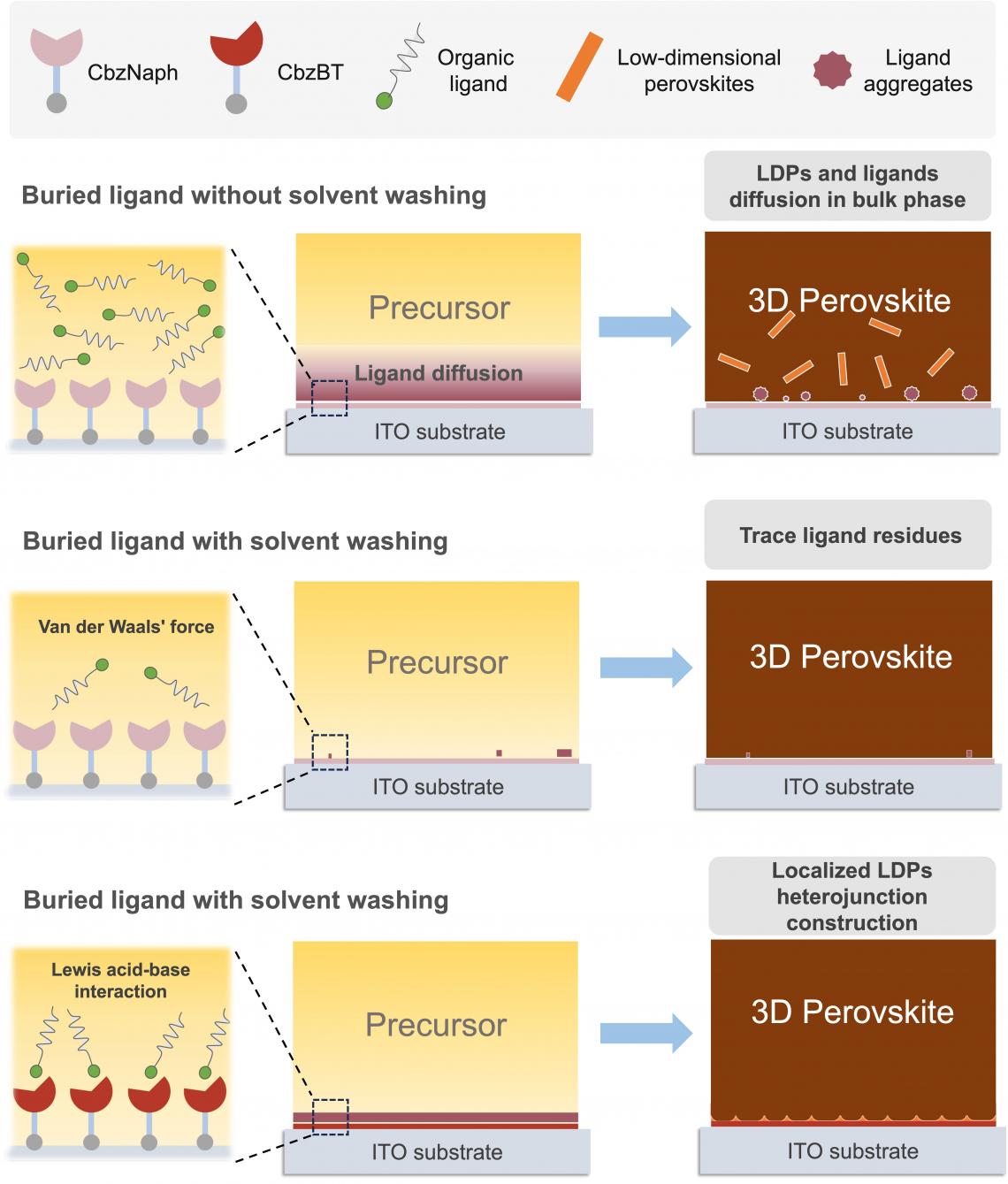
Conventional strategies often lead to the uncontrolled diffusion of ligand molecules into the perovskite bulk or their severe loss during solvent washing, failing to form an effective ligand layer. The research team proposes a novel strategy that successfully immobilises the ligand molecules onto the SAM molecules, constructing a localised 2D/3D structure.
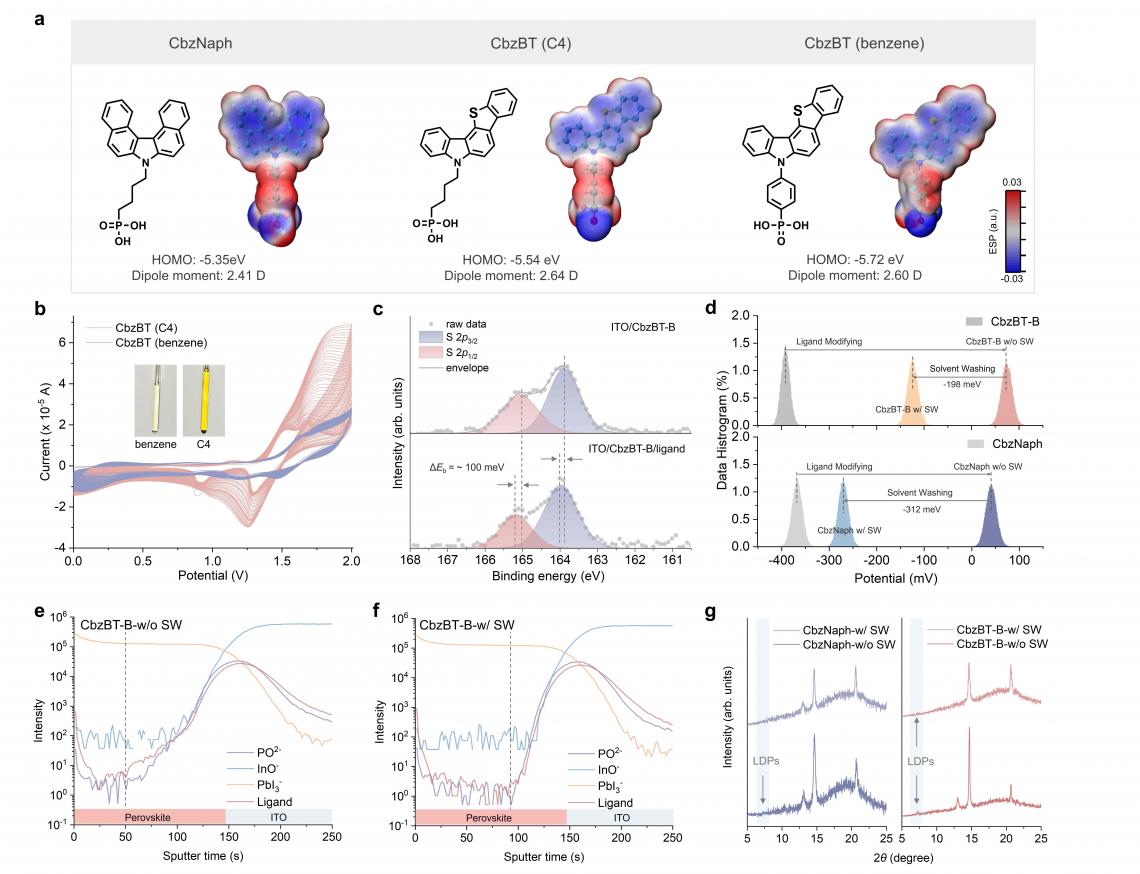
The figure illustrates the novel SAM molecule designed by the team, named CbzBT-B. This molecule exhibits excellent stability, and its energy levels are better aligned with the perovskite. The sulfur atoms within this molecule can interact with the ligands, ensuring the formation of a localised 2D/3D perovskite heterojunction structure at the bottom interface.
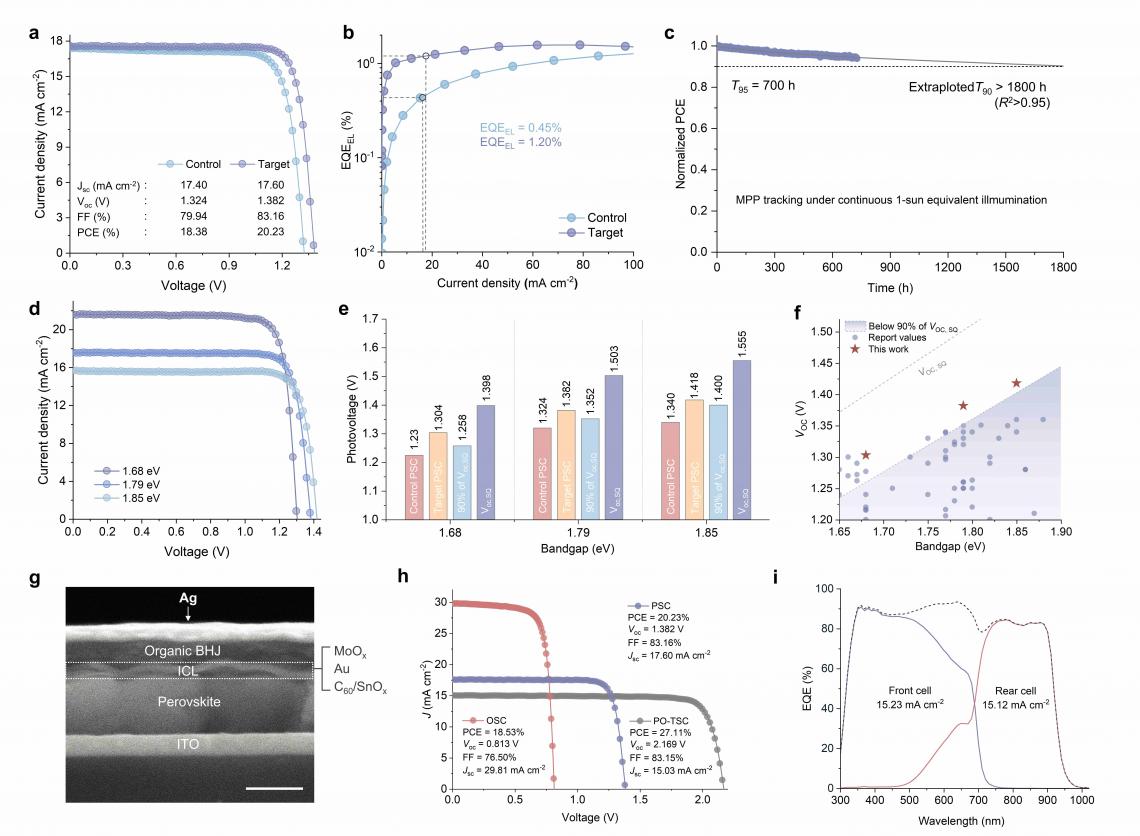
Solar cell test results indicate that wide-bandgap perovskite solar cells employing this strategy achieve significant enhancements in open-circuit voltage and efficiency, while exhibiting excellent operational stability. This strategy is applicable to various wide-bandgap perovskite solar cells and has broken multiple performance records. Based on this, the team fabricated tandem solar cells, achieving a high efficiency of 27.11 per cent.
Advertisement