
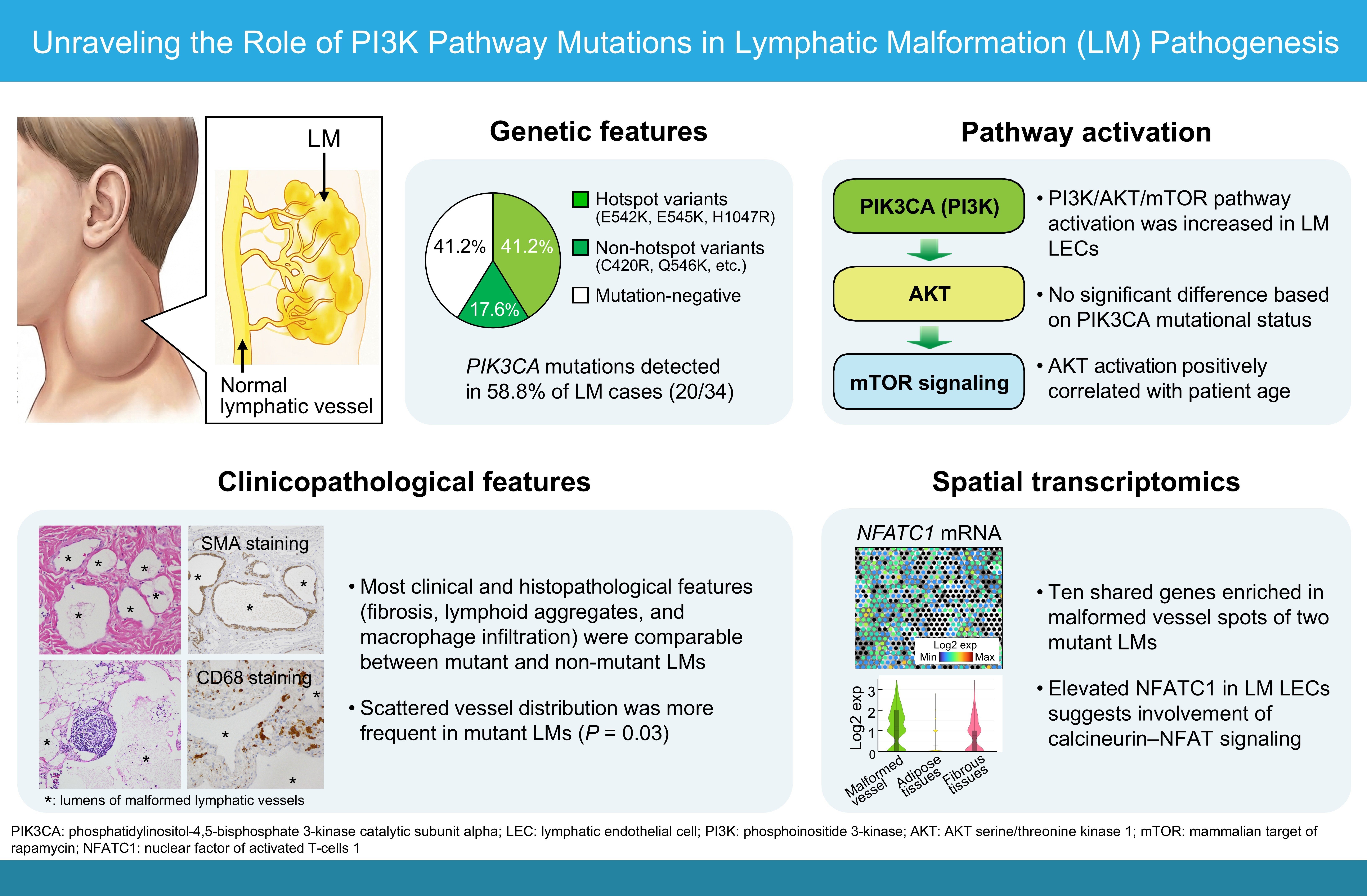

Researchers led by the University of Osaka analyzed lymphatic malformations from 34 patients and found shared molecular features regardless of whether PIK3CA mutations were detected. The PI3K/AKT/mTOR pathway was activated in malformed lymphatic vessels, while spatial transcriptomics highlighted NFATC1, associated with the calcineurin-NFAT pathway, as a possible contributor to the disease pathogenesis. The findings deepen the understanding of lymphatic malformations and may help refine existing treatments and identify new therapeutic targets.
Fig. 1
Graphic abstract
©Original content, Credit must be given to the creator. Adaptations must be shared under the same terms. No derivatives or adaptations of the work are permitted. Only noncommercial uses of the work are permitted., Hirose Katsutoshi
University of Osaka-led study reveals shared disease mechanisms across patients and points to a possible new treatment pathway
Osaka, Japan – Lymphatic malformations are rare disorders in which lymph vessels develop abnormally, often beginning in childhood and sometimes causing swelling, infection, bleeding, pain, or airway obstruction. Researchers led by the University of Osaka have combined genetic analysis with detailed examination of patient tissues to uncover common features of the disease and identify molecular clues that could inform future treatment strategies.
The team analyzed tissue samples from 34 patients. Changes in the PIK3CA gene, which are known to contribute to abnormal lymphatic vessel growth, were detected in 20 patients, or 58.8%. Most clinical features were similar whether a mutation was detected, but malformed vessels showed a more scattered growth pattern in patients carrying PIK3CA mutations.
The researchers also found that a major cell-growth signaling system, the PI3K/AKT/mTOR pathway, was more active in malformed lymphatic vessels than in normal vessels regardless of PIK3CA mutation status. AKT activity also increased with patient age. These findings are consistent with the clinical effectiveness of sirolimus, a drug that targets this pathway, across patients with lymphatic malformations.
To search for additional disease-related molecules, the team performed spatial transcriptomic analysis in two PIK3CA-mutant cases. Ten genes were commonly more active in malformed lymphatic vessels. Among them, NFATC1 was strongly expressed in the endothelial cells lining malformed lymphatic vessels. The findings suggest that the calcineurin-NFAT pathway may also contribute to the disease pathogenesis and could represent a future therapeutic target.
“We succeeded in providing a more integrated view of lymphatic malformations, from genetic changes to pathological morphology and molecular activity. We hope that this may help refine existing treatments while guiding the search for new ones,” says first author Katsutoshi Hirose.
###
The article, “Comprehensive Molecular and Clinicopathological Profiling of Lymphatic Malformations,” was published in Laboratory Investigation at DOI: https://doi.org/10.1016/j.labinv.2026.106168
About The University of Osaka
The University of Osaka was founded in 1931 as one of the seven imperial universities of Japan and is now one of Japan's leading comprehensive universities with a broad disciplinary spectrum. This strength is coupled with a singular drive for innovation that extends throughout the scientific process, from fundamental research to the creation of applied technology with positive economic impacts. Its commitment to innovation has been recognized in Japan and around the world. Now, The University of Osaka is leveraging its role as a Designated National University Corporation selected by the Ministry of Education, Culture, Sports, Science and Technology to contribute to innovation for human welfare, sustainable development of society, and social transformation.
Website: https://resou.osaka-u.ac.jp/en
Advertisement