
Researchers at the University of Osaka developed a simple two-step culture system that turns human blood-derived B cells into germinal center-like B cells using CD40L, IL-4, and IL-21 in a specific sequence. The resulting cells closely resemble genuine human germinal center B cells and undergo somatic hypermutation. The platform provides a practical tool for studying antibody formation directly in human cells and may support future vaccine and autoimmune disease research.
Fig. 1
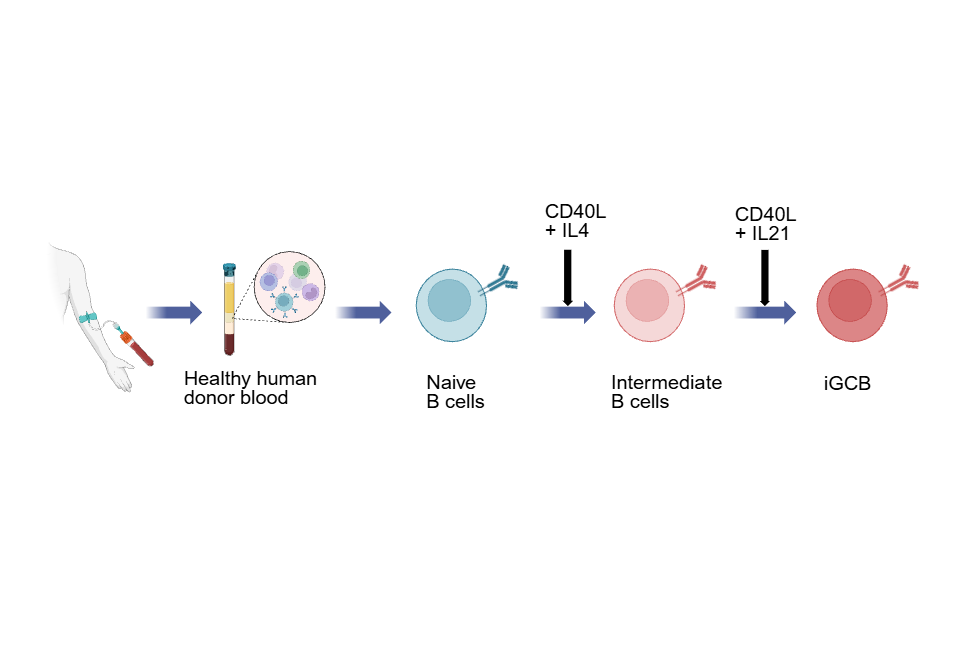
In vitro induction of human germinal center B cells. Naive B cells from human blood are first isolated and then cultured with a two-step differentiation method that allows them to form in vitro germinal center-like B (iGCB) cells
CC BY-ND, Credit must be given to the creator. No derivatives or adaptations of the work are permitted., Created in BioRender. Wing, J. (2026) https://BioRender.com/i3m0psk
Three immune signals delivered in sequence produce human B cells with germinal center features
Osaka, Japan – Researchers at the University of Osaka have developed a simple culture method that converts B cells isolated from human blood into cells resembling germinal center B cells, the cells that refine antibodies after infection or vaccination. The method uses only three signals normally supplied by helper T cells, delivered in a precise sequence. The resulting in vitro germinal center-like B cells, or iGCB cells, reproduced major molecular features of their counterparts in human tonsils and underwent somatic hypermutation, the process that alters antibody genes. This study was published in Science Immunology.
Germinal centers form in lymph nodes and tonsils after infection or vaccination. There, B cells multiply, alter their antibody genes, and compete so that cells producing better-fitting antibodies survive. Human germinal center B cells are difficult to obtain and manipulate, and previous culture systems had not fully reproduced their molecular features.
The team first stimulated naive B cells with soluble CD40L and IL-4, then replaced IL-4 with IL-21 after four days. This sequence activated BCL6, a key regulator of the germinal-center program, and generated in vitro germinal center-like B cells (iGCB cells). Reversing the cytokine order, or keeping IL-4 present, did not work. As shown in Figure 1, the method uses a two-step differentiation process. The resulting iGCB cells closely matched human tonsil germinal center B cells in surface markers, transcription factors, and DNA-repair machinery, and they underwent somatic hypermutation, although affinity maturation was not detected.
Because the system uses only three defined signals, researchers can add or remove individual factors and directly test what promotes or blocks human germinal center formation. This could help improve vaccine-induced antibody responses and identify targets relevant to autoimmune disease.
“The germinal center is where the immune system fine-tunes its antibodies. What surprised us most was how little it took: three signals, given in the right order, and human B cells will build the germinal center program themselves. I hope this gives the field a straightforward way to investigate the signals that drive human germinal center B cells and helps support research on better vaccines and autoimmune disease,” said Dr. James B. Wing, corresponding author.
###
The article, “In vitro induction of human germinal center B cells,” was published in Science Immunology at DOI: https://doi.org/10.1126/sciimmunol.aeg5223
About The University of Osaka
The University of Osaka was founded in 1931 as one of the seven imperial universities of Japan and is now one of Japan's leading comprehensive universities with a broad disciplinary spectrum. This strength is coupled with a singular drive for innovation that extends throughout the scientific process, from fundamental research to the creation of applied technology with positive economic impacts. Its commitment to innovation has been recognized in Japan and around the world. Now, The University of Osaka is leveraging its role as a Designated National University Corporation selected by the Ministry of Education, Culture, Sports, Science and Technology to contribute to innovation for human welfare, sustainable development of society, and social transformation.
Website: https://resou.osaka-u.ac.jp/en
Advertisement