
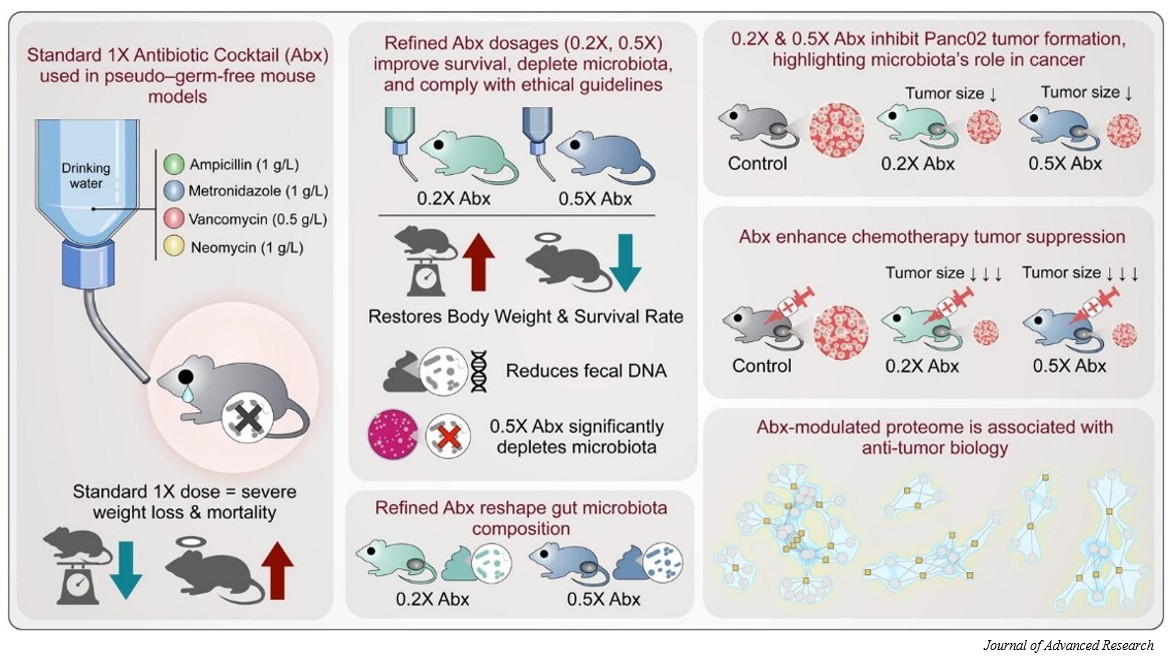

Researchers at National Taiwan University refined a pseudo-germ-free mouse model to make gut microbiome studies safer for mice and more reliable. Using this model, they found that antibiotic-driven changes in gut microbes suppressed pancreatic tumor growth and enhanced the effect of gemcitabine chemotherapy.
National Taiwan University researchers refined a pseudo-germ-free mouse model and showed that antibiotic-driven microbiota modulation can suppress pancreatic cancer growth and improve chemotherapy response.
Journal of Advanced Research
Pancreatic cancer is one of the most difficult cancers to treat, and researchers are increasingly studying how gut microbes may influence cancer growth and treatment response. To investigate this connection, scientists often use animal models in which gut bacteria are greatly reduced by antibiotics. These animals are known as pseudo-germ-free mice.
Although this approach is widely used in microbiome research, standard antibiotic doses can cause serious side effects, including reduced food and water intake, severe body weight loss, and even death. These problems make the model difficult to use and raise important animal welfare concerns.
A research team from National Taiwan University refined this model by lowering the dose of a commonly used antibiotic cocktail while maintaining effective microbiota depletion. The team tested different antibiotic concentrations and found that reduced-dose regimens could strongly decrease gut bacterial levels while causing less body weight loss and better survival.
The study, published in Journal of Advanced Research, also showed that adding sucrose to improve taste did not provide clear benefits and may even promote residual bacterial growth.
After establishing this refined pseudo-germ-free mouse model, the researchers used it to study pancreatic ductal adenocarcinoma, a major form of pancreatic cancer. Mice treated with the lower-dose antibiotic regimens developed smaller tumors than untreated mice. Similar findings were observed in germ-free mice, supporting the idea that gut microbes can contribute to pancreatic tumor progression.
The team also tested whether microbiota modulation could affect chemotherapy response. When antibiotic treatment was combined with gemcitabine, a chemotherapy drug commonly used for pancreatic cancer, tumor suppression was stronger than with either treatment alone. Protein analysis of tumor tissues further showed that antibiotic-treated mice had changes in cancer-related pathways, including reduced tumor-supporting metabolism and inflammation, as well as increased pathways related to tumor cell stress and death.
Together, these findings show that the refined pseudo-germ-free mouse model can serve as a safer and more reliable tool for microbiome research. The results also suggest that changing the gut microbiome may influence pancreatic cancer progression and improve the response to chemotherapy.
“Our study provides a safer and more reproducible pseudo-germ-free mouse model for studying how gut microbes affect disease,” says co-corresponding author Prof. Wei-Kai Wu at Graduate Institute of Microbiology. “By reducing the antibiotic dose, we were able to improve animal welfare while still achieving effective microbiota depletion.”
“These findings highlight the important role of the gut microbiome in pancreatic tumor growth and chemotherapy response,” says Ming-Shiang Wu, distinguished professor of internal medicine at National Taiwan University. “They suggest that microbiome modulation may become a useful strategy to support future cancer treatment.”
Prof. Wei-Kai Wu's email address: [email protected]
Prof. Ming-Shiang Wu‘s email address: [email protected]
Advertisement