
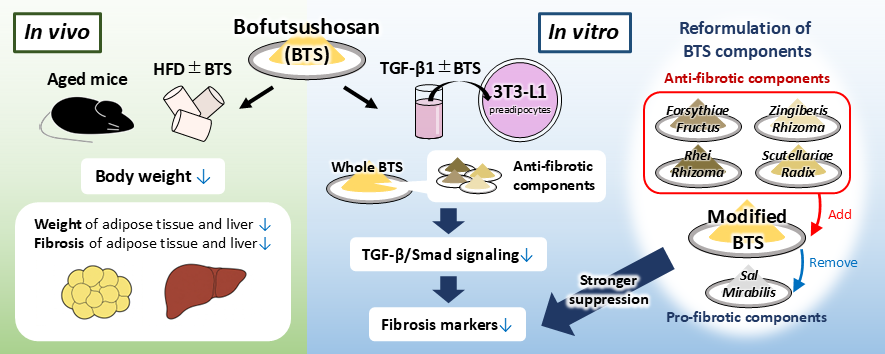

Researchers at the University of Osaka found that Bofutsushosan, a Kampo medicine used for obesity, reduced fibrosis-related changes in fat tissue and the liver of aged male mice. Cell experiments suggested that Bofutsushosan also had a direct effect on fibrosis-related signals, partly through the TGF-β/SMAD2/3 pathway. Four ingredients showed particularly strong anti-fibrotic activity, while some mineral ingredients showed the opposite effect under cell-culture conditions. Adjusting the formula strengthened the suppression of some fibrosis-related markers in cultured cells. However, the modified formulas have not been tested in animals or people, and further research is required before the findings can guide treatment.
Fig. 1
Graphical Abstract
CC BY, 2026, Ayano Onishi, et al., Identification of anti-fibrotic components of Bofutsushosan under conditions of age-associated obesity in mice, Phytomedicine
A Japanese research group found that Bofutsushosan reduced age-related fibrosis in fat tissue and the liver of mice with obesity and identified herbal components that may help strengthen its effects
Osaka, Japan - A traditional Japanese medicine used for obesity may do more than support weight loss. Researchers at the University of Osaka, working with Kobayashi Pharmaceutical Co., Ltd. investigated whether Bofutsushosan could protect aging tissues from fibrosis - the excessive buildup of scar-like tissue that can make organs stiff and less functional. The study was published in Phytomedicine.
Aging and obesity can promote chronic inflammation and fibrosis in fat tissue and organs such as the liver, heart, and kidneys. Although Bofutsushosan contains 18 crude-drug ingredients and is widely used in Japan for obesity, its effects on fibrosis associated with aging and obesity, and the contribution of each ingredient, remained unclear.
The team fed 63-week-old male mice a high-fat diet with or without 2% Bofutsushosan for eight weeks. Mice receiving Bofutsushosan weighed 14.8% less than untreated mice at the end of the study. They also ate less, had smaller fat deposits, showed less fat buildup in the liver, and had fewer fibrosis-related changes in fat tissue and the liver.
Because weight loss itself can improve fibrosis, the researchers also used cultured fat-cell precursors to investigate whether Bofutsushosan had a more direct effect. In these cells, Bofutsushosan reduced several fibrosis-related signals and partly suppressed the TGF-β/SMAD2/3 pathway, which helps drive the buildup of scar-like tissue.
The researchers then tested the 18 ingredients separately. Forsythiae Fructus, Zingiberis Rhizoma, Rhei Rhizoma, and Scutellariae Radix showed particularly strong anti-fibrotic activity in cultured cells. Some mineral ingredients, particularly Sal Mirabilis, showed the opposite effect under the same cell-culture conditions.
The researchers caution that this finding does not show that Sal Mirabilis promotes fibrosis in the body or during clinical use. The effect may be specific to the cell-culture environment. Increasing the amounts of the four candidate anti-fibrotic ingredients, with or without removing Sal Mirabilis, produced stronger suppression of some fibrosis-related markers in cultured cells. The modified formulas have not yet been tested in animals or people.
The findings suggest that Bofutsushosan may have benefits beyond weight control and provide a scientific basis for studying how the ingredients in multi-component Kampo medicines work together.
The results are preclinical and do not support changing the approved formula or altering treatment without medical advice. Further animal and human studies will be needed to determine whether this approach could eventually contribute to treatments for fibrosis associated with obesity and aging.
“Bofutsushosan is best known for its effects on obesity,” said lead author Ayano Onishi. “Our findings suggest that it may also act on fibrosis associated with aging and obesity. Understanding the role of each ingredient could help guide future research into Kampo medicines, but human studies will be needed before the findings can be applied to treatment.”
###
The article, “Identification of anti-fibrotic components of Bofutsushosan under conditions of age-associated obesity in mice,” was published in Phytomedicine at DOI: https://doi.org/10.1016/j.phymed.2026.158522
About The University of Osaka
The University of Osaka was founded in 1931 as one of the seven imperial universities of Japan and is now one of Japan's leading comprehensive universities with a broad disciplinary spectrum. This strength is coupled with a singular drive for innovation that extends throughout the scientific process, from fundamental research to the creation of applied technology with positive economic impacts. Its commitment to innovation has been recognized in Japan and around the world. Now, The University of Osaka is leveraging its role as a Designated National University Corporation selected by the Ministry of Education, Culture, Sports, Science and Technology to contribute to innovation for human welfare, sustainable development of society, and social transformation.
Website: https://resou.osaka-u.ac.jp/en
Advertisement