

National Taiwan University Hospital (NTUH), in collaboration with multiple medical centers across Taiwan, has found that patients with hepatitis C remain at a significantly elevated risk of hepatocellular carcinoma (HCC) even after successful viral eradication with direct-acting antivirals (DAAs), particularly if metabolic dysfunction–associated steatotic liver disease (MASLD) is present.
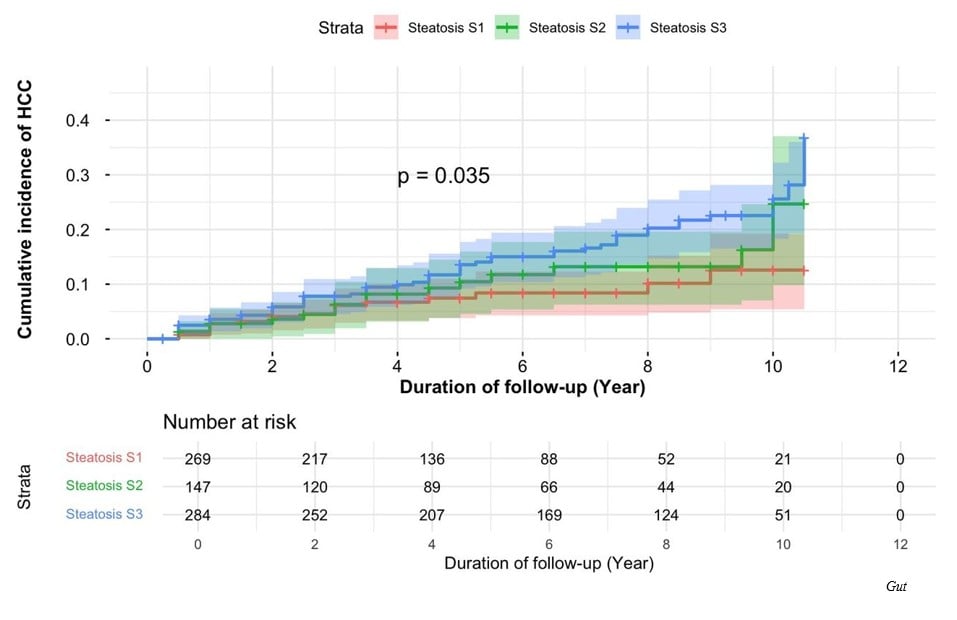
Cumulative incidence of hepatocellular carcinoma (HCC) with 95% CI in patients with MASLD with different hepatic steatosis grades. The cumulative incidence of HCC among patients with MASLD, stratified by hepatic steatosis grades S1, S2 and S3 (log-rank test, p=0.035). Pairwise comparisons of cumulative incidence of HCC using log-rank tests with Bonferroni correction between S1 versus S2 (p=0.86), S1 versus S3 (p=0.037) and S2 versus S3 (p=0.76). HCC, hepatocellular carcinoma; MASLD, metabolic dysfunction-associated steatotic liver disease.
Gut
National Taiwan University Hospital (NTUH), in collaboration with multiple medical centers across Taiwan, has found that patients with hepatitis C remain at a significantly elevated risk of hepatocellular carcinoma (HCC) even after successful viral eradication with direct-acting antivirals (DAAs), particularly if metabolic dysfunction–associated steatotic liver disease (MASLD) is present.
The study further demonstrates that among these patients, those with severe hepatic steatosis or diabetes/prediabetes face an approximately twofold higher risk of developing liver cancer, highlighting metabolic abnormalities as critical determinants of post-cure cancer risk.
This large-scale, longitudinal cohort study was led by Dr. Yu-Ping Chang of NTUH Hsin-Chu Branch and Dr. Yun-Chu Chen of the Department of Internal Medicine at NTUH, under the supervision of Vice Superintendent Prof. Jia-Horng Kao and Prof. Chen-Hua Liu of the Hepatitis Research Center.
The findings have been published in the leading international medical journal Gut, providing robust clinical evidence on residual liver cancer risk among patients cured of hepatitis C worldwide.
With the advent of highly effective and well-tolerated DAA therapies, more than 95% of patients with hepatitis C can now achieve viral clearance through short-term oral treatment. Although the overall risk of liver cancer can be reduced by approximately 80%, a subset of patients continues to develop HCC during long-term follow-up, indicating that viral eradication does not equate to complete elimination of cancer risk.
The research team previously reported in 2025, in the Journal of Hepatology, that patients with MASLD after viral clearance had a twofold increased risk of liver cancer compared to those without fatty liver. The current study further refines these findings, identifying two major risk amplifiers among patients with MASLD:
.Severe hepatic steatosis (vs. mild steatosis)
.Diabetes or prediabetes (vs. normoglycemia)
Each of these factors independently contributes to an approximate doubling of HCC risk, suggesting that metabolic dysfunction continues to drive hepatocarcinogenesis even after viral clearance.
NTUH emphasized that these findings carry significant implications for the long-term management of patients cured of hepatitis C. The results support more precise risk stratification and surveillance strategies in clinical practice.
Furthermore, the study underscores that active management of metabolic risk factors, including control of fatty liver and blood glucose through lifestyle modification and appropriate medical intervention, may help further reduce the incidence of liver cancer.
“While more than 95% of patients with HCV infection can achieve viral cure following a short course of potent and safe DAAs, the presence of MASLD remains a significant residual risk factor for HCC development after viral cure. Lifestyle modification, medical or surgical interventions, and prudent HCC surveillance are crucial for improving long-term liver-related health and prognosis in patients with MASLD, particularly those with severe hepatic steatosis and poor glycemic control,” says Prof. Jia-Horng Kao.
Prof. Jia-Horng Kao's email address: [email protected]
Advertisement