
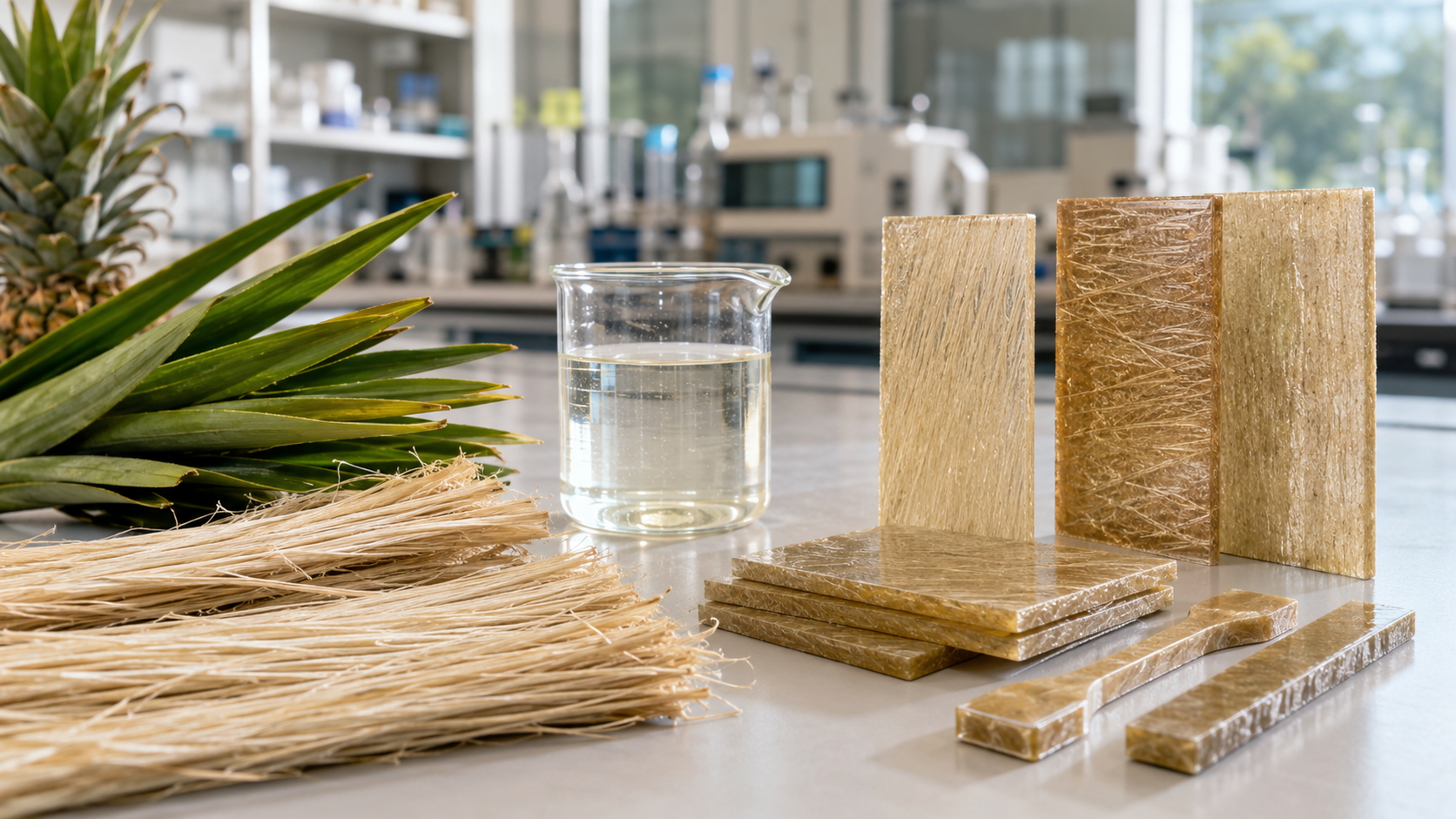

Pineapple leaf fibres gain strength through alkali treatment, supporting stronger and more sustainable biobased composites.
Pineapple leaf fibres can be strengthened through simple alkali treatment to produce more sustainable natural-fibre epoxy composites.
Alkali treatment has long been used to improve natural-fibre composites, but whether it actually strengthens the fibres themselves has remained unclear.
Pineapple leaf fibre has long been valued in parts of Southeast Asia for traditional uses, including basketry in Malaysia and Thailand and textile applications in the Philippines. Its high cellulose content and ready availability as an agricultural residue have also made it attractive as a reinforcement for polymer composites.
In a recent study, an international collaborative team from Mahidol University in Thailand and Newcastle University in Singapore examined how a simple and widely used alkali treatment can more consistently improve the structural and mechanical properties of pineapple leaf fibre for epoxy composite reinforcement.
Alkali treatment, usually carried out using sodium hydroxide, is already one of the most common methods for improving natural fibre composites. It is typically understood as a way to clean the fibre surface by removing non-cellulosic materials such as lignin and hemicellulose, thereby improving bonding between the fibre and polymer matrix.
However, this explanation is incomplete. Many previous studies have attributed better composite performance mainly to improved fibre–matrix adhesion, even though composite testing alone cannot easily separate interfacial effects from changes occurring within the fibre itself.
Moreover, improvements in the intrinsic mechanical properties of natural fibres after alkali treatment are not universal. While some fibre species show enhanced performance, others exhibit little improvement or even reduced stiffness following treatment. These differences suggest that the response to alkali treatment depends strongly on the internal structure of each fibre.
The new study shows that alkali treatment can strengthen the fibre itself, rather than merely improving its bonding with the surrounding polymer. Using X-ray diffraction, the researchers found that the cellulose I crystalline phase was retained, while the crystalline order of the fibre increased. This structural refinement was linked to the removal of amorphous components such as hemicellulose and lignin.
To measure the fibre’s intrinsic mechanical properties, the team used the Impregnated Fibre Bundle Test, which reduces the influence of fibre–matrix interfacial adhesion. The results showed that alkali treatment increased the fibre modulus from 18 to 29 GPa and the fibre strength from 390 to 530 MPa. These findings provide direct evidence that alkali treatment strengthens the fibre itself, rather than improving composite performance solely through better fibre–matrix bonding.
These fibre-level improvements translated into stronger composites. When 20 wt% treated pineapple leaf fibre was incorporated into epoxy, the resulting unidirectional composites showed increases of approximately 200% in flexural modulus, 180% in flexural strength and 400% in notched impact resistance compared with neat epoxy.
The findings help clarify why alkali treatment can work effectively for pineapple leaf fibre composites. Rather than improving performance only through better adhesion, the treatment can also reinforce the internal structure of the fibre itself. This provides a clearer basis for designing stronger, more reliable biobased composites from agricultural residues. Because pineapple leaves are an abundant agricultural by-product in many tropical countries, including Thailand, improving their reinforcing performance could increase the value of agricultural waste, reduce reliance on synthetic reinforcements, and support the development of sustainable materials within the circular bioeconomy. More broadly, the work illustrates how agricultural residues can be converted into value-added materials for advanced engineering applications.
The paper, “Effect of Alkali Treatment on the Mechanical and Structural Properties of Pineapple Leaf Fiber for Epoxy Composite Reinforcement”, by Thanistha Akarapoowadol, Kheng Lim Goh and Taweechai Amornsakchai, is published in ACS Omega. DOI: 10.1021/acsomega.5c07292.
Authors and affiliations
The study was carried out by Thanistha Akarapoowadol and Taweechai Amornsakchai from Mahidol University, Thailand; and Kheng Lim Goh from Newcastle University in Singapore.
For further details, contact:
Dr Kheng Lim Goh at [email protected]
Dr Taweechai Amornsakchai at [email protected]
Advertisement
Advertisement