

Subducted Carbonates Drive Deep Carbon Cycling and Reshape Mantle Discontinuity Structure
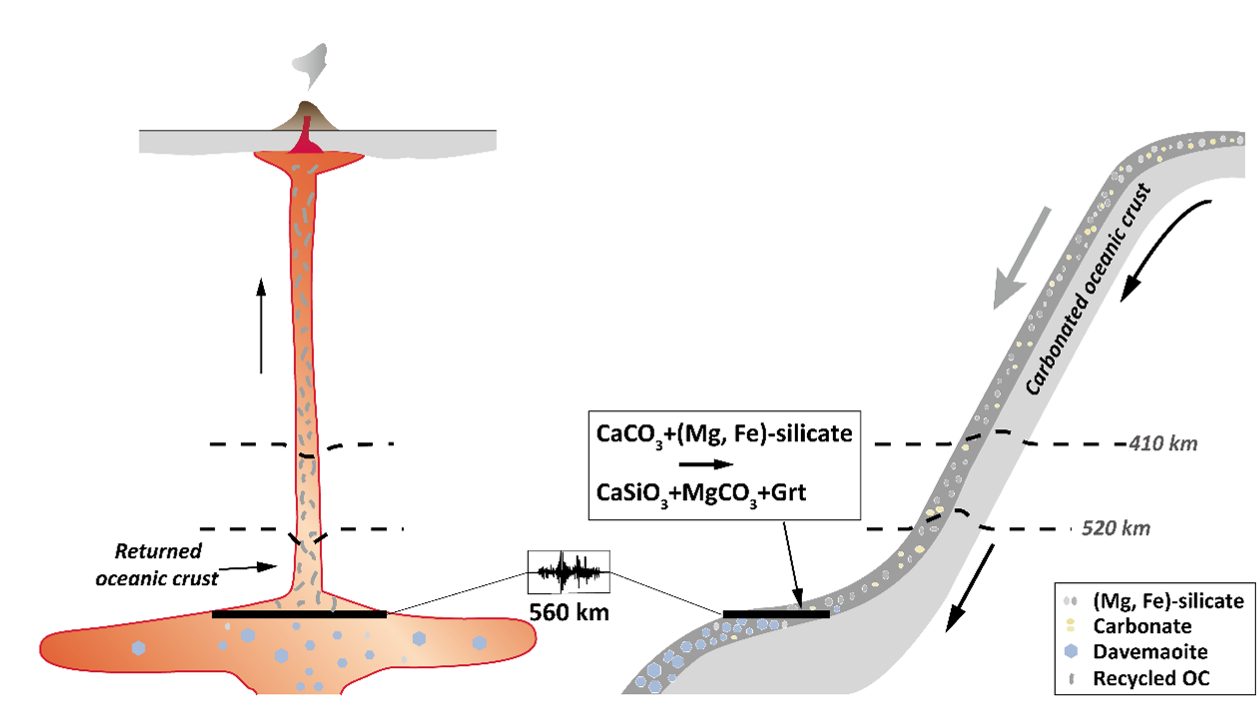
【Sketch of the formation of 520-km discontinuity splitting】Cartoon shows the proposed mechanism for the splitting of the 520-km discontinuity in the mid-transition zone. CaCO3 reacts with silicates in the carbonated oceanic crust during slab sinking, which greatly increases Ca contents in silicates. The exsolution of davemaoite from the Ca-enriched oceanic crust could be seismically detected to exhibit an ISS of 2–4% at 560-km depth. The upwelling plume could carry the ancient recycled altered oceanic crust back to the Earth’s surface with a great Ca content, which could also exhibit a seismic signature of 2–4% ISS at ~560-km depth. The transformation of light grey to dark grey means the increase of the amount of Ca in silicate, while the dark yellow to light yellow means the decrease of the amount of Ca in carbonate.
Zhang Youyue
Deep carbon cycling into Earth's mantle regulates fundamental processes such as melting, redox state, and volatile transport, yet its geophysical expression within seismic structures has remained elusive. A prominent seismic puzzle is the sporadic splitting of the 520-km discontinuity into a secondary reflector near 560 km depth beneath subduction slabs and mantle plumes. Although previously attributed to davemaoite (CaSiO3) exsolution, standard shear-wave properties of davemaoite failed to generate the observed 2–4% impedance contrast.
To resolve this discrepancy, researchers conducted high pressure-temperature experiments (~20 GPa, 1,200–1,600 °C) using a large-volume multianvil apparatus on compositions similar to carbonate-altered oceanic crust. The results reveal that carbonate addition drives significant Ca-Mg exchange with silicates and increases Ca incorporation into silicates specifically under Fe-rich conditions. This mechanism dramatically boosts davemaoite exsolution, concentrating the mineral to 12–33(2) vol.% near ~560 km depth—a level sufficient to account for the observed seismic impedance contrast.
Furthermore, davemaoite-rich crust recycled by mantle plumes explains the persistent 560-km seismic reflectors detected beneath hot thermal regions. Ultimately, this study demonstrates that subducted carbonates actively alter mineral phase equilibria, reinforce chemical stratification, and leave distinct, long-lasting seismic signatures of deep carbon cycling within Earth's interior.
Advertisement