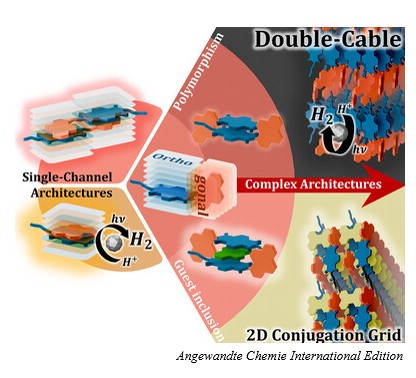

Researchers uncovered that an orthogonal molecular architecture directs the formation of a rare double-cable structure, offering a new blueprint for advancing the fundamental design of energy-active materials. By guiding charges to move along separate pathways, the new design minimizes energy loss and boosts clean energy generation.
Orthogonal molecular design drives the transition from conventional single-channel packing to rare double-cable and complex architectures, enabling efficient charge separation and enhanced solar hydrogen production.
Angewandte Chemie International Edition
In a recent study published in Angewandte Chemie International Edition, a research team has uncovered a surprisingly simple way to improve how materials convert sunlight into clean hydrogen fuel. Instead of relying on complicated chemical modifications, the scientists focused on how molecules arrange themselves in the solid state. They found that by carefully designing the shape and orientation of molecules, it is possible to control how energy and charges move after light absorption—one of the key challenges in solar energy conversion.
Traditionally, similar molecular systems tend to stack in a straightforward, one-dimensional manner, where electrons and holes remain close together and quickly recombine, wasting the absorbed energy.
In contrast, this team discovered that introducing an “orthogonal” arrangement—where key parts of the molecule are positioned at right angles—can lead to a very different packing pattern. This arrangement gives rise to a rare “double-cable” structure, in which electrons and holes travel along separate pathways. By physically separating these charges, the system reduces energy loss and allows more of the absorbed sunlight to be used productively.
What makes this discovery particularly exciting is its simplicity and generality. Rather than depending on complex synthesis or external additives, the strategy relies on molecular geometry as a guiding principle. This opens up new possibilities for designing next-generation materials for solar fuels and other energy-related applications, where controlling charge movement is essential for performance.
“This work demonstrates that molecular arrangement alone can govern how photoexcited energy is converted and utilized, thereby providing a new avenue to harness charge separation and transport beyond conventional design strategies,” says co-corresponding author Prof. Pi-Tai Chou.
“We demonstrate that simple molecular building blocks can self-organize into complex architectures with emergent functions, offering a new pathway toward the rational design of functional soft matter,” says Prof. Chien-Lung Wang from Department of Chemistry at National Taiwan University.
Prof. Pi-Tai Chou's email address: [email protected]
Prof. Chien-Lung Wang’s email address: [email protected]
Advertisement