This story is featured in the Asia Research News 2026 magazine. Book space in the next issue now.
Get the news in your inbox
An enormous amount of energy is wasted as heat in factories. On top of that, more energy is often used to cool electronics, from the fans in laptops to the complex cooling systems of data centres. Thermoelectric materials, which generate electricity from heat and vice versa, could help recover some of that waste heat or efficiently cool devices. But creating high-performance thermoelectric materials has been challenging. Thin film materials have potential, but so far only a specific type — called n-type thin films — has delivered high performance.
Researchers at Japan’s National Institute for Materials Science (NIMS) have developed a thin film material of the other type, a p-type film. Fabricating thermoelectric devices by coupling these with n-type films has long been a goal, but it’s been difficult to achieve high thermoelectric performance in p-type films. According to their paper, published in Science and Technology of Advanced Materials, the new material converts heat into power up to four times more efficiently than existing p-type films.
The film is made from a Heusler alloy and is composed of safe and low-cost materials, opening avenues not only for practical applications but for researchers to further investigate how thermoelectric materials work.

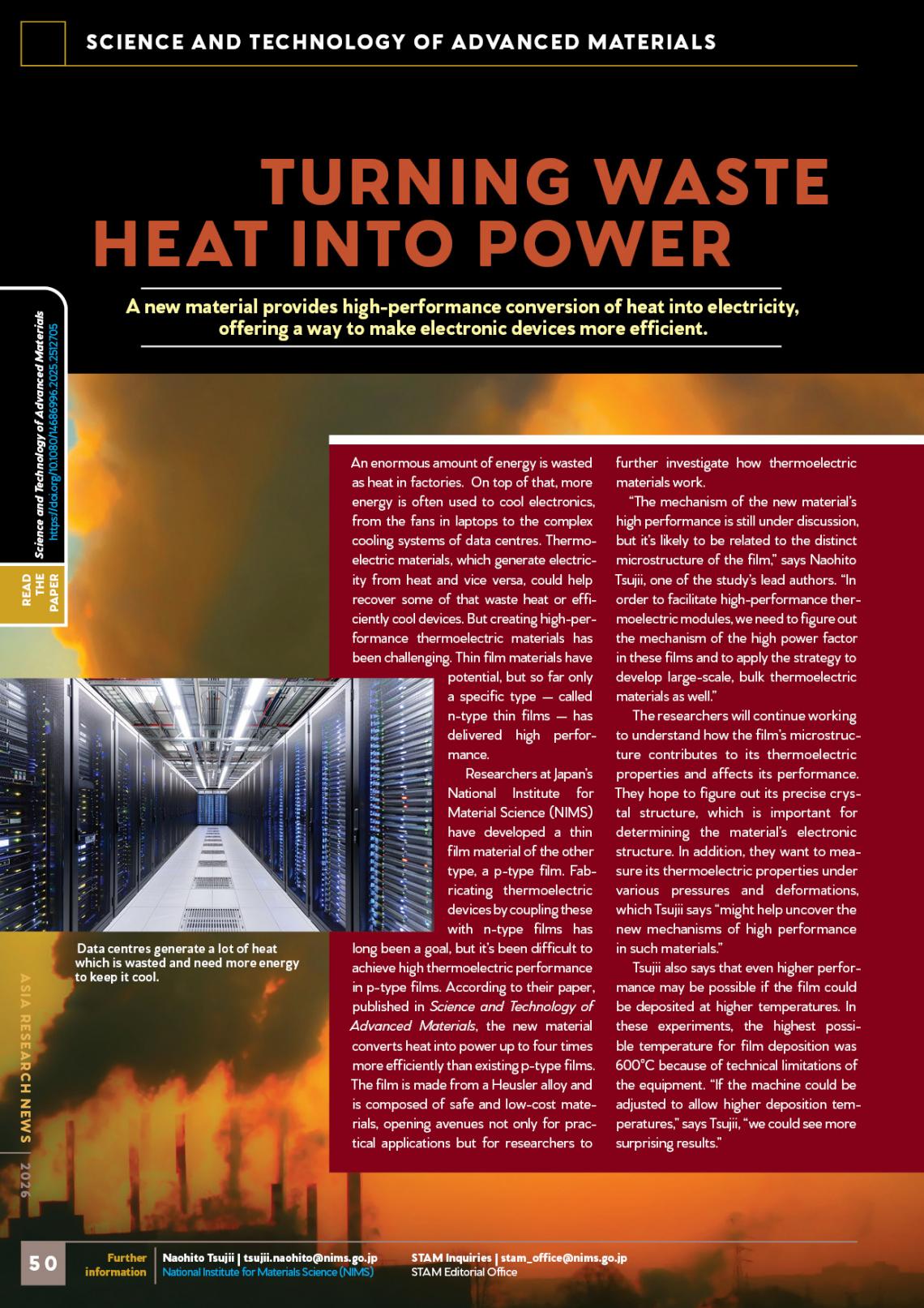
Data centres generate a lot of heat which is wasted and need more energy to keep it cool.
“The mechanism of the new material’s high performance is still under discussion, but it’s likely to be related to the distinct microstructure of the film,” says Naohito Tsujii, one of the study’s lead authors. “In order to facilitate high-performance thermoelectric modules, we need to figure out the mechanism of the high power factor in these films and to apply the strategy to develop large-scale, bulk thermoelectric materials as well.”
The researchers will continue working to understand how the film’s microstructure contributes to its thermoelectric properties and affects its performance. They hope to figure out its precise crystal structure, which is important for determining the material’s electronic structure. In addition, they want to measure its thermoelectric properties under various pressures and deformations, which Tsujii says “might help uncover the new mechanisms of high performance in such materials.”
Tsujii also says that even higher performance may be possible if the film could be deposited at higher temperatures. In these experiments, the highest possible temperature for film deposition was 600°C because of technical limitations of the equipment. “If the machine could be adjusted to allow higher deposition temperatures,” says Tsujii, “we could see more surprising results.”
Read the paper
Science and Technology of Advanced Materials: https://doi.org/10.1080/14686996.2025.2512705
Further information
Naohito Tsujii
[email protected]
National Institute for Materials Science (NIMS)
STAM Inquiries
[email protected]
STAM Editorial Office
Download this story

Advertisement