


To reduce plastic pollution and promote environmental sustainability, scholars from the Lingnan University School of Interdisciplinary Studies and their research team have developed a successful new eco-friendly bioplastic material. Unlike conventional plastics, it degrades naturally into harmless water and carbon dioxide in as little as 29 days under ambient conditions, and is a practical way to mitigate global plastic pollution. Their study, “Sustainable DNA-polysaccharide hydrogels as recyclable bioplastics”, was recently published in the respected journal Nature Communications.
A spoon made of the new DNA-polysaccharide bioplastic (right) designed from natural plant-derived molecular structures. When buried in soil with a conventional polyethylene (PE) spoon (left), the bioplastic fully degraded in as little as 29 days.
Lingnan University
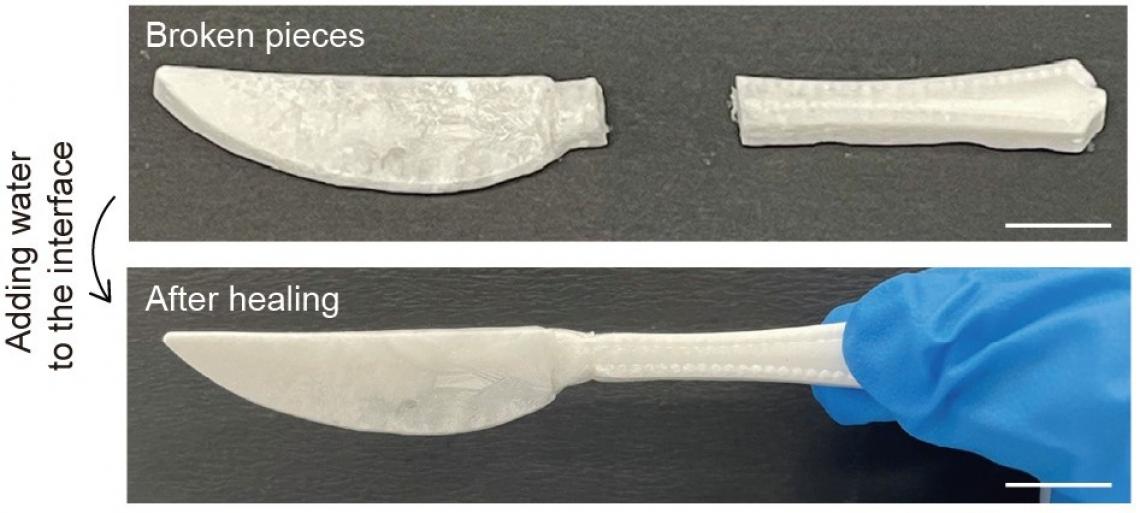
The bioplastic exhibits self-healing properties. Minor surface scratches or cracks can be repaired at room temperature by adding a little water, which restores the original molecular structure and load-bearing capacity.
Lingnan University
In 2023, Hong Kong discarded approximately 3.72 billion plastic shopping bags, or over ten million bags per day. To reduce plastic pollution and promote environmental sustainability, scholars from the Lingnan University School of Interdisciplinary Studies and their research team have developed a successful new eco-friendly bioplastic material. Unlike conventional plastics, it degrades naturally into harmless water and carbon dioxide in as little as 29 days under ambient conditions, and is a practical way to mitigate global plastic pollution. Their study, “Sustainable DNA-polysaccharide hydrogels as recyclable bioplastics”, was recently published in the respected journal Nature Communications.
The interdisciplinary research team includes Prof Chen Xi, Dean of the School of Interdisciplinary Studies (SIS) and Chair Professor of Interdisciplinary Studies at Lingnan University, and Prof Ke Yujie, Assistant Professor of SIS (first author), along with collaborators from North Carolina State University in the US, The Hebrew University of Jerusalem in Israel, the Agency for Science, Technology and Research (A*STAR) in Singapore, Nanyang Technological University in Singapore (NTU), the National University of Singapore (NUS), and the Singapore University of Technology and Design (SUTD). Together, they have developed a new type of biodegradable and recyclable bioplastic based on DNA-polysaccharide hydrogels derived from natural plant and biological waste sources. As durable as conventional plastics, the bioplastic is water-resistant and can be processed into sturdy sheets or pellets.
In soil-based simulation experiments, spoons made from the new bioplastic and conventional polyethylene (PE) were buried under ambient soil conditions, and completely degraded in as little as 29 days, driven by natural soil microorganisms leaving only water and carbon dioxide, whereas traditional PE spoons remained intact. Tests have also confirmed that the bioplastic’s molecular structure is biocompatible, dissolves under specific conditions for recycling, and remains stable when exposed to common organic solvents such as oils, alcohol, and detergents, ensuring safe everyday use.
Moreover, the bioplastic demonstrates a self-healing function. Experiments show that minor scratches or cracks on its surface can repair themselves when a little water is added at room temperature, restoring the original molecular structure and load-bearing capacity without heating or chemical treatment. Unlike commercially available biodegradable plastics such as polylactic acid (PLA), which require industrial composting and yield mixtures unsuitable for recycling into new plastics, this new material is truly recyclable.
Another important advancement is the extremely low microplastic residue generated during degradation. Animal experiments have confirmed no detectable microplastic accumulation in vivo, suggesting the material can effectively address one of the most challenging global environmental issues - microplastic pollution. Microplastics, formed from the breakdown of larger plastics, remain present in oceans and soil, and preventing their spread has become a key research focus. This study provides a solution that accelerates plastic recycling, reduces carbon emissions, and minimises secondary environmental and human health impacts.
Prof Chen Xi, Dean of SIS and Chair Professor of Interdisciplinary Studies at Lingnan University, said “Plastic decomposition can take hundreds of years, placing a long-term burden on landfills and threatening marine ecology and public health. This new material is not limited to shopping bags; it has potential applications in other plastic products, including disposable tableware. Its molecular structure can also be precisely engineered at the nanoscale for micro-components in electronics or high-tech materials. In normal use, it does not dissolve in water, and when recycled and exposed to specific enzymes, it can fully degrade in as little as 120 minutes. We believe this innovative material is a scientific breakthrough that will reduce plastic impact at source.”
Prof Ke Yujie, Assistant Professor of SIS at Lingnan University, added “Most commercial plastics are derived from non-renewable fossil fuels, contributing to carbon emissions and environmental burden. Our bioplastic is a sustainable alternative with a much lower carbon footprint. We aim to introduce eco-friendly shopping bags in the retail sector, which, coupled with recycling and reuse, should considerably alleviate landfill pressure in Hong Kong. We are also exploring applications with international partners in food packaging, logistics, and agriculture, aiming to gradually replace conventional plastics and contribute to a zero-plastic future for global sustainable development.”
This interdisciplinary research combines chemical engineering, environmental science, and materials technology, aligning with the United Nations Sustainable Development Goals (SDGs) on responsible consumption and production (SDG12), and climate action (SDG13). This biodegradable bioplastic demonstrates the important role of higher education in Hong Kong in assisting sustainable development.
Advertisement
Advertisement