The spatial resolution of X-ray CT systems commonly used in clinical practice is approximately 0.5 mm, which is insufficient for visualizing the fine internal bone microstructures known as trabeculae, whose thickness is typically 0.1–0.2 mm. To overcome this limitation, the research group conducted extensive investigations into the scanning mechanisms of CT systems, including the X-ray source, detector, and rotational drive mechanisms, and optimized them to a level capable of clearly depicting trabecular bone in the extremities.
As a result, the voxel size—representing the three-dimensional unit of reconstructed data—was successfully reduced to 0.08 × 0.08 × 0.08 mm³. Previously, CT systems with such extremely small voxel sizes were limited to experimental setups that could not be applied to the human body. The newly developed system enables very short-time scanning of the extremities, imposes minimal burden on subjects, and nonetheless provides clear visualization of fine bone microstructures.
The system has already been completed in a configuration suitable for clinical application, and it is expected to contribute to accurate diagnosis of bone diseases and traumatic injuries of the hands and feet in the future.
This research was published online on November 13, 2025, in the specialized journal Skeletal Radiology.
Background
Whole-body X-ray CT systems are currently the mainstream in clinical practice, but their spatial resolution, approximately 0.5 mm, is insufficiently fine. While they allow gross assessment of the morphology of the bones of the hands and feet, they cannot depict trabecular bone structures (0.1–0.2 mm). Although a small number of extremity-dedicated CT systems have received medical device approval, their resolution remains comparable to that of whole-body systems (0.3–0.5 mm), and they suffer from inferior image contrast.
There have been research attempts to use small-animal CT systems for imaging the human hand; however, these approaches required extremely long scan times (approximately 2 minutes) and provided only a very limited imaging range (approximately 10 mm), rendering them impractical for clinical use.
Therefore, this research group aimed to develop a novel, clinically applicable ultra-high-resolution CT system capable of clearly visualizing bone microstructures such as trabeculae.
Summary of Research Results
The developed system consists of:
- a compact, low-output X-ray source,
- a high-resolution X-ray detector composed of 0.099-mm detector elements, and
- a motor-driven mechanism capable of rotating the gantry holding these components with a central alignment accuracy better than 0.1 mm.
As shown in Figure 1, the system has a simple structure with an opening for inserting the hand or foot when the front panel is attached. The system has already passed safety testing approved by the institutional ethics committee of Kanazawa University.
The scan time is only 6.5 seconds, enabling clear imaging over a maximum range of 122 mm × 122 mm (slice plane) × 51 mm (axial direction) with a resolution of 0.08–0.10 mm. By extending the scan time to approximately 10 seconds, the axial imaging range can be expanded to about 90 mm.
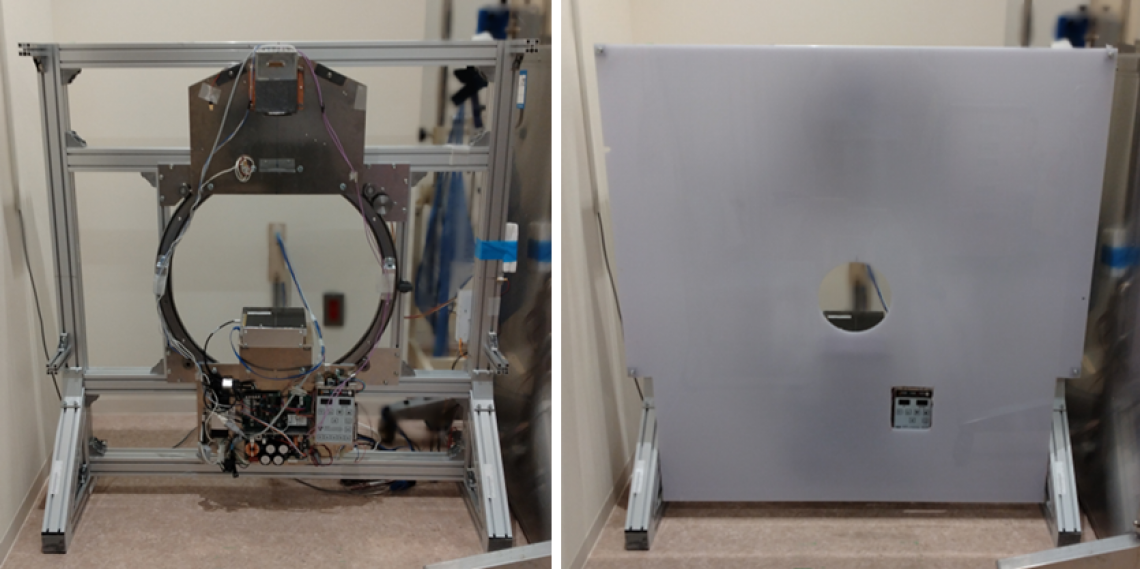
Figure1. Internal configuration (left) and external appearance with the front panel attached (right) of the ultra-high-resolution X-ray CT system. The system consists of a compact X-ray source, a high-resolution X-ray detector composed of 0.099-mm detector elements, and a computer-controlled motor-driven gantry that rotates these components with high central alignment accuracy. CT scanning procedure is performed while rotating the gantry and emitting X-rays, and the acquired projection data are reconstructed into three-dimensional images with voxel sizes of 0.08–0.10 mm.
Figure 2 shows obtained CT images of the hands of two healthy volunteers acquired under approval of the ethics committee. The left images are axial slices (perpendicular to the rotation axis), and the right images are coronal slices (parallel to the palm). As demonstrated, the system enables detailed observation of bone microstructures from any direction, and due to its optimized design, does not suffer from the contrast degradation reported in conventional systems.
Furthermore, the effective radiation dose is extremely low at 0.024 mSv, well below the minimum volunteer exposure level of 0.1 mSv recommended by the International Commission on Radiological Protection (ICRP Publication 103), indicating negligible impact on the human body.
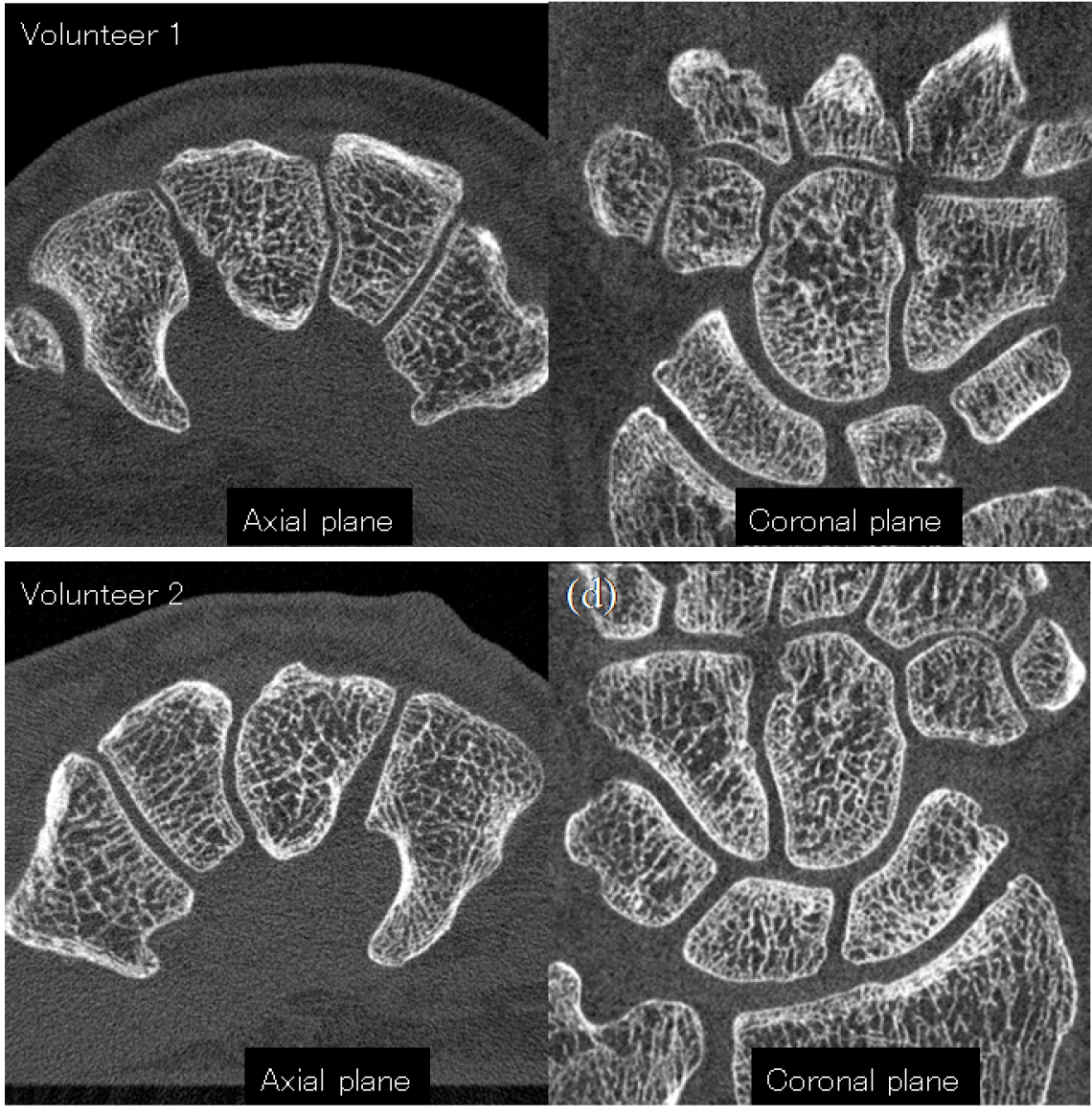
Figure2. CT images of the hands (carpal region) of two healthy volunteers acquired with the developed system. The internal fine bone microstructures (trabeculae) of the carpal bones and wrist joints are clearly and almost completely separated and visualized. The coronal plane is parallel to the palm, and the images demonstrate ultra-high spatial resolution in all spatial directions.
In these images, individual trabeculae are clearly separated and visualized, making micro-scale damages due to trauma readily apparent. Figure 3 compares the spatial resolution of the developed system with that of a clinically available whole-body CT system using a 0.25-mm detector. A graph extending further to the right and higher upward indicates superior resolution, and the developed system clearly outperforms the 0.25-mm detector CT system.
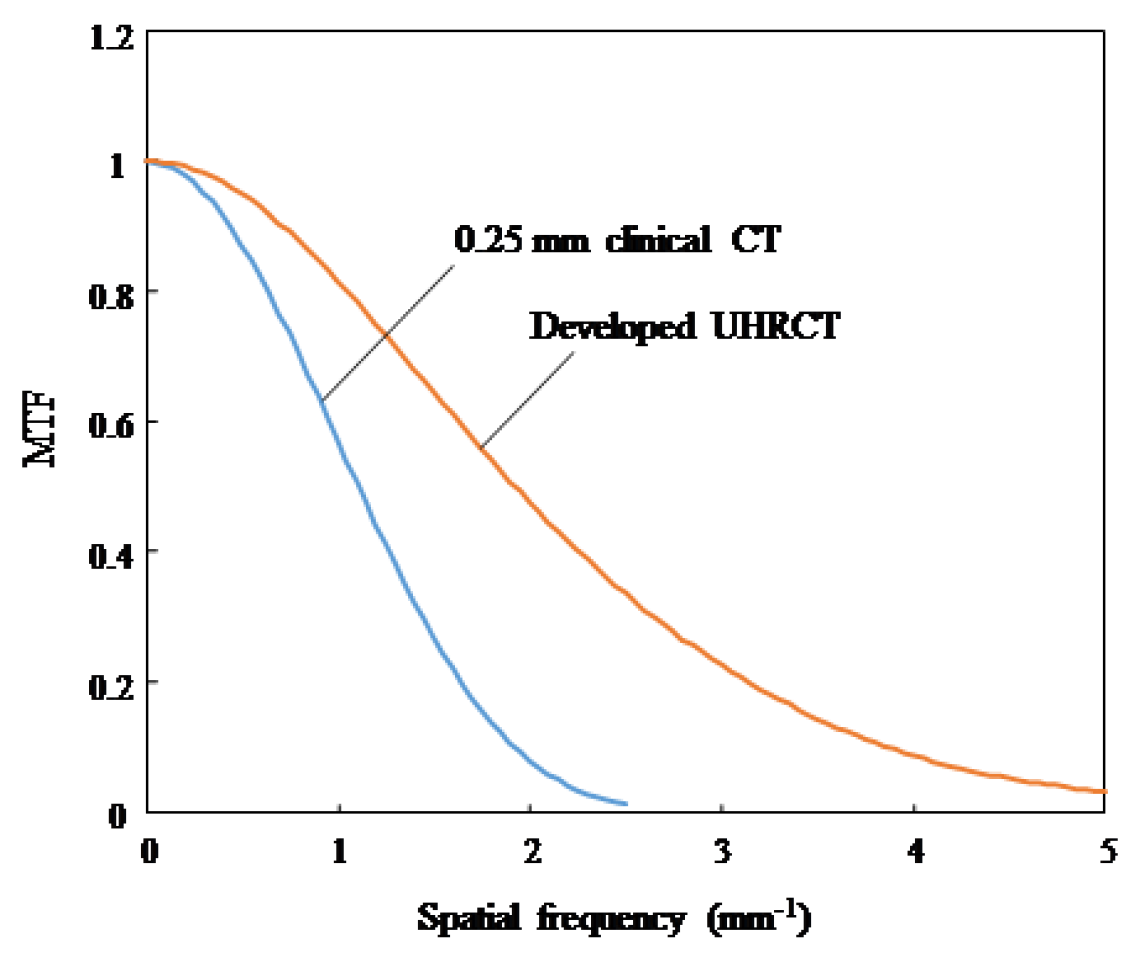
Figure 3. Comparison of spatial resolution characteristics between the developed system and a clinically available CT system equipped with a 0.25-mm detector. In the graph, curves extending further to the right and higher upward indicate superior spatial resolution. The developed ultra-high-resolution CT system clearly outperforms the CT system using a 0.25-mm detector.
Figure 4 presents highly realistic three-dimensional images reconstructed from CT data of the volunteer 1 in Figure 3. In parallel with system development, the research group also created an innovative visualization technique for efficiently interpreting ultra-high-resolution CT data. This technique enables generation of images that appear as if a physical specimen has been extracted from the living body. Although ultra-high-resolution CT data consist of an extremely large number of slices, this visualization method allows comprehensive observation at a glance and enables virtual sectioning to inspect internal structures as needed.
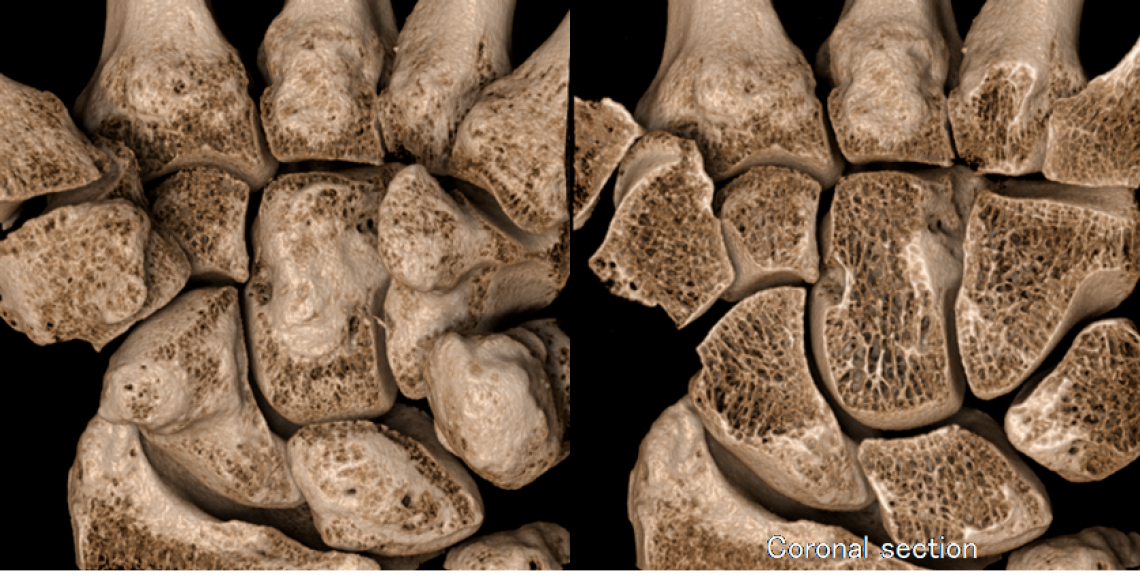
Figure 4. Highly realistic three-dimensional image generated using a novel visualization technique developed in parallel with the CT system. The technique enables the generation of images that appear as if a physical specimen were extracted from the living body. Although ultra-high-resolution CT data consist of a very large number of slices, this visualization method allows comprehensive observation at a glance and enables virtual sectioning to inspect internal structures as needed.
Future Perspectives
This research enables detailed observation of bone microstructures in the hands, feet, elbows, and knees within the field of orthopedics. It is expected to bring innovation to X-ray diagnostic imaging by improving the accuracy of diagnosis, assessment of treatment effects, and evaluation of the healing process.
Glossary
*1 X-ray Computed Tomography (CT) System
A medical imaging system that uses X-rays and computer-based calculations to generate images of the internal structures of the human body. In conventional X-ray radiography, internal organs and tissues overlap in a single projection image and cannot be clearly separated. In contrast, a CT system reconstructs cross-sectional images, allowing internal structures to be visualized separately and in detail.
*2 Spatial Resolution
A measure of how small a structure can be distinguished as separate objects in an image. For example, a spatial resolution of 0.1 mm means that multiple structures of approximately 0.1 mm in size can be individually recognized even when they are located close to each other.
*3 Trabeculae
Fine, interconnected pillar- or beam-like structures within bone that form a complex internal network. Similar to the beams of a building, trabeculae support the bone from the inside and play a critical role in maintaining bone strength.
*4 CT Scanning
The process of acquiring imaging data by irradiating the human body with X-rays while recording the intensity of X-rays transmitted through the body. These data are then used to reconstruct cross-sectional and three-dimensional images.
*5 High-Resolution X-ray Detector
A device that records X-ray intensity as digital data. By using detector elements with very small individual sizes, the detector enables the acquisition of imaging data with higher spatial resolution.