
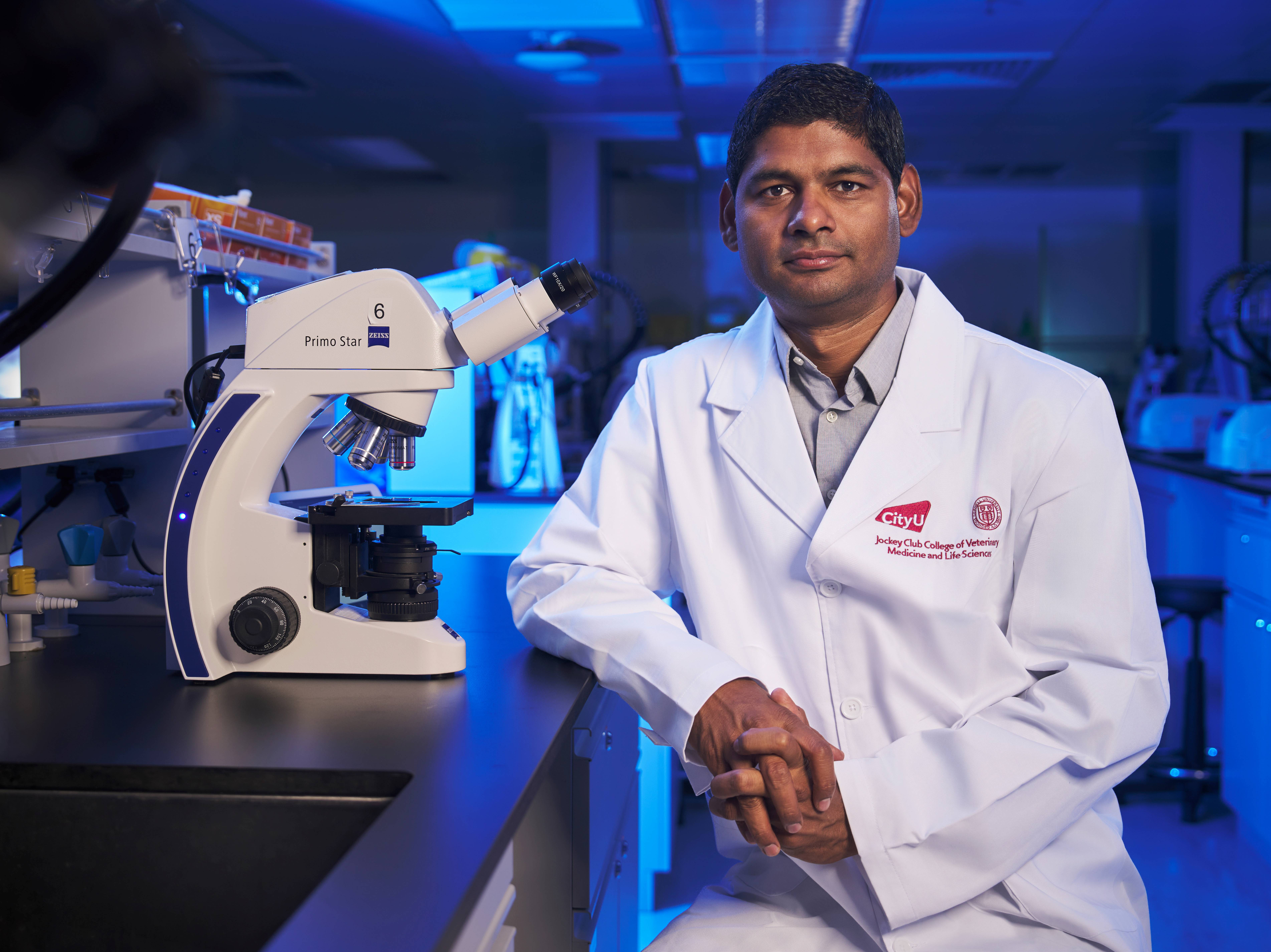

A research team led by City University of Hong Kong (CityUHK), in collaboration with the University of Zurich, has uncovered the first comprehensive map of how the anti‑ageing protein Klotho operates in distinct regions of the kidney, resolving long‑standing scientific uncertainties about its physiological roles.
Professor Pathare recently established the Bone–Kidney Axis and Regeneration Laboratory at CityUHK, where his research focuses on Klotho signalling. In addition to his research activities, he teaches veterinary anatomy and physiology to veterinary students at CityUHK.
City University of Hong Kong
A research team led by City University of Hong Kong (CityUHK), in collaboration with the University of Zurich, has uncovered the first comprehensive map of how the anti‑ageing protein Klotho operates in distinct regions of the kidney, resolving long‑standing scientific uncertainties about its physiological roles.
Klotho, widely recognised as a “longevity protein”, is produced primarily by the kidneys and has long been regarded as a key factor in maintaining youthfulness and health. However, its segment‑specific functions along the nephron remained unclear. In a study titled “Klotho in the kidney distal convolution regulates urinary Klotho excretion and kidney calcium reabsorption, but not phosphate homeostasis” recently published in Kidney International, the research team demonstrates with unprecedented precision that different kidney tubule segments carry out fundamentally different aspects of Klotho biology.
The study was led jointly by Professor Ganesh Pathare, from the Department of Infectious Diseases and Public Health of the Jockey Club College of Veterinary Medicine and Life Sciences at CityUHK, and Professor Johannes Loffing, from the University of Zurich, Switzerland. The team used single‑cell RNA sequencing to show that Klotho is unevenly distributed across the nephron segment called the distal convolution (DC), with its expression markedly enriched in the late DC compared to the early DC. This discovery guided the generation of a suite of targeted mouse models that selectively deleted Klotho in specific nephron segments, allowing the team to trace the renal origins of soluble Klotho (sKlotho), the secreted form of the protein.
Through three DC specific knockout models, the team demonstrated that approximately 80% of urinary sKlotho originates from the late DC, while the remaining 20% derives from the early DC. Notably, when Klotho was removed only from the DC, the mice maintained normal serum sKlotho and phosphate homeostasis, but developed pronounced hypercalciuria and significant reductions in bone mineral density, revealing a previously unappreciated role of DC derived Klotho in regulating renal calcium handling and bone integrity.
Molecular analyses uncovered the mechanistic basis of these phenotypes. In the absence of Klotho in the DC, several key genes essential for calcium reabsorption, including Trpv5, Vdr, Pth1r and Klk1, were markedly downregulated, and the mitogen-activated protein kinase (MAPK) signalling pathway was significantly suppressed. These findings demonstrate how DC-derived Klotho regulates calcium transport mechanisms and the associated intracellular signalling landscape.
To clarify the role of Klotho in the proximal tubule (PT), the team generated an additional pan‑tubular knockout model, in which Klotho was deleted across both the PT and DC. This model produced a profoundly different outcome: mice rapidly developed severe phosphate retention, exhibited dramatic increases in FGF23, showed undetectable levels of both serum and urinary sKlotho, and experienced progressive weight loss. These results sharply contrast with the DC‑only deletion and establish the PT—not the DC—as the critical site where Klotho maintains systemic phosphate balance, prevents aging-like phenotypes, and likely contributes the majority of circulating sKlotho. Importantly, the study also overturns a long‑standing hypothesis suggesting that sKlotho secreted from the DC might act in a paracrine manner in the PT to regulate phosphate reabsorption.
Together, these discoveries provide the first definitive segment‑specific functional map of Klotho in the kidney. The study clarifies that DC‑derived Klotho governs urinary sKlotho production and renal calcium reabsorption, while PT‑derived Klotho is essential for phosphate homeostasis and likely circulatory sKlotho levels. This new framework resolves long-standing uncertainties in Klotho biology and offers a scientifically robust foundation for future therapeutic strategies targeting Klotho in disorders involving chronic kidney disease and mineral‑bone disorders.
Advertisement