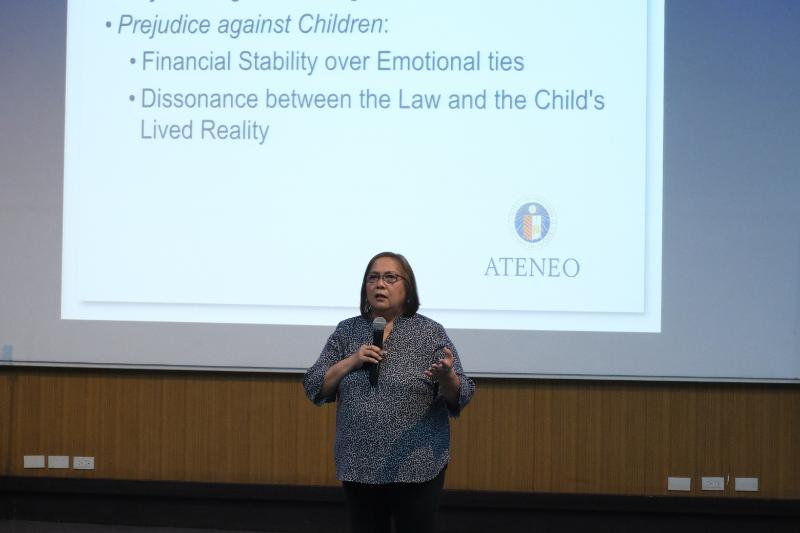
Ateneo School of Law faculty Atty. Amparita S. Sta. Maria examined the broader significance of “legitimacy” in the Philippine context, where traditional ideas about marriage and family remain strong even as actual family arrangements become increasingly diverse.
View Atty. Sta. Maria’s full Ateneo Breakthroughs lecture here: https://www.youtube.com/live/HpwercievGE
Philippine family law must look beyond traditional labels of legitimacy and focus more closely on what actually serves the best interests of the child, legal scholar and human rights advocate Atty. Amparita S. Sta. Maria said at the opening of the new Ateneo Breakthroughs Lectures series on “The Family.” The law privileges marriage-based relationships deemed legitimate over unions not sanctioned by the law.
“A further assumption created by the application [of the law] is that the legal parent [rather than the biological parent] is the best parent. Why? Because he is the legal husband.” The law presumes that the child’s relationship with the legal father provides protection even when the biological father is someone else. This presumption is made without examining actual family relationships, Sta. Maria noted in her lecture, Rethinking the Best Interests of the Child: Beyond Legitimacy in Family Law. As she stressed, “I think we [as a culture] don’t want to be seen as deviating from that devotion to the family and to marriage.”
Sta. Maria examined how the Philippine Civil Code, Family Code, and court decisions have historically treated legitimate children as having a preferred legal status, with consequences for inheritance, parental authority, support, surnames, custody, and other family rights.
She argued that, while the presumption of legitimacy was intended partly to protect children from the stigma historically associated with illegitimacy, rigidly applying the rule can sometimes work against the very children it is supposed to protect.
Sta. Maria cited cases in which a child had been raised by the biological father, only for the law to recognize the mother’s legal husband as the child’s father because the child was conceived or born during an existing marriage. Such situations, she said, can create a gap between a child’s lived family relationships and what appears in law and official records.
The problem, she stressed, is therefore not simply the label attached to a child, but the unequal rights and discrimination that continue to accompany that status.
“If you actually remove the provisions which discriminate against illegitimate children, then even if you have those labels... it won’t matter anymore,” Sta. Maria said during the discussion. She added that children should not be discriminated against merely because of the circumstances of their birth.
Sta. Maria said legal presumptions can remain useful starting points for protecting children, but should not override clear evidence of what is best for a particular child. “Presumptions are just presumptions,” she said, arguing that they should not be applied rigidly when circumstances show that doing so would harm a child’s interests.
The discussion also examined how legitimacy can affect parental authority, visitation, custody, property, succession, and a child’s ability to establish a relationship with a biological parent. Sta. Maria noted that changing terminology—from “illegitimate” to terms such as “non-marital”—could also help reduce stigma, although substantive legal inequalities would still have to be addressed.
The lecture took on broader significance in the Philippine context, where traditional ideas about marriage and family remain strong even as actual family arrangements become increasingly diverse.
Responding to a question from the audience, Sta. Maria pointed to this tension between law and social reality. “Families are changing,” she said, while Philippine law continues to operate from a comparatively rigid conception of marriage and the family.
The event opened the new semester of the “Ateneo Breakthroughs Lectures,” Ateneo de Manila University’s flagship public lecture series for bringing University research, scholarship, creative work, and expertise into wider public conversations. This semester’s series uses “The Family”as a lens for examining childhood, parenting, relationships, well-being, responsibility, and life in the digital era.
Upcoming lectures will examine parenting styles in the Philippines, functional medicine and family dynamics, and children’s access to social media and artificial intelligence.
Visit ateneo.edu/breakthroughs for more information about this and upcoming events.
For interview requests and other inquiries, please email [email protected]. Visit archium.ateneo.edu for more information about our latest research and innovations.