

Chemists at National Taiwan University have uncovered a tiny scissor-like motion inside molecular crystals that helps explain why some crystals can bend and expand without breaking. By changing the molecular components that control how far these “scissors” can open and close, the team showed why closely related crystals can behave very differently—from brittle fracture to explosive motion and remarkable flexibility.
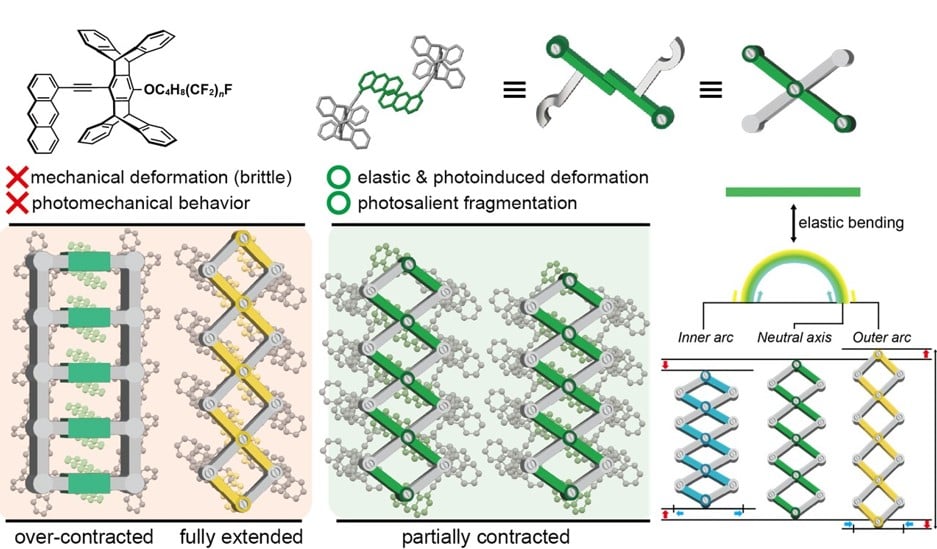
Interconnected molecular “scissors” open and close in a coordinated manner during crystal bending, helping the crystal accommodate strain without breaking. In contrast, crystals with fully extended or over-contracted scissors are brittle and show little or no light-driven motion.
National Taiwan University
Crystals are usually thought of as rigid and brittle. Yet some molecular crystals can bend, jump, twist, or even change shape when exposed to light. Understanding how tiny molecular movements inside an ordered crystal can produce such large visible motions is an important challenge for developing responsive materials that could eventually be used in actuators, sensors, and other miniature devices.
A research team led by Professor Jye-Shane Yang at National Taiwan University has now uncovered a molecular mechanism that helps explain how such crystals accommodate large mechanical changes without necessarily breaking. The study, published in Angewandte Chemie International Edition, focuses on a family of closely related light-responsive molecular crystals built from anthracene, pentiptycene, and semifluorinated molecular segments.
The researchers discovered that molecules within these crystals are arranged in a way that resembles a network of interconnected scissors. Neighboring molecules form joints that allow the structure to extend or contract in a coordinated manner. When a crystal is bent, the molecular “scissors” open on one side and close on the other, helping the crystal accommodate the strain. Light can trigger related structural changes, producing much larger deformation.
Using X-ray measurements on bent crystals, computer simulations, single-crystal structural analysis, and solid-state nuclear magnetic resonance spectroscopy, the researchers tracked these molecular changes from several complementary perspectives. Particularly important was the structural characterization of a crystal partway through its light-induced transformation, which provided direct evidence of the large rearrangement associated with the scissor-like motion.
The team then compared several closely related crystals in which the length of a semifluorinated molecular segment was systematically varied. Surprisingly, small changes in this segment produced very different behaviors. Some crystals were brittle, one displayed dramatic light-induced motion and fragmentation, while another could undergo unusually large elastic bending and light-driven expansion while remaining intact.
The comparison revealed an important feature behind this difference: the starting position of the molecular scissors determines how much room remains for them to open and close. The crystal showing the most robust deformation had a relatively balanced capacity for both motions. By contrast, structures positioned too close to one extreme had less ability to accommodate strain and were more prone to fracture or mechanical instability.
“Our results show that the remarkable motion of these crystals can be traced back to coordinated movements at the molecular level,” says co-corresponding author Jye-Shane Yang, professor of chemistry at National Taiwan University.
“The molecular-scissor picture gives us an intuitive way to understand how crystal packing controls the ability of a crystal to bend, expand, or break. We hope that this mechanistic understanding will help guide future studies toward molecular crystals that combine large responses with greater mechanical robustness.”
Prof. Jye-Shane Yang‘s email address: [email protected]
The organic and material chemistry laboratory of Prof. Yang linked to
Advertisement