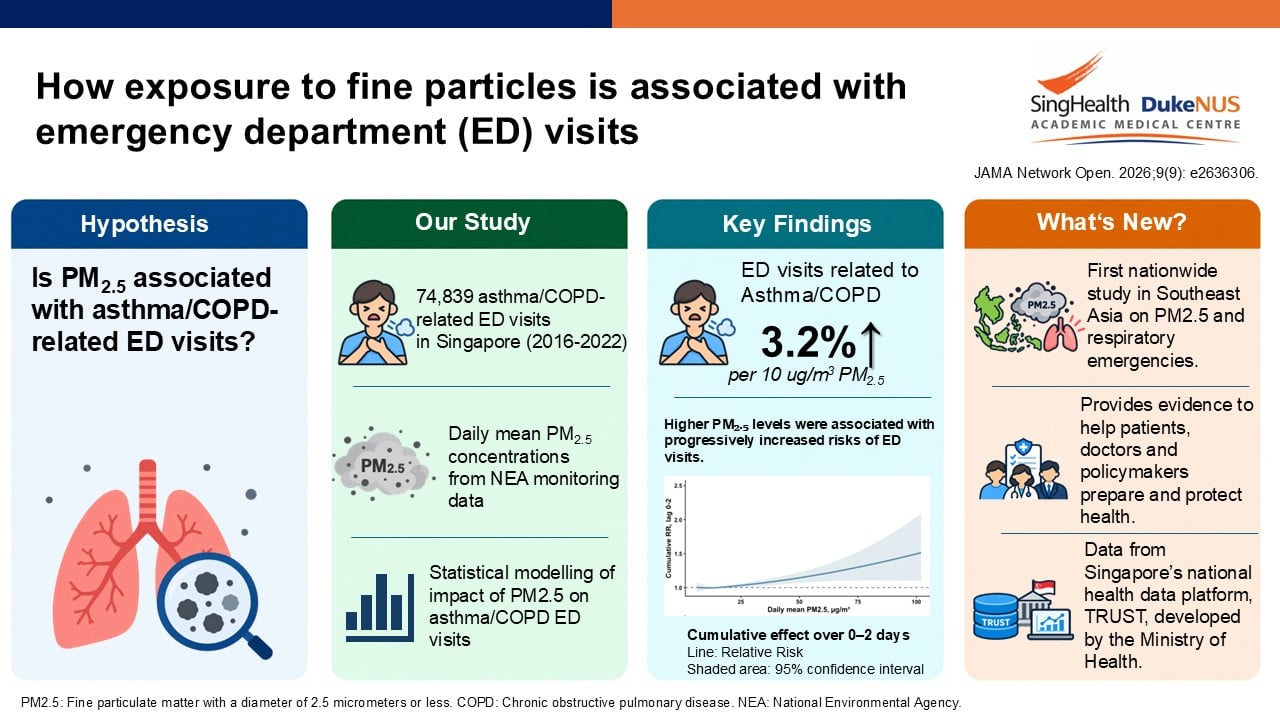

Nationwide Duke-NUS study finds asthma-related emergency visits rise within two days of increases in PM2.5, underscoring the importance of early precautions during periods of poorer air quality.
A visual abstract showing the study's findings
Duke-NUS Medical School
Even relatively small increases in fine-particle air pollution can be followed by more asthma and chronic obstructive pulmonary disease (COPD)-related emergency department visits according to a nationwide study in Singapore. The increase was most pronounced for asthma, while COPD showed a similar direction of effect but did not reach statistical significance at lower pollution levels.
Published in JAMA Network Open, the study by researchers from Duke-NUS Medical School, Duke University, and Singapore General Hospital analysed 6.5 years of national air quality data alongside almost 75,000 asthma and COPD0F[1]-related emergency department admissions across Singapore’s public hospitals.
The researchers focused on fine particulate matter known as PM2.5, particles measuring 2.5 micrometres or less, that are small enough to travel deep into the lungs. PM2.5 is one of the six pollutants measured in Singapore’s Pollutant Standards Index (PSI), and reported as a 24-hour average, with five bands of air quality ranging from ‘Good’ to ‘Hazardous’.
Over the study period from February 2016 to December 2022, there were 74,839 asthma or COPD-related emergency department visits, of which approximately 43,446 resulted in hospital admission, and 1,369 patients died within 30 days.
Comparing the timing of the emergency department admissions and deaths with daily PM2.5 concentrations, the researchers found a clear relationship between PM2.5 levels and admissions, which peaked two days following the increased air pollution.
For each 10 µg/m³ increase in PM2.5 above the reference level of 15 µg/m³, combined asthma and COPD emergency department visits increased by 3.2 per cent over the following two days.
Asthma-related emergency department visits specifically rose by 4.4 per cent over the same period. COPD-related visits also tended to increase, though the association was less clear at these lower PM2.5 concentrations. The researchers observed stronger evidence of an increase in COPD-related visits at higher pollution levels—suggesting that the respiratory effects of PM2.5 may become more apparent with increased exposure.
The findings provide new insights into the health effects of short-term air pollution in a tropical Southeast Asian setting with relatively low background pollution, a context that remains understudied compared with other regions of the world.
Air pollution in Singapore generally sits at around the current World Health Organization guideline thresholds for PM2.5 exposure, but the city does experience occasional spikes of increased concentrations.
Dr Yohei Okada, corresponding author and Assistant Professor in the Prehospital and Emergency Research Centre at Duke-NUS Medical School said:
“Our findings show that respiratory effects can emerge even after relatively modest increases in PM2.5, and can have measurable impacts on respiratory health. This may only become apparent over the following couple of days. For people with asthma or other chronic respiratory conditions, this reinforces the importance of monitoring air quality advisories and taking precautions early rather than waiting until symptoms worsen.”
The researchers also examined hospital admissions and 30-day mortality following emergency department visits. Hospital admissions showed a similar upward pattern, but the increase was not statistically significant, while no association was observed between PM2.5 levels and 30-day mortality.
The analysis also found no evidence that the risk different significantly according to factors such as sex, age, income, or existing other diseases.
The study was made possible by Singapore’s new national health data platform called TRUST – Trusted Research and real-world data Utilisation and Sharing Tech – which was developed by the Ministry of Health. The platform leverages nationwide linked health data, and this research highlights how TRUST can enable vital population-level research to inform public health policy and healthcare planning.
Professor Marcus Ong, Director of the Health Services Research and Population Health programme at Duke-NUS Medical School, said:
“Haze is not only an environmental issue; poorer air quality can translate into additional demand on emergency healthcare within days. Integrating real-time air-quality information with health data could eventually help hospitals anticipate respiratory surges and give vulnerable patients earlier warning.”
The study could help the development of early warning systems that combine air quality data with weather forecasts to inform vulnerable people – such as those with asthma – and give them the opportunity to take preventive action and avoid triggering an acute health episode.
Professor Lok Sheemei, Interim Vice-Dean in the Office of Research at Duke-NUS Medical School, said:
“This study fills an important knowledge gap in tropical Southeast Asia. The findings could help healthcare providers and policymakers better prepare for breathing-related emergencies, in local settings. It also supports advocating for measures to address and mitigate the root causes of air pollution that crosses national borders in the region.”
The research was supported by the Duke/Duke-NUS Research Collaboration Pilot Project Award.
[1] Chronic obstructive pulmonary disease
Advertisement