
▲ Schematic illustration showing the PilQ secretin outer-membrane channel during type IV pilus assembly being blocked by SlkA or SlkB protein plugs. SlkA/B occupy the PilQ lumen before docking of the inner-membrane complex, thereby limiting the influx of external compounds.
A joint research team led by Professor Hongbaek Cho of the Department of Biological Sciences at Sungkyunkwan University (SKKU) and Professor Jeong Min Chung of the Department of Biotechnology at The Catholic University of Korea has identified a new mechanism underlying antibiotic resistance in Pseudomonas aeruginosa, a major multidrug-resistant “superbug.” The discovery provides important clues for the development of new treatments for multidrug-resistant bacterial infections.
Antibiotic resistance in pathogenic bacteria has emerged as a major global public health threat. In particular, multidrug-resistant bacteria, often referred to as “superbugs,” can survive treatment with multiple antibiotics and are extremely difficult to treat. Among them, P. aeruginosa is a representative multidrug-resistant pathogen that can cause healthcare-associated infections, pneumonia, sepsis, and other serious infections.
P. aeruginosa possesses an outer membrane (OM) that acts as a strong barrier against antibiotic penetration. To infect a host, the bacterium also forms thread-like structures called type IV pili (T4P) on its cell surface, which play an important role in attaching to host cells. The research team identified plug-like proteins that prevent antibiotics from entering through the OM channel of the T4P assembly machinery during the vulnerable stage before T4P is fully assembled, thereby maintaining the integrity of the OM barrier.
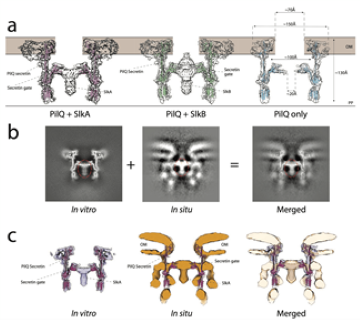
Until now, it had remained unclear how P. aeruginosa maintains the channels required for infection while simultaneously preventing antibiotics from entering the cell. In this study, the joint research team discovered that two proteins, SlkA and SlkB, bind inside the channel and act as physical plugs that block antibiotic influx. Using cryo-electron microscopy (cryo-EM), the researchers also succeeded in visualizing the high-resolution three-dimensional structures of these proteins bound within the channel.
Previously, the channel itself was thought to prevent the influx of antibiotics. The new findings reveal a different mechanism in which dedicated proteins plug the channel and reinforce the protective function of the outer membrane. This discovery provides an important explanation for how P. aeruginosa can maintain structures essential for infection while preserving its defense against antibiotics.
This research was supported by the Mid-Career Researcher Program and the Bio & Medical Technology Development Program funded by the Ministry of Science and ICT and the National Research Foundation of Korea. The findings were published online in Nature Communications on May 29.
The research team explained that the discovery could provide a foundation for developing next-generation antimicrobial agents and adjuvant therapies that target the outer-membrane barrier of Gram-negative bacteria*. By disrupting the mechanism that prevents antibiotics from entering bacterial cells, the findings may also lead to new therapeutic strategies for overcoming multidrug resistance in P. aeruginosa.
*Gram-negative bacteria: Bacteria with an outer membrane that acts as a barrier, making it difficult for many antibiotics to penetrate the cell.

▲ Three-dimensional structure of the protein plug complex within the outer-membrane channel determined by cryo-electron microscopy, compared with its organization inside bacterial cells. The Slk plug density observed in the purified protein complex closely aligns with the central density in the PilQ lumen observed during type IV pilus assembly in cells.