


Evidence from an ancient fault may help understand how earthquakes cause tsunamis
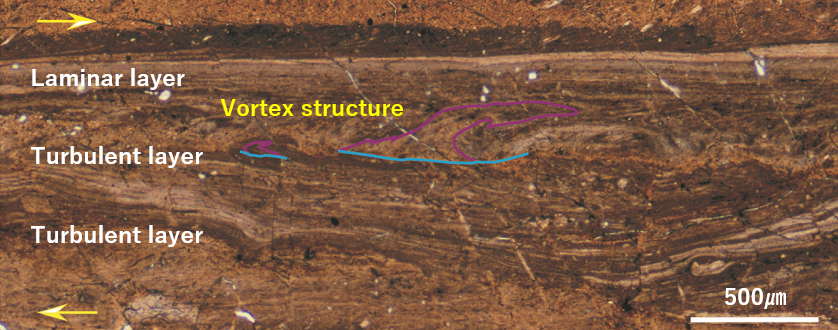
A fossilized fault showing signs of turbulent flow: Traces of turbulent flow generated during an earthquake are visible as swirls within the rock.
Osaka Metropolitan University
In 2011, a huge earthquake struck eastern Japan. Recorded at magnitude 9.1, its epicenter shook for almost 6 minutes. However, its effects didn’t end there, as the movement of the plates displaced the seafloor enough that it caused a devastating tsunami.
Understanding how such earthquakes cause tsunami is an important part of early-warning systems. One proposed mechanism is that the rapid movement of the plates generates large amounts of heat by friction. As the temperature increases, heated water trapped within the pores of rocks increases pressure, which makes the boundaries between the faults become increasingly slippery. The fault subsequently slips an exceptionally large distance, displacing the seafloor enough to cause a tsunami.
To understand how these massive events happen, researchers often turn to similar occurrences preserved in rockfaces from Earth’s ancient past. Looking at rocks exposed on the Boso Peninsula, Japan, that were once part of an ancient seafloor environment, a research group led by Professor Tetsuro Hirono of Osaka Metropolitan University has identified vortex-like structures in an ancient fault that suggest the material underwent fluid-like flow during an earthquake approximately 15 million years ago.
The researchers called the rock layers “turbulent-flow-like”, as they showed wavy and curved laminations and vortex-like structures. When they performed fluid-dynamical analyses of the structures, their findings suggested that thermal pressurization had been enough to fluidize the clay in the fault.
“Our analysis suggests that the viscosity approached that of water,” Professor Hirono explained. “This would have been a dramatic reduction. The fluidized state would have acted as a form of dynamic lubrication, causing the fault to weaken dramatically. The resulting large-scale slip would have produced a large displacement on the fault near the seafloor, potentially causing a tsunami.”
Using their insights, the group hope to apply the same methodology to modern faults to improve scientists’ ability to estimate fault-slip magnitude.
“Understanding the change in viscosity in fault-slips may allow us to more accurately recognize the magnitude of fault slips, which would support tsunami mitigation efforts,” Professor Hirono concluded.
The findings were published in Scientific Reports.
Competing interests
The authors declare no competing interests.
###
About OMU
Established in Osaka as one of the largest public universities in Japan, Osaka Metropolitan University is committed to shaping the future of society through the “Convergence of Knowledge” and the promotion of world-class research. For more research news, visit https://www.omu.ac.jp/en/ and follow us on social media: X, Instagram, LinkedIn.
Advertisement
Advertisement