

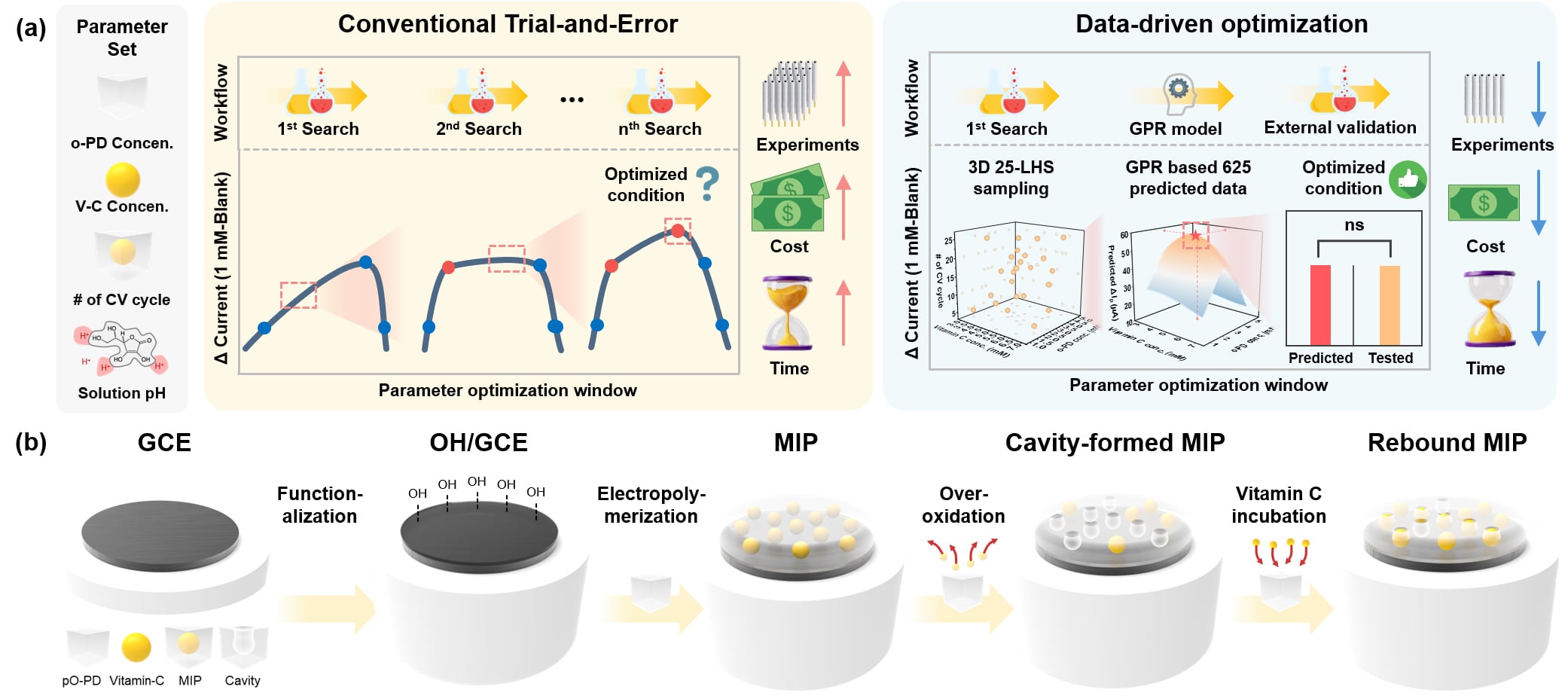

- AI identifies promising sensor fabrication conditions from 625 possible combinations using just 25 initial experimental conditions
- Newly developed sensor detects trace amounts of vitamin C and demonstrates potential for biological sample analysis
▲ Schematic illustration of the AI-assisted optimization strategy and the molecularly imprinted polymer (MIP) sensor for vitamin C detection.
Park, D., Choi, D., Jo, W., Chai, K., Kim, M., Kim, S., Kim, Y., Kim, C., Park, J., & Park, J. (2026). Data-driven multi-parameter optimization of molecularly imprinted polymers for Pico-level vitamin C detection. Chemical Engineering Journal, 184042. htt
Researchers led by Professor Jinsung Park from the Department of Biomechatronic Engineering at Sungkyunkwan University (SKKU), led by President Yoobeom Yoo, have developed an ultrasensitive electrochemical sensor capable of detecting extremely low concentrations of vitamin C. By incorporating artificial intelligence (AI) into the sensor development process, the research team identified promising fabrication conditions using a limited amount of experimental data, reducing the need for extensive trial-and-error optimization.
The findings were published online on November 9, 2026, in Chemical Engineering Journal, a leading international journal in chemical engineering.
Vitamin C is an essential nutrient that plays important roles in antioxidant protection and immune function. Measuring vitamin C levels in blood can provide valuable information about nutritional status. However, conventional analytical techniques often require sophisticated equipment, while developing sensitive electrochemical sensors typically involves repeated experiments to determine suitable fabrication conditions.
To address these challenges, the researchers used a specialized material called a molecularly imprinted polymer (MIP), which can selectively recognize vitamin C molecules. Similar to how a lock is designed to fit a particular key, an MIP contains recognition sites that match the structural and chemical characteristics of its target molecule. The team combined this material with AI-based machine learning to predict which fabrication conditions would produce the best sensor performance.
The researchers focused on four key parameters affecting sensor performance, including material concentrations, the number of electrochemical polymerization cycles, and solution pH. When evaluated at five representative levels each, these parameters produce 625 possible combinations.
Rather than experimentally testing every combination, the team trained a machine learning model using 25 initial experimental conditions. The AI-based optimization approach then identified promising combinations that had not previously been tested. The researchers fabricated sensors under the recommended conditions and experimentally confirmed their performance.
The optimized sensor achieved a calculated detection limit of **778 picomolar (pM)**, demonstrating its ability to detect extremely low concentrations of vitamin C. The sensor also showed promising performance in human serum and artificial urine samples. Furthermore, the researchers successfully monitored changes in urinary vitamin C concentrations following vitamin C intake. The measurements showed strong correlations with results obtained using a conventional enzyme-linked immunosorbent assay (ELISA), supporting the sensor's potential for biological sample analysis.
"The most significant aspect of this study is that AI can help identify promising sensor fabrication conditions without requiring researchers to experimentally test every possible combination," said Professor Jinsung Park. "We hope to extend this approach beyond vitamin C detection to develop sensors for disease-related biomarkers and harmful environmental substances."
Daeil Park, a doctoral student who led the experimental work, added, "Our next goal is to expand the role of AI beyond optimizing fabrication conditions, enabling it to recommend the most suitable sensing materials for different target molecules."
This research was supported by the Ministry of Science and ICT (MSIT) and the National Research Foundation of Korea (NRF), including the Mid-Career Researcher Program and the Sejong Science Fellowship.
※ Article Title: Data-driven multi-parameter optimization of molecularly imprinted polymers for pico-level vitamin C detection
※ Journal: Chemical Engineering Journal
※ DOI: https://doi.org/10.1016/j.cej.2026.184042
Advertisement
Advertisement