
A nationwide Japanese birth cohort study of 101,864 children found that ovulation induction, intrauterine insemination and in vitro fertilization were associated with a higher risk of Kawasaki disease before age five compared with spontaneous conception. Intracytoplasmic sperm injection showed no clear difference in risk. The findings remained broadly consistent after adjustment for maternal comorbidities and highlight the need for further research into underlying mechanisms.
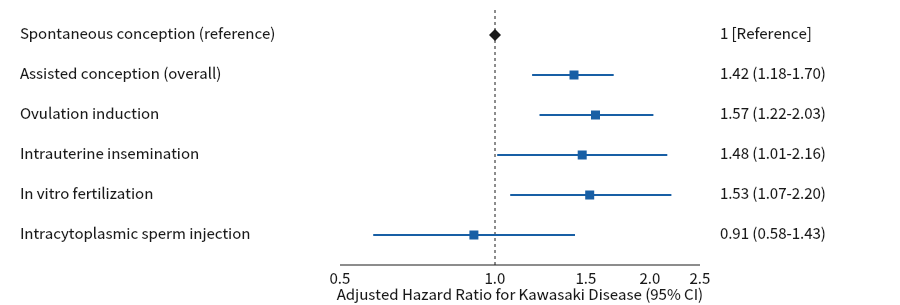
Hazard Ratios of Kawasaki Disease, by Method of Conception
Original content, No restrictions., Sachiko Baba
Nationwide study of more than 100,000 children finds different risk patterns across fertility treatments
Osaka, Japan - A large-scale study in Japan, led by researchers from the University of Osaka and the Osaka Women's and Children's Hospital, has found that certain fertility treatments are associated with an increased risk of Kawasaki disease before age five, although the association differed by treatment type. The findings were published in JAMA Network Open.
Kawasaki disease is a systemic inflammatory disease that primarily affects young children and is a leading cause of acquired heart disease in children. Its exact cause remains unclear.
The research team analyzed data from 101,864 children participating in the Japan Environment and Children’s Study (JECS), a nationwide prospective birth cohort. They examined Kawasaki disease occurring before age 5 among children conceived spontaneously or following ovulation induction, intrauterine insemination (IUI), in vitro fertilization (IVF), or intracytoplasmic sperm injection (ICSI).
During the 5-year follow-up, 1,226 children developed Kawasaki disease. Compared with spontaneous conception, the risk was higher following ovulation induction (adjusted hazard ratio [HR], 1.57), IUI (HR, 1.48), and IVF (HR, 1.53). ICSI showed no clear difference in risk (HR, 0.91).
These patterns remained broadly consistent after accounting for maternal conditions including endometriosis, polycystic ovary syndrome, allergic conditions, and autoimmune disease.
“Kawasaki disease remains an important cause of acquired heart disease in children, yet its causes are still not fully understood,” Ryo Kawasaki said. “Further investigation of the association between fertility treatments and Kawasaki disease may help clarify the mechanisms underlying the disease.”
The results highlight a nuanced relationship between fertility treatments and child health, showing that the association with Kawasaki disease differs by treatment type. The authors emphasize that the findings show associations rather than causation and require confirmation in other populations.
###
The article, “Fertility Treatments and the Risk of Kawasaki Disease Among Offspring,” was published in JAMA Network Open at DOI: https://doi.org/10.1001/jamanetworkopen.2026.28586
About The University of Osaka
The University of Osaka was founded in 1931 as one of the seven imperial universities of Japan and is now one of Japan's leading comprehensive universities with a broad disciplinary spectrum. This strength is coupled with a singular drive for innovation that extends throughout the scientific process, from fundamental research to the creation of applied technology with positive economic impacts. Its commitment to innovation has been recognized in Japan and around the world. Now, The University of Osaka is leveraging its role as a Designated National University Corporation selected by the Ministry of Education, Culture, Sports, Science and Technology to contribute to innovation for human welfare, sustainable development of society, and social transformation.
Website: https://resou.osaka-u.ac.jp/en
Advertisement