
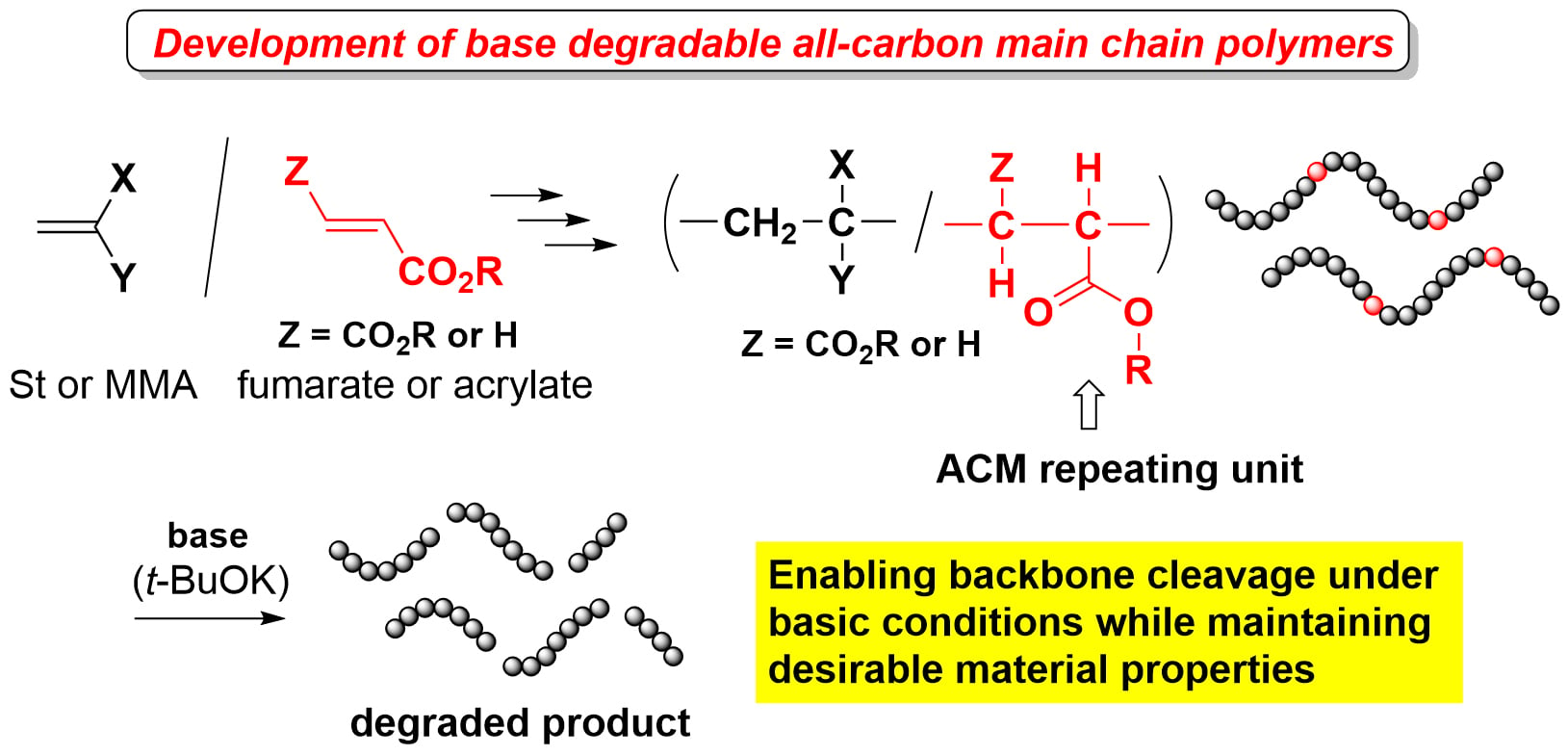
【Figure 1】
Synthesis and degradation of carbon-based main chain polymers
The Ehime University research team directed by H. Shimomoto and E. Ihara have developed a new molecular design strategy that imparts degradability to carbon–carbon (C–C) backbone polymers (Figure 1). The study demonstrates that incorporating alkoxycarbonylmethylene (ACM) units into polymer backbones creates specific sites that enable backbone cleavage under basic conditions while maintaining desirable material properties.
The research team first investigated the degradation behavior of poly(alkoxycarbonylmethylene)s (PACMs), a family of polymers synthesized from alkyl diazoacetates. They discovered that treatment with potassium tert-butoxide (t-BuOK) efficiently reduced the molecular weight of these polymers under relatively mild conditions. Mechanistic studies revealed that the degradation proceeds through deprotonation of the polymer backbone followed by a retro-Michael reaction, leading to cleavage of carbon–carbon bonds and conversion of high-molecular-weight polymers into oligomeric products.
Building on this finding, the researchers proposed that ACM units could serve as “degradation-inducing sites” within other carbon–carbon backbone polymers. To test this concept, they synthesized copolymers of styrene or methyl methacrylate with dialkyl fumarates or alkyl acrylates, thereby introducing ACM units into the polymer backbone. Remarkably, these ACM-containing polymers underwent significant molecular weight reduction upon treatment with base, whereas conventional polystyrene and PMMA showed essentially no degradation under similar conditions. These results demonstrate that a small number of strategically placed ACM units can transform otherwise nondegradable carbon–carbon backbone polymers into degradable materials.
Importantly, the introduction of ACM units did not simply add degradability. In several cases, the resulting materials retained or even improved their thermophysical properties. For example, certain ACM-containing polystyrene derivatives exhibited thermal stability and glass-transition temperatures comparable to or higher than that of a polystyrene homopolymer. In PMMA-based materials, incorporation of ACM-containing comonomers significantly improved thermal stability while simultaneously enabling base-triggered degradation.
The study provides a new and potentially general strategy for designing degradable carbon–carbon backbone polymers using readily accessible monomers such as fumarates and acrylates. By introducing degradation-inducing ACM units into otherwise stable polymer backbones, the approach offers a promising route toward next-generation plastics that combine practical performance with improved end-of-life management. The findings are expected to contribute to the development of more sustainable polymeric materials and future circular-materials technologies. This achievement appeared in the electronic version of Macromolecules published by the American Chemical Society on May 4, 2026.
Advertisement