
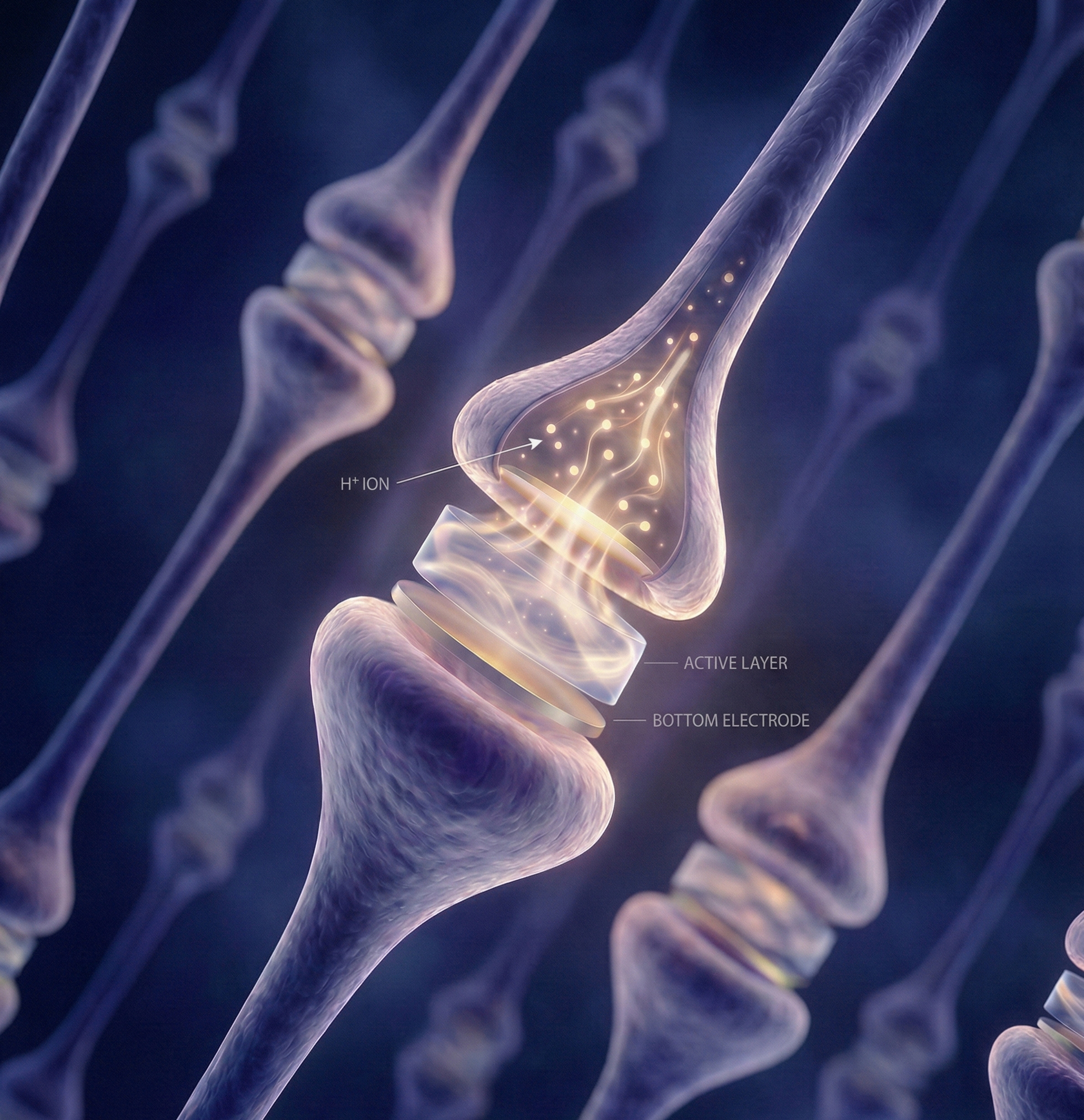

- Breaking through the limitations of conventional oxygen-defect-based memories... Simultaneously performing AI computation and storage through precise hydrogen atom control
- First case of successfully controlling hydrogen in a two-terminal vertical structure, accelerating the era of ultra-low-power, high-density neuromorphic chips
- Selected as cover paper for the prestigious international journal ACS Applied Materials & Interfaces
□ A research team led by Lee Hyun Jun and Noh Hee Yeon from the Division of Nanotechnology at DGIST (President Lee Kunwoo) has succeeded in implementing the world’s first two-terminal-based artificial intelligence (AI) semiconductor that precisely controls hydrogen with electrical signals to enable self-learning and memory.
□ Whereas modern AI requires the rapid processing of vast amounts of data, the separation of computation and memory in conventional computers results in the following limitations: speed degradation and high power consumption. “Neuromorphic semiconductors,” which perform computation and storage simultaneously by mimicking the human brain, are gaining attention as a next-generation technology that can resolve this problem. At the heart of this semiconductor is an “artificial synapse device” that changes its conductivity based on electrical signals and maintains that state, and the research team focused on “hydrogen” as the solution.
□ Conventional oxide-based memory devices primarily utilized the migration of oxygen vacancies (defects) as memory. However, this made it difficult to ensure long-term stability and uniformity between devices. In contrast, the research team solved this problem by developing its own method to precisely control the injection and discharge of hydrogen ions (H⁺) using an electric field.
□ This is of particular significance because this technology was implemented for the first time ever in world history in a “two-terminal vertical structure.” This structure is highly advantageous for next-generation, high-density AI chips as it facilitates high integration density and simple manufacturing processes for devices. To date, there have been no reported cases of hydrogen migration being precisely controlled within a vertical structure to implement AI operations.
□ The newly developed hydrogen-based AI device ran stably for over 10,000 repetitive operations and maintained its memory state intact even after being stored for a long time. Furthermore, it was demonstrated that learning and memory functions similar to those of human brain synapses could be successfully performed through its analog characteristics of gradually changing conductivity.
□ Senior Researcher Lee Hyun Jun stated, “This research holds significant meaning beyond developing another AI semiconductor. It presents a novel resistive switching mechanism using hydrogen migration, which is entirely different from existing oxygen vacancy–based memory.”
□ Associate Researcher Noh Hee Yeon emphasized, “This is the first case of precisely controlling the migration of hydrogen atoms between stacked semiconductor layers electrically,” adding, “The findings from this study, which elucidated the hydrogen migration mechanism, will fundamentally change the architecture of AI hardware and accelerate the era of next-generation, low-power, high-efficiency neuromorphic semiconductors.”
□ This study was supported by the Ministry of Science and ICT, the National Research Foundation of Korea’s Mid-Career Researcher Support Program, and DGIST’s institutional project. The study was conducted jointly by DGIST Professor Lee Shin-beom’s team, Senior Researcher Lee Myeong-jae, and Kyungpook National University Professor Woo Ji-yong’s team, and it was selected as a cover paper for ACS Applied Materials & Interfaces, a leading global journal in materials and interfaces.
Advertisement
Advertisement